
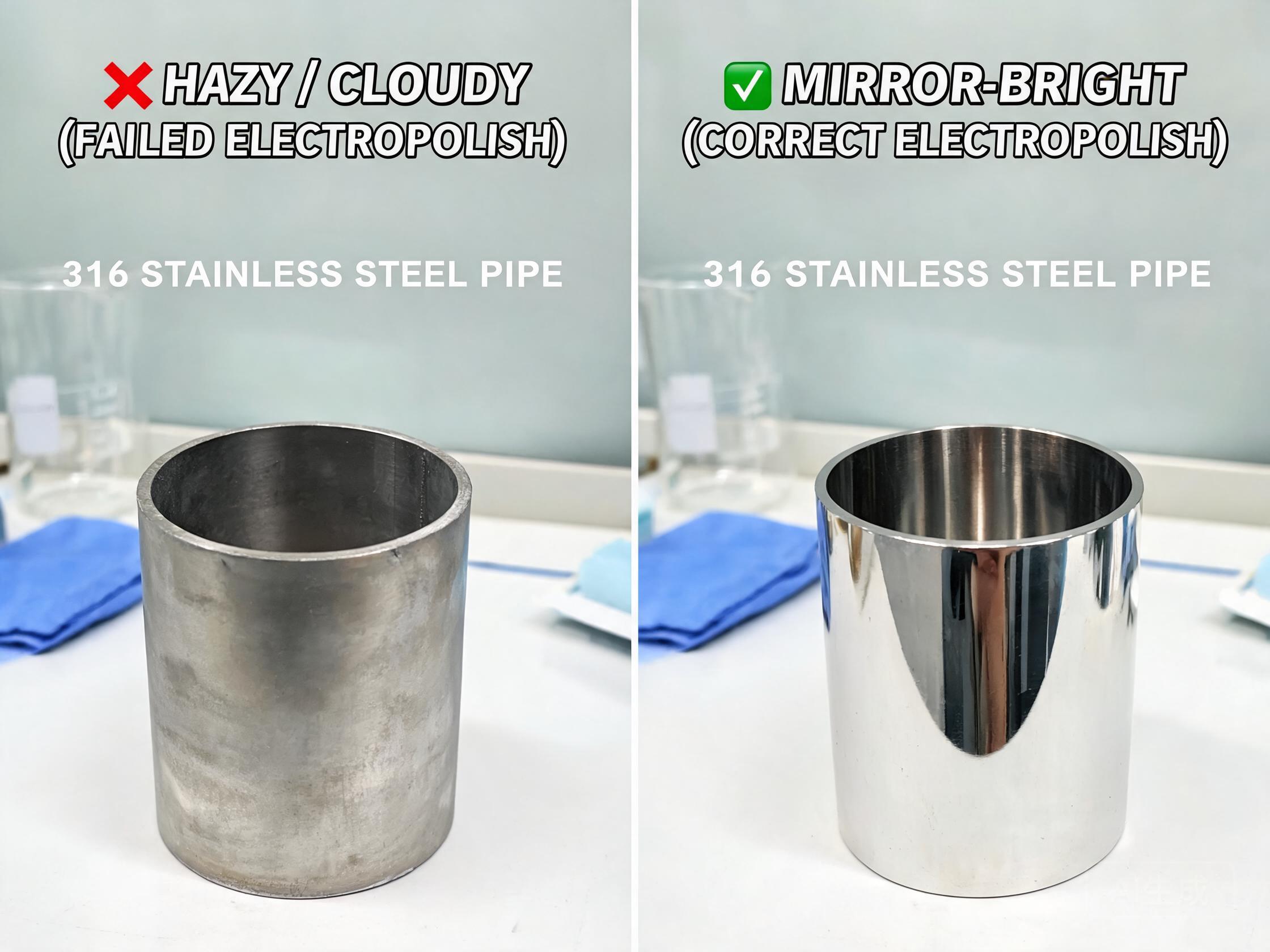
Short answer: Electropolishing haze is almost always a process control failure, not a material failure. If your 316 pharmaceutical tubing came back cloudy instead of mirror-bright, the shop ran the current too low, used a stale electrolyte bath, or cut corners on the post-rinse. Electropolishing is the most process-sensitive surface treatment for stainless — you must specify the current, temperature and electrolyte ratio on the PO.
Medical device makers, CIP tank fabricators and food equipment OEMs all rely on electropolished 304/316 surfaces for cleanability and aesthetics. Haze ruins both. Unlike pickling haze, electropolishing haze cannot be polished out with a cloth — it requires a second pass or full rework.
Quick Comparison
| Haze cause | Typical current density | Visible symptom | Fix |
|---|---|---|---|
| Current too low (< 0.5 A/dm²) | 0.3–0.4 A/dm² | Uniform milky haze | Re-pass at 1.0 A/dm² |
| Electrolyte stale (high iron) | Correct | Spotty, patchy haze | Replace bath (iron < 30 g/L limit) |
| Temperature too low (< 60 °C) | Correct | Slight haze, marginal polish | Raise to 70–80 °C |
| Tap water rinse | Correct | White powdery haze within 2 days | DI rinse + alcohol wipe |
| Over-etching (> 5 min) | Correct, but too long | Matte, no polish at all | Re-grind + re-pass |
The electrolyte bath has a life. Replace it when iron content exceeds 30 g/L or conductivity drops below 15 mS/cm. Most Chinese electropolish shops run baths to 60 g/L iron to save on disposal cost — that is where haze starts.
What Buyers Should Evaluate
- Name the electropolishing standard. ASTM A380 covers it, and ASTM B912 covers passivation after electropolishing.
- Specify current density minimum (1.0 A/dm²) and maximum (2.0 A/dm²). Below 1.0 you get haze; above 2.0 you get pitting.
- Confirm the electrolyte ratio (phosphoric acid : sulfuric acid = 5:1 by weight) and bath temperature (70–80 °C).
- Insist on a post-polish Ra reading. A properly electropolished 316 BA surface reaches Ra ≤ 0.05 µm. Hazy surfaces read Ra 0.1–0.3 µm.
Common Purchasing Mistakes
- Ordering “electropolished 316” without specifying current density or Ra target. A low-cost electropolish shop in Shanghai will run at 0.4 A/dm² to handle twice the parts per day, and deliver a milky haze that looks “kind of polished” to an untrained eye but fails every CIP cleanability check.
- Confusing electropolishing with “bright dipping.” Bright dipping is a passivation step that improves luster slightly — it does not reduce surface roughness. Electropolishing is an electrochemical material removal that flattens peaks and removes embedded particles. Name the process correctly on the PO.
- Skipping Ra measurement on incoming inspection. A portable surface roughness gauge costs 2000 RMB (300 USD) and catches haze before you install 1000 meters of tubing.
Recommended RFQ Wording
Grade: AISI 316L / EN 1.4404, cold rolled, BA surface, Ra ≤ 0.2 µm pre-polish Electropolishing: ASTM A380, current density 1.0–1.5 A/dm², bath 70–80 °C Electrolyte: Phosphoric acid : Sulfuric acid = 5:1 by weight, iron content < 30 g/L Post-polish Ra target: ≤ 0.05 µm (mirror finish) Post-treatment: ASTM B912 passivation, 3-stage DI rinse, isopropanol wipe, forced-air dry Certificate: EN 10204 3.1 + electropolishing batch log + Ra pre/post reading
How Still Steel Supports the Project
Still Steel supplies cold rolled stainless steel sheet and strip in 304/304L/316/316L/430 with 2B, BA, No.4 and 8K surfaces. We handle pickling passivation, electropolishing and PVD coating under one roof so your surface tolerance stays consistent. Send the grade, gauge, width and your specific surface problem to vip@still-steel.com, or discuss the requirement on WhatsApp.
Frequently Asked Questions
What causes electropolishing haze vs a proper mirror finish?
Haze forms when the electropolishing current density is too low (below 0.5 A/dm²) — the metal etches uniformly but without the polishing effect, leaving a fine-grained matte finish. Other causes: electrolyte concentration off (phosphoric:sulfuric ratio outside 4:1 to 6:1), bath temperature too low (< 60 °C), or the part did not reach full polishing current before the timer started.
Can haze be fixed with a second electropolishing pass?
Yes, if the haze is light and the original pass did not over-etch the part. Run a second pass at 1.0–1.5 A/dm² for 3–5 minutes in a fresh electrolyte bath, then a full DI water rinse. If the part was already over-etched (surface roughness Ra increased), you need to re-grind or bead-blast first and then re-electropolish.
Why does electropolished stainless get hazy again days or weeks after polishing?
Post-rinse contamination. If the electropolished part is rinsed with tap water (chloride), wiped with a linty cloth, or left to dry in open air without alcohol displacement, residual salts or fibres create a cloudy appearance. The fix: 3-stage DI rinse → 99 % isopropanol wipe → forced-air dry → seal in acid-free plastic packaging within 2 hours.
Technical References
- ASTM A380/A380M cleaning, descaling and passivation of stainless steel
- ASTM B912/B912M passivation of electropolished stainless steel
- ASTM A240/A240M flat-rolled stainless steel sheet
Reference documents support general selection and fabrication principles. The final material decision must follow the applicable contract, standard, regulation and engineering review for the specific product.