
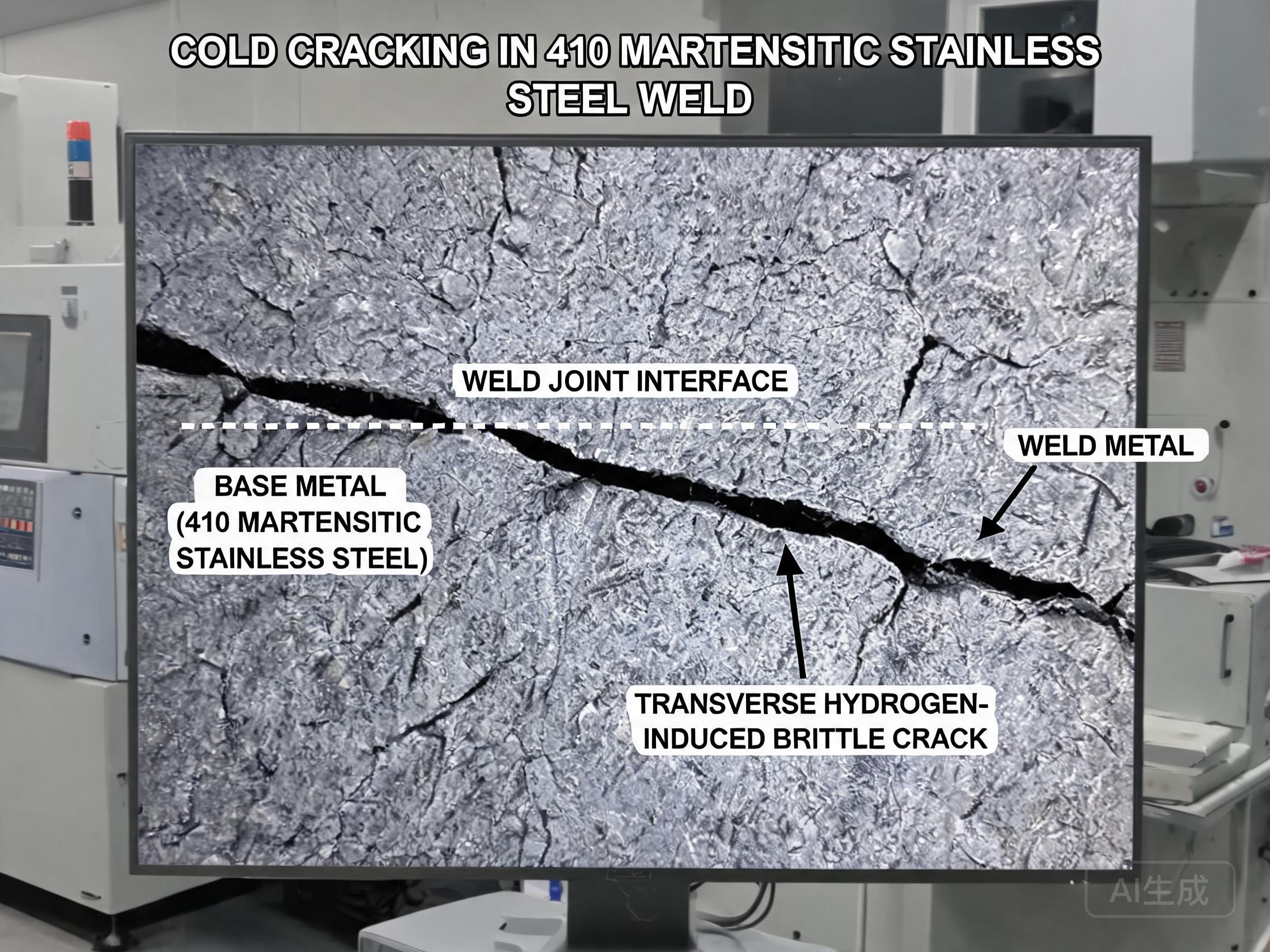
Short answer: Cold cracking in 410 and 420 welds is not a weld defect — it is a material behavior problem. When these air-hardening steels cool from welding heat, they form hard martensite in the HAZ. If hydrogen is present and the joint is restrained, cracks appear at the weld toe or in the HAZ — often 24-72 hours after the welder has left. The fix is preheat, post-weld temper and hydrogen control.
Cold cracking is the reason many fabricators avoid martensitic stainless steels. They forget that 410 and 420 harden during air cooling — unlike 304 or 316, which stay soft. Without preheat, the HAZ reaches HV 450-550, becoming brittle. Hydrogen from moisture, wire coating or shielding gas diffuses into this hard zone, recombines at dislocations, and creates internal pressure that cracks the steel.
Quick Comparison
| Grade | Hardness after welding | Required preheat | Post-weld temper | Hydrogen source |
|---|---|---|---|---|
| 410 (ER410 filler) | HV 450-550 (untempered) | 200-250°C | 600°C × 1-2h | Wire moisture, humidity |
| 420 (ER420 filler) | HV 500-600 (untempered) | 250-300°C | 600°C × 2h | Same, plus higher carbon |
| 410L (ER410L filler) | HV 350 max (tempered) | 150-200°C | 550-600°C × 1h | Low-hydrogen filler |
| 17-4PH (H900 condition) | HV 440 (precipitation) | 100°C (low) | Precipitation harden H1150 | Low risk but verify |
Note that 420 has higher carbon (0.15-0.40%) than 410 (≤0.15%), so it hardens more aggressively and needs higher preheat and longer tempering.
What Buyers Should Evaluate
- Is the fabricator using low-hydrogen filler wire, or just whatever is on the shelf?
- Do they preheat with a controlled method (induction, resistance, propane torch with thermocouple), or just “heat it with a torch until it’s warm”?
- Do they hold post-weld temper at temperature for the specified time, or skip it to save time?
- Has the procedure been qualified per AWS D1.6 clause 5 (martensitic stainless steels)?
- Is the base metal in the annealed condition (HB ≤170) before welding, not already hardened?
A 410 plate delivered in the H1100 or H1150 condition will crack during welding no matter what you do. Specify annealed (O) condition on the purchase order.
Common Purchasing Mistakes
- A China factory trick: quoting you preheated welding, but on the shop floor the welder skips preheat entirely (“it’s just 410, it doesn’t need it”). Require temperature records — either thermocouple logs or heat-indicator crayons showing the preheat temperature was reached. A ¥50 tempering chart saves you from a cracked weld that costs ¥5,000 to repair.
- Specifying ER410 filler but forgetting to require bakeout. Opened ER410 wire absorbs moisture from shop air within 24 hours. If the fabricator does not bake it at 300°C for 2-4 hours before use, you get hydrogen in the weld and cold cracks. Put bakeout requirements in your WPS.
- Confusing martensitic with austenitic. 410 and 420 need preheat; 304 and 316 do not. If your fabricator treats all stainless the same, you will get cold cracks on martensitic welds and no one will know why until inspection.
- Ordering 420 in full-hard condition for fabrication, then wondering why the weld cracks when cooling. Always order martensitic stainless in the annealed condition for welding.
Recommended RFQ Wording
“Please supply cold rolled 410 or 420 stainless steel sheet per EN 10088-2 in the annealed (O) condition, HB ≤170. Provide EN 10204-3.1 test reports. Fabrication must follow AWS D1.6 qualified WPS for martensitic stainless steel. Preheat: 200-300°C per grade, verified with thermocouple or heat crayon. Post-weld temper: 600°C minimum for 1-2h per 25mm thickness. Filler wire must be low-hydrogen ER410L or ER420L, baked at 300°C for 2-4h if opened >24h. Hydrogen content in weld deposit ≤5 ml/100g.”
Frequently Asked Questions
What causes cold cracking in 410 and 420 welds?
Cold cracking in martensitic stainless steels has three conditions that must all be present: a hard martensitic microstructure in the HAZ or weld metal, diffusible hydrogen exceeding ~5 ml/100g deposit, and tensile restraint stress. Unlike hot cracking, cold cracking can appear hours or even days after welding.
What preheat and post-weld heat treatment should I specify?
For 410 and 420 base metals welded with matching filler (ER410), preheat to 200-300°C and maintain interpass temperature at or above preheat. After welding, temper at 600°C for 1-2 hours per 25mm of thickness. This converts hard martensite to tempered martensite (HV ~350 max) and reduces hydrogen trapping.
How do I control hydrogen in martensitic welding?
Use low-hydrogen filler wires (ER410L or pre-baked ER410 at 300°C for 2-4 hours), store opened wire in a heated cabinet at 60°C, use pure argon shielding (99.99% minimum for TIG), and dry the base metal surface before welding to remove moisture that decomposes into hydrogen.
How Still Steel Supports the Project
Still Steel supplies cold rolled stainless steel sheet and strip with pre-cut edges, beveling and pre-weld cleaning services so your fabricator can start welding immediately. We stock matching filler wires (ER308L, ER316L, ER2209) and provide material traceability via EN 10204-3.1 test reports. Send your weld joint design, grade and thickness to vip@still-steel.com, or discuss on WhatsApp.
Technical References
- AWS D1.6/D1.6M Clause 5: Martensitic Stainless Steels
- ASME IX QW-403: Hardness and Hardenability Considerations
- EN 1011-3: Arc welding of stainless steels — hydrogen control recommendations
- A480/A480M: Standard Specification for General Requirements for Flat-Rolled Stainless and Heat-Resisting Steel Plate, Sheet, and Strip