
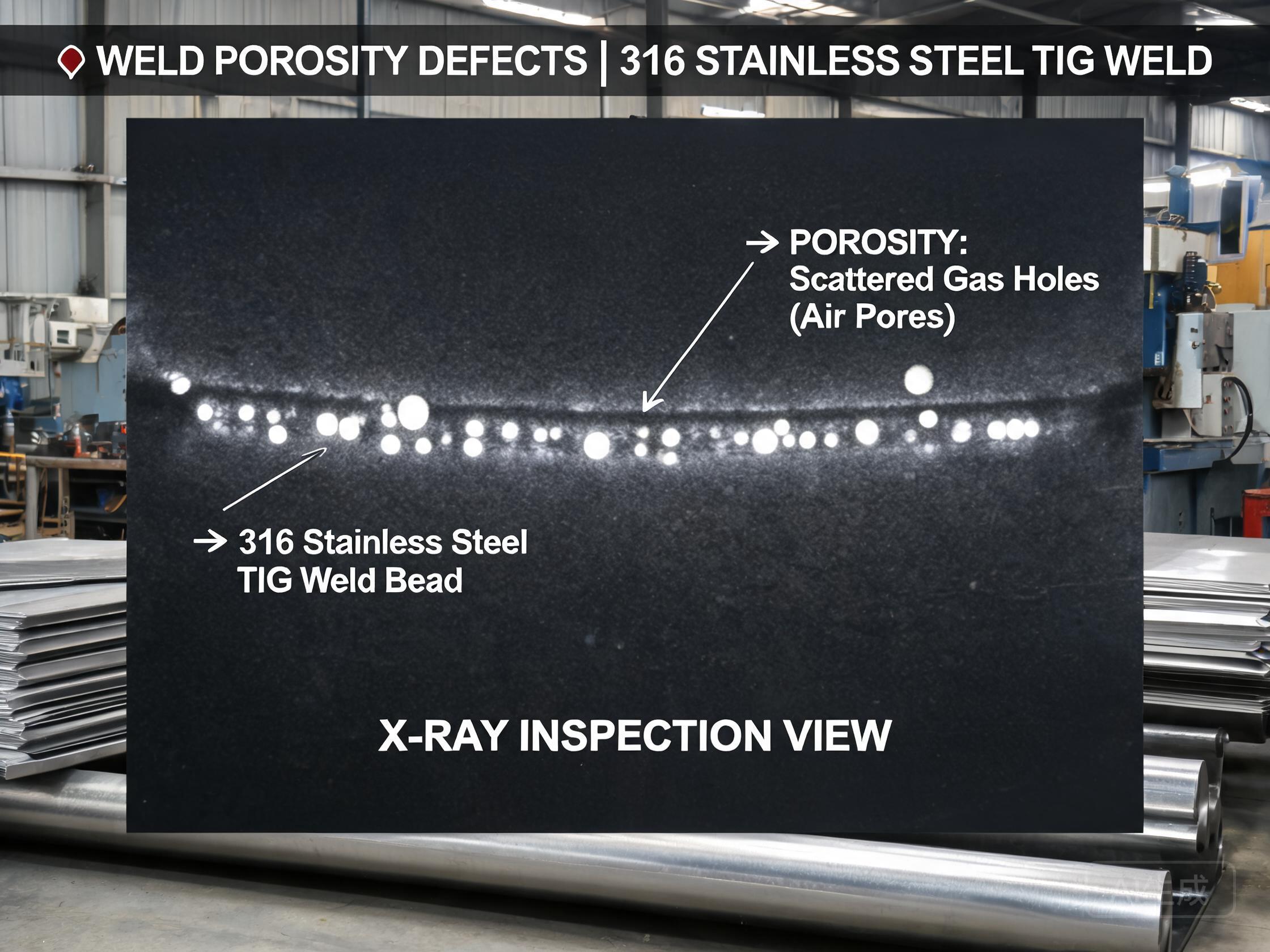
Short answer: Weld porosity — those round gas holes in the weld bead — is almost always preventable. The root causes are moisture on the plate, oil residue, impure shielding gas or unbaked filler wire. Buyers should require a pre-weld checklist that covers all four, and spot-check the shop floor. One 10-minute verification run saves you from rework on 50 meters of weld.
Porosity is not cosmetic. Each pore acts as a stress concentrator, reducing weld fatigue life by 30-50%. In food or pharmaceutical equipment, trapped moisture in pores harbors bacteria. In pressure vessels, pores can grow into leaks under cyclic pressure. Most fabricators know the causes; many cut corners to save time. Your job is to make cutting corners expensive.
Quick Comparison
| Porosity cause | Welding process affected | Fix | Verification |
|---|---|---|---|
| Surface moisture | All (TIG, MIG, SMAW) | Wipe with acetone, air-dry | Visual pre-weld check |
| Oil/grease residue | All | Same as above, plus grind if heavy | Acetone-wipe test |
| Argon purity <99.99% | TIG, MIG (GMAW-G) | Use 99.995%+ argon, check cylinder | O2 analyzer, purge paper test |
| Filler wire unbaked | SMAW (stick), flux-cored | Bake 300°C × 2h, store heated | Wire label heat indicator |
| Trapped air at root | TIG (no back purge) | Back purge argon, O2 <10 ppm | Purge paper, O2 meter |
The purge paper test is the fastest shop-floor check. Get a roll of plain absorbent paper, hold it at the root gap, light it with a lighter while shielding gas flows. No flicker = good purge.
What Buyers Should Evaluate
- Does the fabricator have a written pre-weld cleaning procedure, or does each welder do their own thing?
- Do they maintain filler wire in a heated cabinet (60°C for opened wire)?
- Do they have an oxygen analyzer or at least use the purge paper method for root passes?
- What is their argon cylinder policy — do they stop using bottles below 1 MPa, or run them dry?
- Do they do a test weld at the start of each shift to verify gas and wire condition?
If the answer to any of these is “no,” expect porosity. The fabricator’s QC supervisor should be signing off on pre-weld checks daily.
Common Purchasing Mistakes
- A China factory trick: the fabricator runs 99.9% pure argon (cheaper) instead of 99.99% and blames the “bad wire” when porosity appears. Argon purity is ¥30 difference per cylinder but costs you ¥3,000 in rework. Specify minimum 99.995% argon and require a purity certificate with each cylinder.
- Accepting welds with “just a little porosity” because the fabricator says “it’s within tolerance.” AWS D1.6 clause 8 limits scattered porosity to specific percentages, but food-processing, pharmaceutical and pressure-vessel welds have zero-tolerance. Know your application and specify the correct standard — EN 1011-3 for European food contact, ASME VIII for pressure vessels.
- Skipping the pre-weld cleaning step entirely. Cold rolled stainless arrives with mill oil, protective film adhesive or storage moisture. If the fabricator skips acetone wiping, you will get porosity. Add a 5-minute pre-weld inspection clause to your PO.
- Forgetting that SMAW (stick welding) electrode flux absorbs moisture. Opened electrodes must be baked at 300°C for 2-4 hours and stored in a heated quiver at 100-150°C. Many fabricators leave opened boxes on the floor near the welding booth — condensation from humid shop air goes straight into the flux.
Recommended RFQ Wording
“Please supply cold rolled 304L/316L stainless steel sheet per EN 10088-2 with EN 10204-3.1 test reports. Fabrication must follow AWS D1.6 pre-weld cleaning procedure: all joint surfaces shall be wiped with acetone or alcohol before welding, no oil, paint, marker ink or rust within 25mm of the joint edge. Filler wire shall be stored in a heated cabinet (60°C) after opening, baked at 300°C × 2h if opened >8h. Shielding gas: argon purity minimum 99.995%, back purge O2 verified <10 ppm via purge paper or O2 meter. Porosity acceptance: zero for food-contact surfaces, AWS D1.6 table 8.1 for other welds.”
Frequently Asked Questions
What causes weld porosity in stainless steel?
Porosity forms when gas bubbles become trapped in solidifying weld metal. The four main sources are: moisture on the plate surface (decomposes to H2 and O), oil or grease residue (same decomposition), argon or shielding gas with purity below 99.99% (contains nitrogen and moisture), and filler wire that has not been baked (moisture in the flux coating or on the wire surface).
How do I verify argon purity on the shop floor?
Use an oxygen analyzer or a “purge paper” test: ignite a piece of tissue paper held at the weld joint root with the shielding gas flowing. If the flame is stable and the paper burns without flickering, purge is good (O2 <10 ppm). If the flame jumps or dies, purge is insufficient. Also check the argon bottle pressure — below 1 MPa (10 bar), moisture from the cylinder wall can be drawn into the gas.
Does AWS D1.6 allow any porosity in stainless welds?
AWS D1.6 limits porosity: for general fabrication, scattered individual pores up to 1.5mm diameter are acceptable if the total porosity area is less than 1% of the weld surface. For critical pressure vessels or food-contact applications, any porosity is rejectable. Always specify the acceptance criteria on your purchase order.
How Still Steel Supports the Project
Still Steel supplies cold rolled stainless steel sheet and strip with pre-cut edges, beveling and pre-weld cleaning services so your fabricator can start welding immediately. We stock matching filler wires (ER308L, ER316L, ER2209) and provide material traceability via EN 10204-3.1 test reports. Send your weld joint design, grade and thickness to vip@still-steel.com, or discuss on WhatsApp.
Technical References
- AWS D1.6/D1.6M: Structural Welding Code — Stainless Steel (Clause 8: Porosity Acceptance)
- ASME IX QW-195: Porosity Limits for Qualification Tests
- EN 1011-3: Arc welding of stainless steels — pre-weld cleaning requirements
- ISO 15614-1: Specification and qualification of welding procedures — porosity verification