
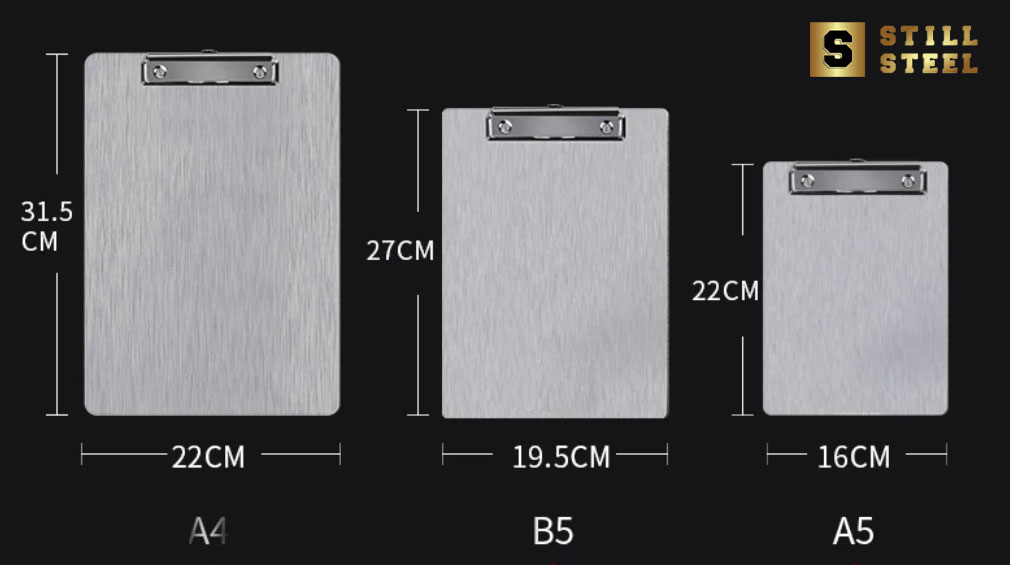
For most stainless steel clipboard programs, 1.0 mm sheet is the practical starting point for lower weight and cost, while 1.2 mm is the safer choice when an A4 board needs greater rigidity or must tolerate industrial handling. Thickness alone does not determine quality. Flatness, edge finishing, surface direction, clip contact, riveting, protective-film removal and export packaging have an equally visible effect on the customer’s experience.
This matters because a clipboard is a simple product with nowhere for a defect to hide. A consumer touches the edges, writes directly over the surface, opens the clip repeatedly and sees every scratch or dent. For manufacturers, the right stainless steel specification can prevent many complaints before stamping and assembly begin.
What Users Complain About
A review of public consumer discussions and ecommerce feedback reveals a consistent group of problems:
| Consumer complaint | Likely production cause | Control point for the manufacturer |
|---|---|---|
| Rough or sharp edges | Incomplete deburring or insufficient corner treatment | Specify edge radius, corner radius and 100% touch inspection |
| Paper spins under the clip | Uneven clip contact or misaligned rivets | Check contact-line pressure, clip flatness and rivet position |
| Board bends or arrives dented | Sheet too thin for the size, poor leveling or weak packaging | Match thickness to format and use rigid export packaging |
| Protective film remains under the clip | Film was not removed in the assembly zone | Define film-removal zones before riveting and folding |
| “Stainless” board is not magnetic | Austenitic grade selected without explaining magnetism | Match 304 or 430 to the actual magnetic requirement |
| Surface scratches or feels coarse | Finish too rough, poor handling or unsuitable interleaving | Control finish, grain direction, film and sheet separation |
These are not theoretical concerns. An Amazon review archive describes rough metal edges that could scratch the user, while another review reports that the clip contacted only one corner, allowing the paper to rotate; the reviewer suspected uneven riveting. A separate product-review summary mentions boards arriving dented, flimsy or with missing parts. On Reddit, users repeatedly complained about protective film trapped beneath the clip or rolled edge, making clean removal almost impossible. See the Amazon review archive, stainless clipboard review summary, and Reddit protective-film discussion.
Should a Clipboard Use 1.0 mm or 1.2 mm Stainless Steel?
The best thickness depends on board size, edge geometry and target use rather than one universal number.
Choose 1.0 mm when:
- The product is A5, B5 or another compact format
- Low carrying weight is an important selling point
- The perimeter or formed edge adds stiffness
- The board is intended for offices, menus or light indoor use
- Cost control is more important than maximum rigidity
Choose 1.2 mm when:
- The product is A4 or has a large unsupported writing area
- Users will write while standing or working away from a desk
- The clipboard is intended for factories, kitchens, warehouses or field work
- Better resistance to local bending and transport dents is required
- A more substantial hand feel supports the product’s price position
The difference is only 0.2 mm, but a 1.2 mm sheet contains roughly 20% more material than a 1.0 mm sheet of the same grade and dimensions. That improves rigidity, but also increases weight and cost. The right decision should therefore be made with a finished-board deflection test, clip-cycle test and packed-product drop test, not thickness alone.
Which Stainless Steel Grade Is Suitable?
304 stainless steel: the dependable default
Type 304 (UNS S30400, EN 1.4301, SUS304) is a strong default for clipboards used in humid factories, commercial kitchens, laboratories, medical environments and other locations where cleaning and corrosion resistance matter. Outokumpu describes 304 as an all-purpose austenitic grade with good resistance to atmospheric corrosion and many chemicals. Its formability also supports corner cutting, punching and shallow forming. See the official 304/4301 material overview.
430 stainless steel: useful when magnetism matters
Some buyers expect every stainless steel clipboard to accept magnets. That expectation should be clarified before quoting. Austenitic grades such as 304 are generally non-magnetic in the solution-annealed condition, although cold working may create slight magnetism. Ferritic stainless steels are magnetic. The Nickel Institute stainless steel selection guide explains this microstructure difference.
If strong magnetic attachment is required, 430 can be considered for dry indoor applications after reviewing corrosion exposure, forming depth and finish requirements. It should not be substituted for 304 only because it is cheaper; the environment and customer promise must come first.
201 stainless steel: for controlled, cost-sensitive applications
201 may be suitable for budget-focused clipboards used in relatively dry indoor settings. It can reduce material cost, but the corrosion environment, cleaning chemicals and expected service life should be defined clearly. For wet, hygienic or premium applications, 304 is usually the more defensible specification.
Safe Edges Begin Before Assembly
The board perimeter is one of the highest-risk contact areas. Laser cutting or shearing establishes the profile, but a safe edge requires a controlled finishing route. Our recommended sequence is:
- Cut the blank with a defined dimensional tolerance.
- Produce consistent rounded corners rather than visually sharp square corners.
- Remove burrs from both faces and the cut edge.
- Inspect the edge by touch and with a defined burr-height limit.
- Clean the board before fitting the clip and corner protectors.
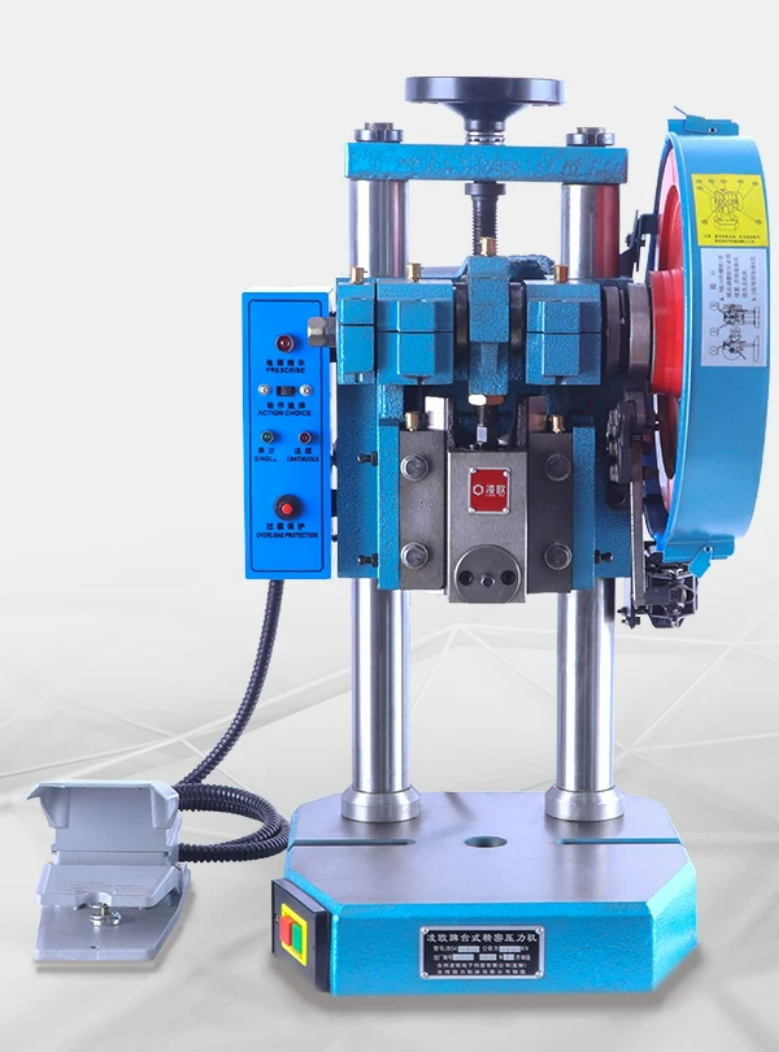
A rounded profile improves safety, but it also protects cartons and adjacent products during shipping. For high-volume orders, the corner geometry should be part of the drawing and inspection standard rather than left to operator judgment.
A Strong Clip Needs More Than a Strong Spring
A clip can feel powerful and still hold paper poorly. The contact edge must remain parallel to the board, and the spring force must be distributed across the paper. If rivet holes are offset or the clip base is distorted, pressure may concentrate at one corner and allow the document to rotate.
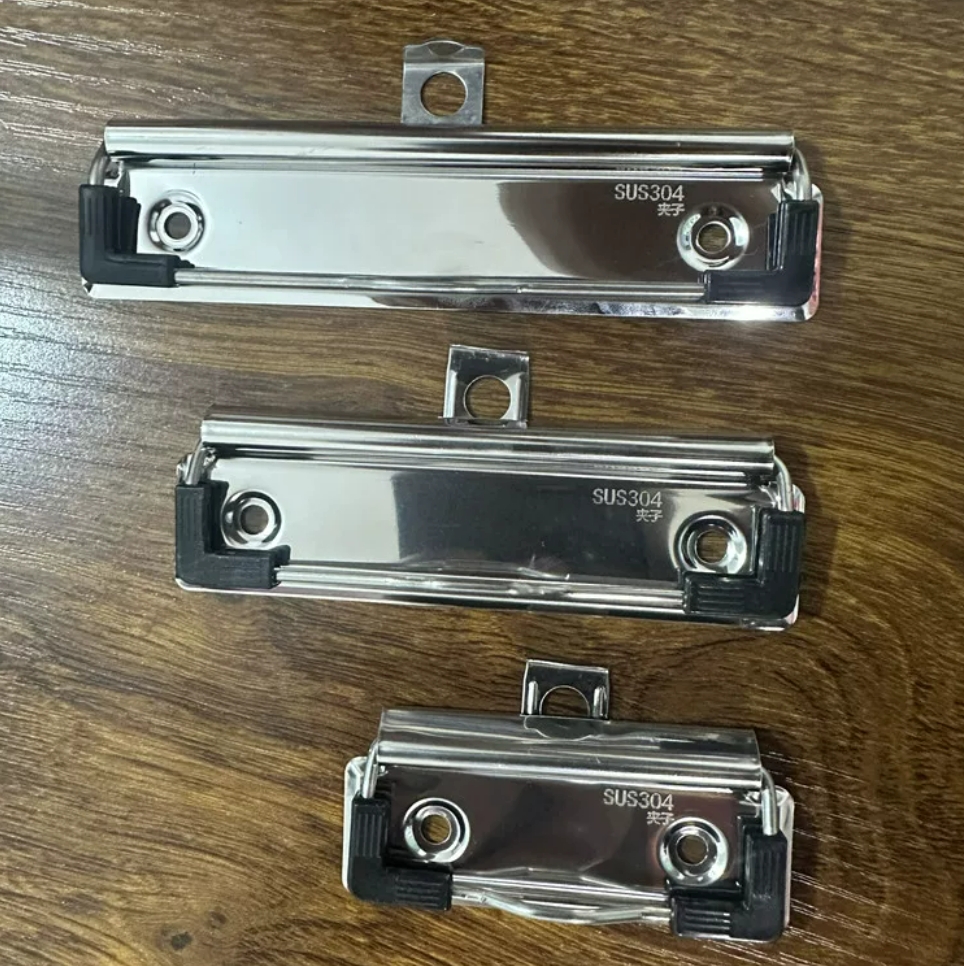
For production approval, we recommend checking:
- Clip opening force and closing force
- Full-width paper contact using one sheet and a small stack
- Rivet position and pull-out resistance
- Clip alignment after repeated opening cycles
- Rubber corner-pad fit and retention
- Corrosion compatibility between the board, clip and fastener
As a material supplier, we can support both the flat board stock and narrower stainless strip used for clip components. Keeping the board and clip specifications aligned helps reduce mixed-finish, corrosion and forming problems.
Surface Finish, Scratches and Protective Film
A highly reflective surface looks premium in a photograph but can show fingerprints, glare and fine scratches quickly. A controlled brushed finish is often more forgiving for daily handling, provided the grain is uniform and not so coarse that it feels rough. Grain direction should be consistent across every board in a shipment.
Protective film should remain on the visible face during cutting and handling, but assembly zones need special treatment. If the film passes beneath rivets, the clip base or a folded edge, the customer may never remove it cleanly. The manufacturing instruction should identify areas where film is peeled or die-cut before assembly while keeping the remaining surface protected.
Packaging Is Part of Material Quality
Flat stainless products can be permanently marked by a hard particle trapped between sheets. Finished clipboards can also dent when the clip of one board presses into the face of another. A suitable packing plan may include:
- Clean interleaving between finished surfaces
- Clip-to-clip orientation or molded separation
- Corner and edge protection
- A rigid inner carton that limits board movement
- Moisture protection for sea freight
- A packed-product drop test before mass shipment
This is especially important for 1.0 mm products, where good packaging can prevent defects that might otherwise be blamed on material thickness.
Recommended Specification for a New Clipboard Project
For an initial A4 stainless steel clipboard sample, a practical starting specification is:
- Board: 1.2 mm 304 stainless steel
- Finish: controlled brushed finish with agreed grain direction
- Corners: rounded and fully deburred
- Clip: corrosion-compatible stainless clip with verified full-width contact
- Protection: removable surface film with pre-cleared assembly zones
- Testing: flatness, edge touch inspection, clip cycling and packed drop test
For B5 or A5 products, 1.0 mm can be evaluated to reduce weight and cost. Once the target market, board size and use environment are known, we can compare 201, 304 and 430, prepare cut-to-size blanks, apply film, brush the surface and support sample production.
Frequently Asked Questions
What thickness is best for a stainless steel clipboard?
For many compact and standard products, 1.0 mm balances weight and cost. A 1.2 mm sheet provides greater rigidity and is often preferable for A4 boards, industrial use or products with large unsupported areas. The final choice should be confirmed by size, edge design and load testing.
Is 304 stainless steel a good material for clipboards?
Yes. 304 stainless steel is a practical default for humid workplaces, kitchens, laboratories and healthcare-related environments because it combines corrosion resistance, formability and cleanability.
Why do some stainless steel clipboards have sharp edges?
Sharp edges usually result from incomplete deburring, an unsuitable corner radius or a cut edge that was not properly finished. Rounded corners, controlled deburring and edge inspection should be specified before assembly.
Why does paper rotate under a clipboard clip?
Paper can rotate when the clip touches only one corner instead of applying pressure across its contact line. Clip flatness, spring force, rivet position and assembly alignment should be checked together.
Are 304 stainless steel clipboards magnetic?
Annealed 304 is generally non-magnetic, although cold working can introduce slight magnetism. If strong magnetic attachment is a product requirement, a ferritic grade such as 430 may be more suitable after corrosion and forming requirements are reviewed.
How can protective film be prevented from getting trapped under the clip?
Define film-removal zones around rivets, clips and folded edges before assembly. Remove or trim the film in those zones before riveting or hemming, while leaving the main surface protected through later operations.
Discuss a Stainless Steel Clipboard Project
Send us your target size, annual quantity, use environment, required finish and whether magnetism is necessary. We can recommend a grade and thickness, prepare samples, and provide slitting, cut-to-length, brushing, polishing and protective-film services.
Email the Still Steel team or discuss your clipboard specification on WhatsApp.