
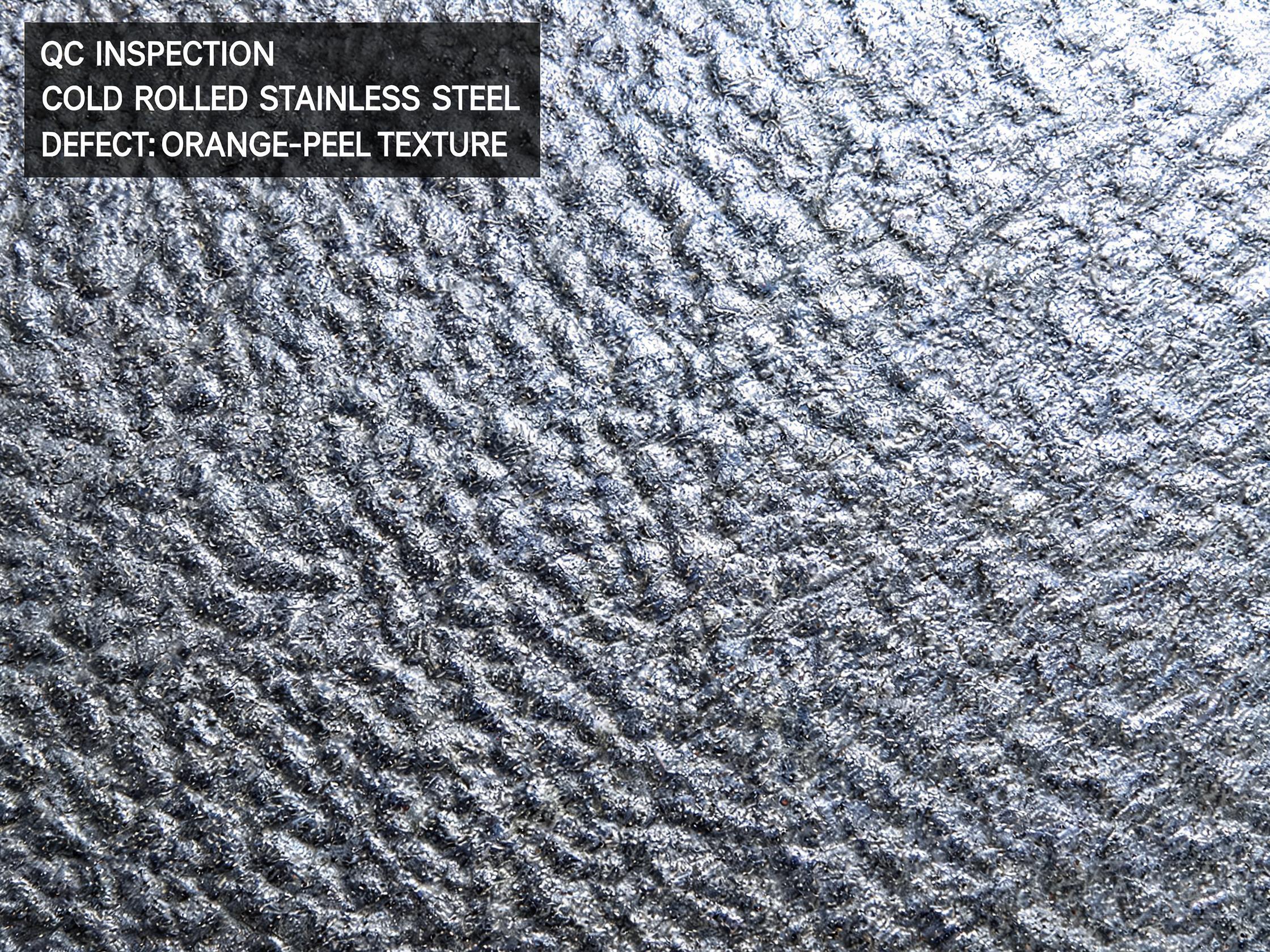
Short answer: Orange peel on cold rolled stainless steel is a grain size problem, not a surface finish problem. If your 304 deep-drawn parts look bumpy like an orange skin, the mill supplied coarse-grained sheet. Fix it by specifying grain size No. 10 or finer on your PO, and keep your drawing ratio below 2.0.
Every kitchen appliance maker who has pressed a 304 sink bowl knows this one. You open a pallet of “defective” parts, reject them, and then find the mill sent grain size No. 6 instead of No. 10. The spec difference is tiny on paper—two numbers—but the result on your finished sink is the whole difference between shipping and scrapping.
Quick Comparison
| Forming operation | Orange peel risk | Grain size to specify | Minimum Ra (2B surface) |
|---|---|---|---|
| Blanking, punching | Very low | No. 8 or finer | Ra ≤ 0.8 µm |
| Simple bending | Low | No. 8 or finer | Ra ≤ 0.6 µm |
| Stamping (cup draws < 1.5 ratio) | Medium | No. 9 or finer | Ra ≤ 0.4 µm |
| Deep drawing (ratio 1.5–2.0) | High | No. 10 or finer | Ra ≤ 0.4 µm |
| Hydroforming, complex draws | Very high | No. 11 or finer | Ra ≤ 0.3 µm |
The drawing ratio (blank diameter ÷ final cup diameter) is your second lever. A ratio above 2.5 will produce orange peel on almost any stainless unless you anneal between draws.
What Buyers Should Evaluate
- Check the grain size on the mill test certificate (EN 10204 3.1) before accepting material. This is your primary upstream control.
- For 304/304L deep draws, request “extra-fine grain” (AISI grain size No. 10–12) material. Mills can produce it through controlled cold reduction and intermediate annealing.
- Specify the surface roughness Ra range. A 2B surface at Ra 0.2–0.4 µm deforms more uniformly than a coarser 2B at Ra > 0.8 µm.
- Confirm the cold reduction schedule. Sheet that receives > 60 % reduction per pass with intermediate annealing at 950–1000 °C produces the finest grains.
Common Purchasing Mistakes
- Accepting a Chinese mill certificate that states “grain size fine” without a number. “Fine” is meaningless. Insist on a measured ASTM E112 grain size number (No. 8, No. 10, No. 11, etc.). Cheap mills often inflate grain size claims to sell cheaper heat batches.
- Ordering 304 without specifying cold rolled and annealed. A cold rolled, unannealed 304 will work-harden rapidly during drawing and produce orange peel even at low strain. Annealed, pickled and passivated (2B) is the baseline for any deep-draw application.
- Skipping a first-article trial draw with the actual tooling. Orange peel only shows up in a real part, not on a flat sheet. Draw three cups with the incoming coil before committing to a volume order.
Recommended RFQ Wording
Grade: AISI 304L / EN 1.4307, austenitic stainless Form: Cold rolled sheet, annealed, pickled, passivated (2B surface) Gauge: 1.0 mm ± 0.02 mm, width 1000 mm Grain size: ASTM E112 No. 10 or finer, measured on annealed coil Surface roughness: Ra 0.2–0.4 µm (2B), mill surface report required Certificate: EN 10204 3.1 with grain size number and Ra reading
How Still Steel Supports the Project
Still Steel supplies cold rolled stainless steel sheet and strip in 304/304L/316/316L/430 with 2B, BA, No.4 and 8K surfaces. We handle pickling passivation, electropolishing and PVD coating under one roof so your surface tolerance stays consistent. Send the grade, gauge, width and your specific surface problem to vip@still-steel.com, or discuss the requirement on WhatsApp.
Frequently Asked Questions
What exactly causes orange peel on cold rolled stainless steel during stamping or drawing?
Orange peel is a grain-boundary roughening that appears when coarse-grained stainless deforms under tensile stress. Large grains slip unevenly at their boundaries, creating the bumpy texture. It is most common in cold rolled stainless above grain size No. 8. Fine-grained grades (No. 10 or finer) deform more uniformly and do not show orange peel at moderate strain levels.
Is orange peel worse on stamping blanks than on deep-drawn parts?
Deep drawing is the worst offender because the blank is stretched in all directions through the die, putting every grain under tensile stress. Simple stamping or blanking has lower triaxial stress and is less likely to produce visible orange peel. For deep draws, insist on grain size No. 10 or finer.
Can orange peel be removed after forming, or do I need to prevent it upstream?
Light orange peel can be reduced with a 120# to 240# abrasive tumble or a No.4 brush pass, but it will never disappear completely without removing significant material. The cost-effective solution is to prevent it: specify fine-grained material, keep drawing ratios below 2.0, and lubricate properly during forming.
Technical References
- ASTM E112 standard test methods for determining average grain size
- EN 10088-2 stainless steels — Part 2: Sheet, strip and plate
- ASTM A240/A240M chromium and chromium-nickel stainless steel plate, sheet and strip
Reference documents support general selection and fabrication principles. The final material decision must follow the applicable contract, standard, regulation and engineering review for the specific product.