
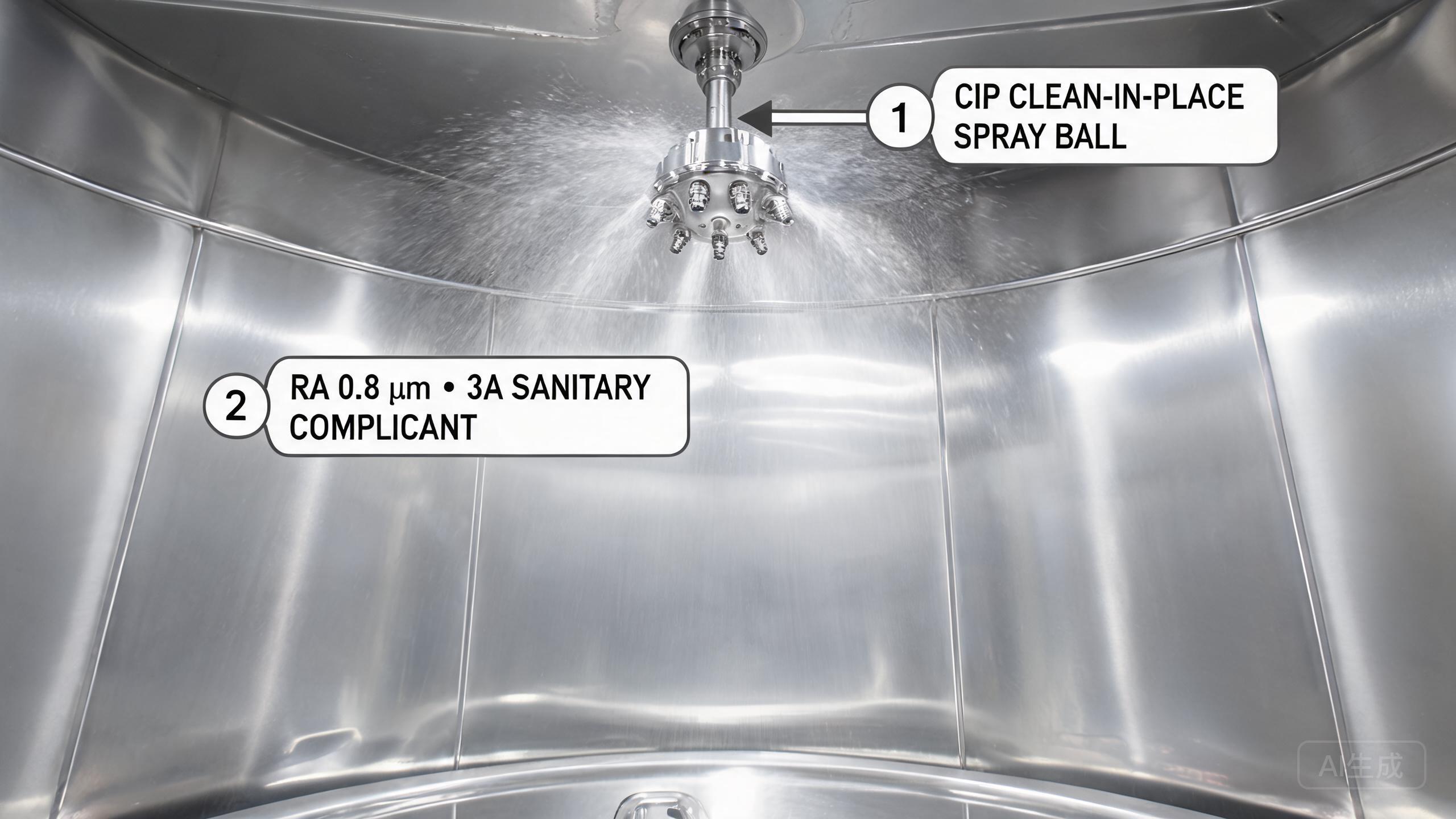
Short answer:
Clean-In-Place (CIP) is the cornerstone of modern food processing hygiene — and your stainless steel surface finish is the single biggest factor in whether a CIP cycle actually cleans or just redistributes bacteria. The 3-A Sanitary Standards and EHEDG guidelines are non-negotiable: Dairy processing needs Ra ≤0.4μm (304 is fine, 2B mill finish naturally hits Ra ~0.15μm). Meat/poultry allows Ra ≤0.8μm but 316L is recommended for the harsher cleaning chemicals. Acidic foods (citrus, tomato, vinegar) demand both Ra ≤0.4μm AND 316L for corrosion resistance. The 2023 FDA inspection of 120 Chinese food plants found 35% were using unpolished 304 (Ra >1.6μm) — a direct violation that led to import detention.
Quick Comparison
| Food Category | Required Ra | Recommended Grade | CIP Medium | Why This Spec |
|---|---|---|---|---|
| Dairy (milk, cheese, yogurt) | ≤0.4μm | 304 (2B finish) | 1-1.5% NaOH + 0.5% HNO₃ @ 70-80°C | 304 handles alkaline CIP well; 2B finish naturally meets Ra |
| Meat/Poultry | ≤0.8μm | 316L | 1-2% NaOH + 1% H₂O₂ @ 60-75°C | 316L handles oxidative cleaners; 0.8μm allows some process residue |
| Acidic Fruits (citrus, tomato) | ≤0.4μm | 316L | 1% NaOH + 1% HNO₃ @ 60-70°C | 316L Mo resists fruit acid corrosion; Ra minimizes residue |
| Beverages (juice, wine) | ≤0.4μm | 316L (electropolished) | 1.5% NaOH + sanitizer @ 60°C | Electropolish for high-viscosity beverage cleanability |
| Processed Foods (canned, sauces) | ≤0.8μm | 304 (No.4 polished) | 1-2% NaOH @ 70°C | 304 handles CIP; No.4 finish is more scratch-resistant |
What Buyers Should Evaluate
- Actual surface roughness measurement. Don’t rely on mill “2B finish” claims — require a Ra measurement per ISO 4288 on every plate. A proper 2B finish on 304 should be Ra 0.10-0.20μm, well below the 0.4μm dairy requirement.
- Weld smoothness. CIP systems have welds that must be ground flush and polished to match the base material Ra. A typical ground weld has Ra 3.2μm — this must be polished to Ra ≤0.4μm for dairy processing.
- CIP flow velocity. Minimum flow velocity in pipes is 1.2 m/s per 3-A Standards — below this, laminar flow allows residue buildup even on perfectly smooth surfaces.
- China-specific note. China’s GB 4806.9-2016 food contact material standard aligns with 3-A and EHEDG. For export to US/EU, require both GB and 3-A/EHEDG certification.
- EHEDG certification. If exporting to EU, equipment must be EHEDG-certified — this requires not just correct Ra but also specific joint designs, gasket materials, and CIP flow analysis.
Common Purchasing Mistakes
Mistake: Specifying “304 food grade” without defining surface roughness. We’ve seen RFQs from Chinese food processors that say simply “304 stainless, food grade” — the mill ships 2B finish that may be Ra 0.15μm (good) or Ra 1.6μm (bad, depending on rolling practice). Fix: always include Ra specification: “304 stainless steel, ASTM A240, 2B mill finish, Ra ≤0.2μm per ISO 4288.”
Mistake: Chinese factory trick — non-sanitary 304 labeled as “3A food grade.” A Shenzhen food equipment manufacturer supplied tanks labeled “3-A Sanitary Standards” that used rough cold-rolled 304 with Ra >1.6μm — far above the Ra ≤0.4μm requirement. The client received FDA import detention in March 2025. Solution: PMI (Positive Material Identification) spectroscopy confirms it’s 304/316L chemistry. Then physically measure surface roughness with a portable profilometer (30 seconds per test). Insist on EN 10204 3.1 mill test certificates with Ra measurement reports per ISO 4288. For export to US/EU, require a valid 3-A or EHEDG certificate — verify the certificate number on the official 3-A Association website.
Mistake: Ignoring CIP flow velocity in tank design. A tank’s Ra can be perfect, but if the CIP spray nozzle doesn’t cover 100% of the interior surface at ≥1.2 m/s flow, you’ll get dead zones with bacterial residue. Always specify 3-A-compliant CIP spray balls and request a CIP coverage analysis from the fabricator.
Mistake: Using 316L where 304 would suffice. 316L costs 20-30% more than 304. For dairy processing with well-engineered CIP, 304 is fully compliant with 3-A Standards. Specify 316L only for acidic foods or meat processing with oxidative cleaners.
Recommended RFQ Wording
Grade: ASTM A240 / UNS S30400 (304) OR UNS S31603 (316L) per buyer selection
Surface finish: 2B mill finish (Ra ≤0.2μm for dairy) OR No.4 polished (Ra ≤0.8μm for meat) OR electropolished (Ra ≤0.1μm)
Application: [dairy processing tank / citrus juice pipeline / meat processing vessel]
Food category: [dairy / meat / acidic fruit / beverage]
CIP medium: [NaOH concentration, HNO₃ concentration, temperature]
Form: [plate / pipe / sheet]
Thickness: [exact mm]
Quantity: [m² or metric tons]
Certification required:
  - EN 10204 3.1 mill test certificate
  - PMI spectroscopy on every heat
  - Surface roughness Ra measurement per ISO 4288 (10 points per plate)
  - 3-A Sanitary Standards compliance certificate OR EHEDG certification (for EU export)
  - GB 4806.9-2016 food contact material statement
Additional: All welds must be ground flush and polished to base material Ra.
FAQ
Does CIP food processing equipment need 316L or is 304 acceptable?
304 stainless steel (UNS S30400, 2B finish, Ra ~0.15μm) is fully acceptable for dairy processing where the CIP solution is typically 1.0-1.5% caustic soda + 0.5-1.0% nitric acid at 70-80°C. 316L (UNS S31603) is required for acidic food processing — citrus (pH 2-3), tomato (pH 3.5-4), and vinegar (pH 2-3) — where the 2-3% molybdenum in 316L provides critical corrosion resistance.
What surface roughness Ra is required for CIP food processing?
Per 3-A Sanitary Standards and EHEDG (European Hygienic Engineering & Design Group): Dairy processing contact surfaces require Ra ≤0.4μm. Meat/poultry processing requires Ra ≤0.8μm. Acidic food processing (citrus, tomato) also requires Ra ≤0.4μm to prevent residue adhesion. 2B mill finish on 304 naturally achieves Ra ~0.15μm, meeting dairy requirements without additional polishing.
Is electropolishing necessary for CIP food processing?
Not always. For dairy processing with well-designed CIP systems (≥1.2 m/s flow velocity), a properly rolled 2B mill finish (Ra ≤0.2μm) is acceptable. Electropolishing (Ra ≤0.1μm) provides marginally better cleanability and is preferred for high-viscosity products (yogurt, cheese, ketchup) where residue adhesion risk is higher. Electropolishing also improves corrosion resistance by enriching the chromium content of the passive surface film.
CTA + Technical References
Send your grade, dimensions, annual volume and application to vip@still-steel.com, or contact us. We supply 304 and 316L per ASTM A240 with verified Ra roughness and full 3-A/EHEDG documentation.
References:
- 3-A Sanitary Standards: Multiple documents governing food processing equipment
- EHEDG Design Guidelines: Hygienic design principles for food processing equipment
- GB 4806.9-2016: National food safety standard — Food contact materials and articles
- ASTM A240 / A240M: Standard specification for chromium and chromium-nickel stainless steel plate, sheet, and strip
- See also: Best stainless steel for cookware
Technical References
- ASTM A240M - Standard Specification for Chromium and Chromium-Nickel Stainless Steel Plate, Sheet and Strip
- EN 10088-2 - Stainless steels. Technical delivery conditions for sheet/plate and strip
- ASM International - Handbook Series, Volume 1: Properties and Selection: Irons, Steels, and High-Performance Alloys