
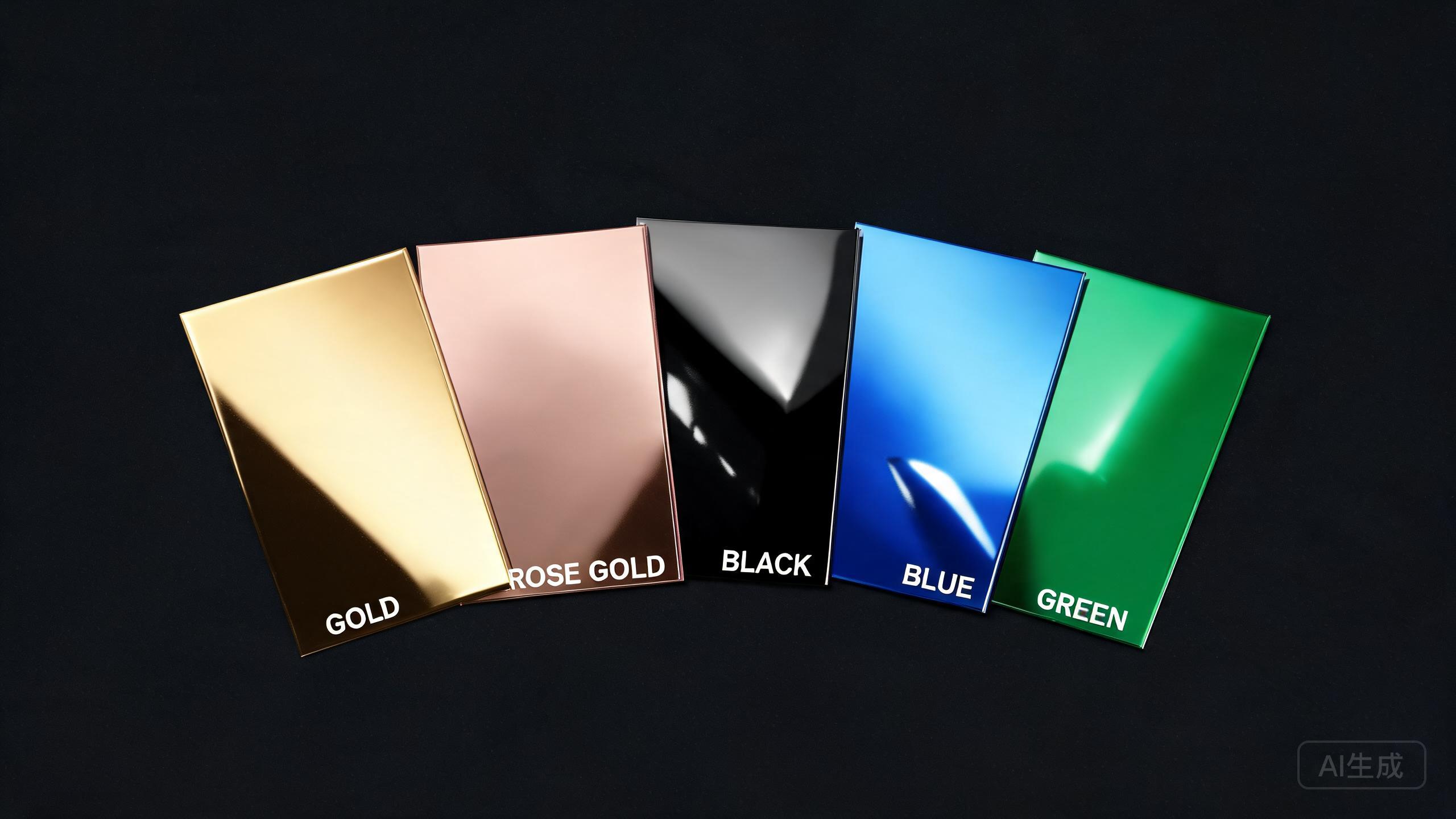
Short answer:
Colored stainless steel via Physical Vapor Deposition (PVD) has become the premium finish for kitchen appliances, architectural hardware, elevator interiors, and luxury consumer products in the last decade. Unlike paint or electroplating, PVD deposits a hard ceramic layer (0.1-0.5μm thick) that bonds directly to the stainless substrate — it won’t chip, peel, or corrode. Gold (TiN), black (TiCN), and rose gold (AlTiN) are the most common PVD colors. The substrate surface finish matters critically: No.8 mirror gives the most brilliant color while 2B mill finish softens it. For food contact, stick with 304 or 316L substrates and confirm FDA compliance per 21 CFR 175.300. Outdoor applications demand AlTiN or thicker multi-layer coatings for UV resistance.
Quick Comparison
| Color | PVD Material | Thickness (μm) | Hardness (HV) | Outdoor Life | FDA Compliant | Best For |
|---|---|---|---|---|---|---|
| Gold | TiN | 0.2-0.5 | 1800-2200 | 3-5 years | Yes | Indoor hardware, kitchen appliances |
| Black | TiCN | 0.2-0.4 | 2000-2500 | 2-4 years | Yes | Luxury elevators, decorative panels |
| Rose Gold | AlTiN | 0.2-0.4 | 1500-2000 | 4-6 years | Yes* | Consumer electronics, premium fixtures |
| Bronze | ZrN | 0.2-0.4 | 1200-1500 | 4-6 years | Yes | Warm interior design, retail displays |
| Copper | TiAlCuN | 0.3-0.5 | 1500-1800 | 3-5 years | Check supplier | Architectural accents |
*Rose gold AlTiN must be tested for FDA compliance — some formulations use aluminum alloys not approved for food contact.
What Buyers Should Evaluate
- Substrate grade. Use 304 (EN 10088-2) for most applications, 316L for coastal or high-corrosion environments. Ferritic grades like 430 may have poor PVD adhesion due to higher thermal expansion mismatch.
- Surface finish. Specify No.8 mirror for maximum color brilliance, No.4 brushed for low-gloss architectural use, or 2B mill for industrial applications. Surface roughness Ra ≤0.05μm is mandatory for No.8 substrates before PVD.
- PVD process temperature. Most PVD is done at 200-400°C, which is below the tempering temperature of 304/316L. Verify your parts won’t experience dimensional change post-coating.
- Adhesion test. Insist on ASTM D3359 crosshatch adhesion testing — PVD coatings must pass 5B with no coating removal.
- China-specific note. Ningbo and Guangdong are the primary PVD coating hubs in China. Premium suppliers (Ningbo PVD Co., Ltd.) offer ISO 9001-certified coating services. Be wary of small shops using 0.1μm thin coatings.
Common Purchasing Mistakes
Mistake: Specifying PVD color without substrate finish. A Shanghai elevator manufacturer ordered “black PVD panels” and received them on 2B mill finish — the black looked flat and industrial instead of the rich, deep black they’d seen on No.8 sample panels. Fix: always specify both color AND substrate finish: “Black TiCN PVD on No.8 mirror finish 304.”
Mistake: Chinese factory trick — thin PVD coatings that wear through. Some coaters in Dongguan use only 0.1μm coatings instead of the 0.2-0.4μm standard, cutting cost by 30-40%. These wear through to the stainless substrate within 6-12 months of normal use. Solution: PMI (Positive Material Identification) spectroscopy can confirm the PVD chemistry is correct (TiN vs fake metallic gold paint). Additionally, measure coating thickness with a Fischer or Elcometer thickness gauge — this takes 30 seconds per sample. Insist on EN 10204 3.1 equivalent documentation for the coating process, including thickness test reports.
Mistake: Using abrasive cleaners on PVD coated surfaces. Steel wool, scouring pads, and abrasive cleaning powders scratch even 0.5μm PVD coatings. Supply customers with a care sheet specifying non-abrasive cloths and mild detergent only. This is a common return reason in consumer products.
Mistake: PVD coating after fabrication. Forming, bending, or welding PVD-coated parts damages the coating. The correct sequence: fabricate first, then PVD coat. This is especially important for complex shapes like cookware and decorative railings.
Recommended RFQ Wording
Grade: [ASTM A240 / UNS S30400 (304) or S31603 (316L)]
Substrate surface: [No.8 mirror / No.4 brushed / 2B mill]
PVD specification:
  - Color: [Gold TiN / Black TiCN / Rose Gold AlTiN / Bronze ZrN]
  - Thickness: ≥0.3μm
  - Hardness: ≥1800 HV (for TiN), ≥2000 HV (for TiCN)
Application: [architectural panel / kitchen appliance / elevator interior / food contact product]
FDA compliance required: [Yes / No]
Form: [sheet / panel / formed part]
Dimensions: [exact mm]
Quantity: [metric tons or pieces]
Certification required:
  - Coating thickness test per ASTM B568 (Fischer gauge)
  - Adhesion test per ASTM D3359 (5B pass)
  - PMI spectroscopy report on 10% sample
  - FDA 21 CFR 175.300 compliance certificate if food contact
FAQ
Will PVD coated stainless steel scratch easily?
PVD coatings (TiN for gold, TiCN for black, TiAlN for rose gold) have hardness 800-2000 HV, significantly harder than the stainless steel substrate (~150-300 HV). They resist most everyday scratching from keys, coins, regular wear. However, sharp objects or abrasive cleaners can mar the coating. For critical applications, specify PVD thickness ≥0.3μm over a No.8 mirror substrate.
Is PVD colored stainless steel FDA-compliant for food contact?
Yes, provided the coating is applied to an FDA-compliant substrate (304 or 316L, per FDA 21 CFR 175.300) and the PVD process uses approved materials (titanium, nitrogen, carbon). Gold TiN, black TiCN, and bronze ZrN coatings all meet FDA requirements. Rose gold coatings may use AlTiN — verify your supplier’s FDA documentation.
How long do PVD coatings last outdoors vs indoors?
Indoors, PVD coatings last 10+ years with minimal fading or scratching. Outdoors, standard TiN gold coatings degrade in 3-5 years due to UV radiation and weathering. For outdoor use, specify AlTiN coatings (10+ year outdoor life) or a dual-layer PVD system with a clear topcoat.
CTA + Technical References
Send your grade, dimensions, annual volume and application to vip@still-steel.com, or contact us. We supply PVD-colored stainless panels per EN 10088-2 with full coating thickness and adhesion documentation.
References:
- EN 10088-2: Stainless steels — Part 2: Technical delivery conditions for plate, sheet and strip
- ASTM B568: Standard test method for thickness of metallic and oxide coatings
- ASTM D3359: Standard test methods for measuring adhesion by tape test
- FDA 21 CFR 175.300: Indirect food additives — Adhesives
- See also: Best stainless steel for cookware
Technical References
- ASTM A240M - Standard Specification for Chromium and Chromium-Nickel Stainless Steel Plate, Sheet and Strip
- EN 10088-2 - Stainless steels. Technical delivery conditions for sheet/plate and strip
- ASM International - Handbook Series, Volume 1: Properties and Selection: Irons, Steels, and High-Performance Alloys