
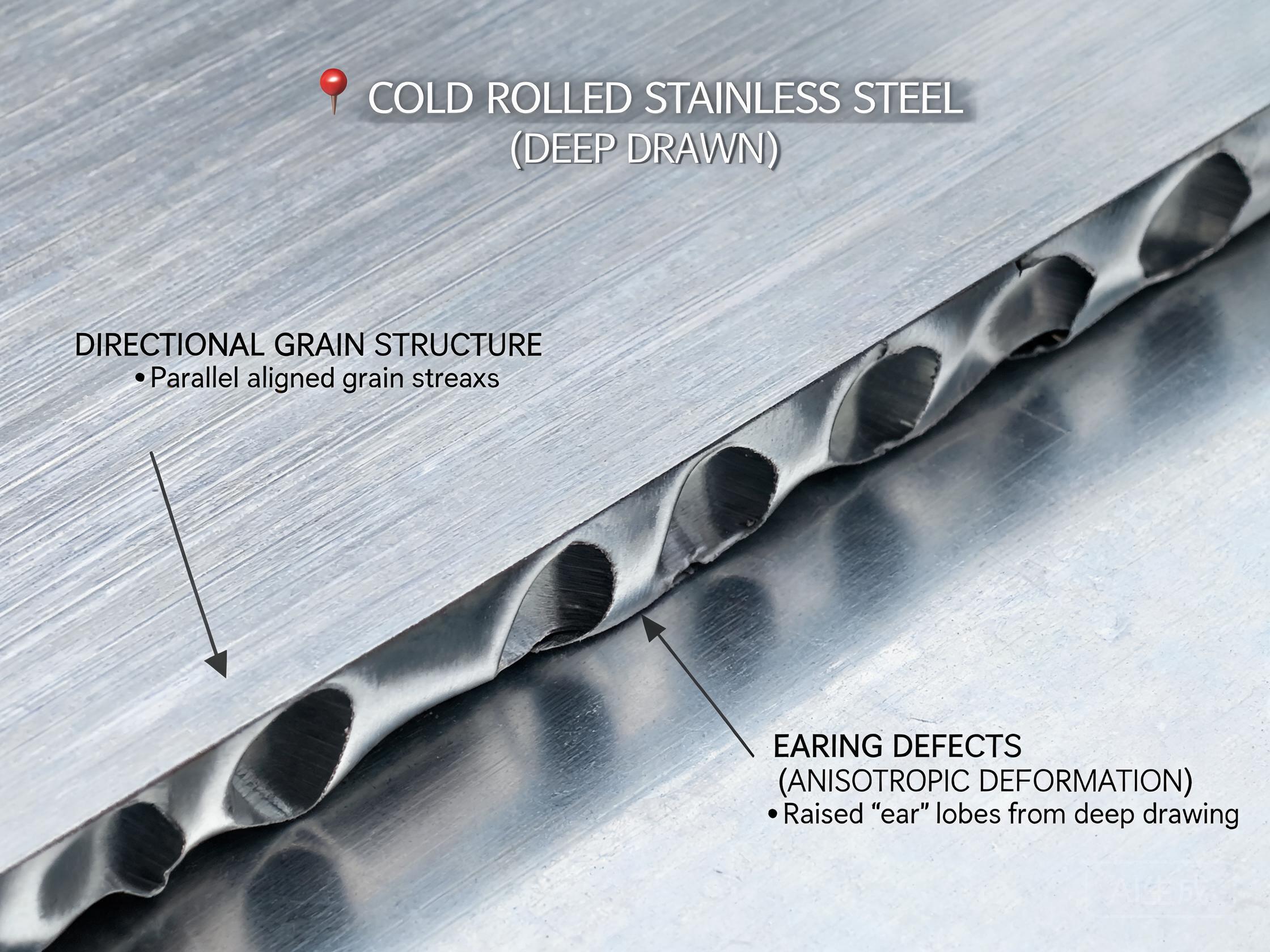
Short answer: Anisotropy means stainless steel behaves differently depending on which direction you pull or punch it. The number that predicts this is planar anisotropy Δr — close to zero means uniform, far from zero means earing and feather edges. 301 and 201 have the worst anisotropy, 304L and 316L the best. Control it by specifying Δr on the RFQ, buying well-annealed coil stock, and adding a light skin pass if you need symmetrical forming.
This is the master problem behind earing, feather edges, wall thickness variation and punch force variation across a run. Every forming defect that changes with direction traces back to anisotropy, and every stainless steel user hits it eventually.
Quick Comparison
| Grade | Typical Δr (annealed) | Typical r̄ | Earing risk | Feather edge risk |
|---|---|---|---|---|
| 304 / 304L | ±0.05 to ±0.10 | 1.9 | Low | Low |
| 316 / 316L | ±0.03 to ±0.08 | 2.0 | Very low | Very low |
| 201 | ±0.15 to ±0.25 | 1.5 | High | Medium-High |
| 301 | ±0.15 to ±0.30 | 1.6 | High | High |
| 430 | ±0.20 to ±0.30 | 1.2 | Very high | Medium |
Higher r̄ means better deep drawability (the material thins uniformly instead of necking). Lower Δr means less direction-dependent behavior. 316L has the best combination of both because molybdenum and higher nickel stabilize a more random austenite texture.
What Buyers Should Evaluate
- Ask for full Δr and r̄ values from tensile coupons at 0°, 45° and 90° to rolling direction. If the supplier does not run this test, they cannot guarantee low anisotropy and you should test a sample before commitment.
- Distinguish between normal anisotropy r̄ (affects deep drawability) and planar anisotropy Δr (affects earing and directionality). A high r̄ is good, a low Δr is good.
- Review the blank layout for your part. Can you rotate the blank to align critical forming features with the better-performing rolling direction? This is free if you plan it before the die is cut.
- For stamping parts with critical edge symmetry (spring clips, contacts), specify the skin-pass temper from the mill — a 0.5–1.0 % thickness reduction after annealing removes the strongest rolling texture and reduces feather edges.
Common Purchasing Mistakes
- Specifying “stainless steel sheet” without direction-specific requirements, then blaming the stamping tooling for the feather edges. The die can only control burr height by adjusting clearance, but it cannot fix an underlying Δr = 0.22. The fix starts at the material — specify Δr ≤ ±0.10 and run a 1 % skin pass.
- Buying 301 to “save nickel cost” compared to 304L. Yes, 301 is 15–20 % cheaper, but the higher Δr (0.20 vs 0.08) means 3x more earing, 20 % more scrap on stamping, and a secondary trimming operation that eats all the savings and then some. Do the total cost math, not the kg price.
- Trusting a “supplier says Δr is good” without measurement. Ask for the actual data. A Chinese mill’s own QC might test only one coupon at 0° and call it good — but Δr needs 0°, 45° and 90° coupons. Specify PMI + EN 10204 3.1 with full anisotropy data.
- Assuming every coil of the same grade has the same Δr. Δr changes batch by batch depending on the annealing temperature, cold reduction ratio and line tension. Test one coupon per incoming coil — a 10-minute tensile test catches the bad material before it hits the press.
Recommended RFQ Wording
Grade 304L (Werkstoffnummer 1.4307), annealed + 1 % skin-pass temper, 2B surface, thickness 0.8 mm ±0.015 mm, width 1250 mm coil. Anisotropy requirements: planar anisotropy Δr ≤ ±0.10, average normal anisotropy r̄ ≥ 1.8. Tensile coupons at 0°, 45° and 90° to rolling direction, report r0, r45, r90, Δr and r̄. EN 10204 3.1 certificate with full PMI, tensile and anisotropy data. Application: deep drawn 2-pass beverage cans + stamping of spring clip contacts, earing height ≤ 1.5 mm, stamping burr height symmetrical within ±10 %.
How Still Steel Supports the Project
Still Steel supplies cold rolled stainless steel sheet and strip in 304/304L/316/316L/430/201 with tight gauge and temper control. We provide pre-annealing, skin-pass and level-flatten processing to improve forming performance before you stamp, draw or bend. Send the grade, gauge, form (sheet or strip) and your specific forming problem to vip@still-steel.com, or discuss on WhatsApp.
Frequently Asked Questions
Why does 301 show more anisotropy than 304L?
301 (Werkstoffnummer 1.4310) is a lower-nickel austenitic stainless steel (6–8 % Ni vs 9–13 % in 304L) with higher carbon and higher nitrogen. Cold rolling creates a stronger brass-type {110}<112> texture in 301 because the lower nickel stabilizes martensite during cold work. As a result, annealed 301 has Δr up to ±0.25 and r̄ = 1.4–1.7, while annealed 304L typically sits at Δr ≤ ±0.10 and r̄ = 1.8–2.2. 301 deep drawn parts earing 2–3x higher than 304L under the same die.
What are feather edges in stamping and how does anisotropy cause them?
Feather edges are asymmetric burrs where one side of a punched blank has a tall sharp burr and the opposite side is clean. Anisotropy causes this because the shear zone does not propagate evenly through the thickness — one direction of rolling has better shear ductility than the other. This is a real problem for spring clips and electrical contacts where both edges need to be consistent. The fix: run a controlled rolling pass (skin pass) after annealing to reduce the texture gradient, or specify a 12 % shear vs tear zone ratio across both directions.
What Δr value should I specify for deep drawing?
Target Δr ≤ ±0.10 for most deep drawing applications. Values between ±0.10 and ±0.20 are acceptable if you trim the rim in a secondary operation. Above ±0.20, reject the material — the earing height will exceed 3 mm and wall thickness variations become significant. Demand that the supplier run tensile coupons at 0°, 45° and 90° to rolling direction and report r0, r45, r90, Δr and r̄ on the EN 10204 3.1 certificate.
Technical References
- EN 10088-2 Stainless steels — Part 2: Material chemical composition and physical properties
- ASTM A666/A666M Standard specification for austenitic stainless steel sheet and strip for forming
- ISO 10113 Metallic materials — Sheet and strip — Determination of plastic strain ratio
- ISO 10275 Metallic materials — Sheet and strip — Determination of tensile strain hardening exponent
- Werkstoffnummer 1.4307 (304L), 1.4310 (301), 1.4372 (201)
Reference documents support general selection and fabrication principles. The final material decision must follow the applicable contract, standard, regulation and engineering review for the specific product.