
Short answer:
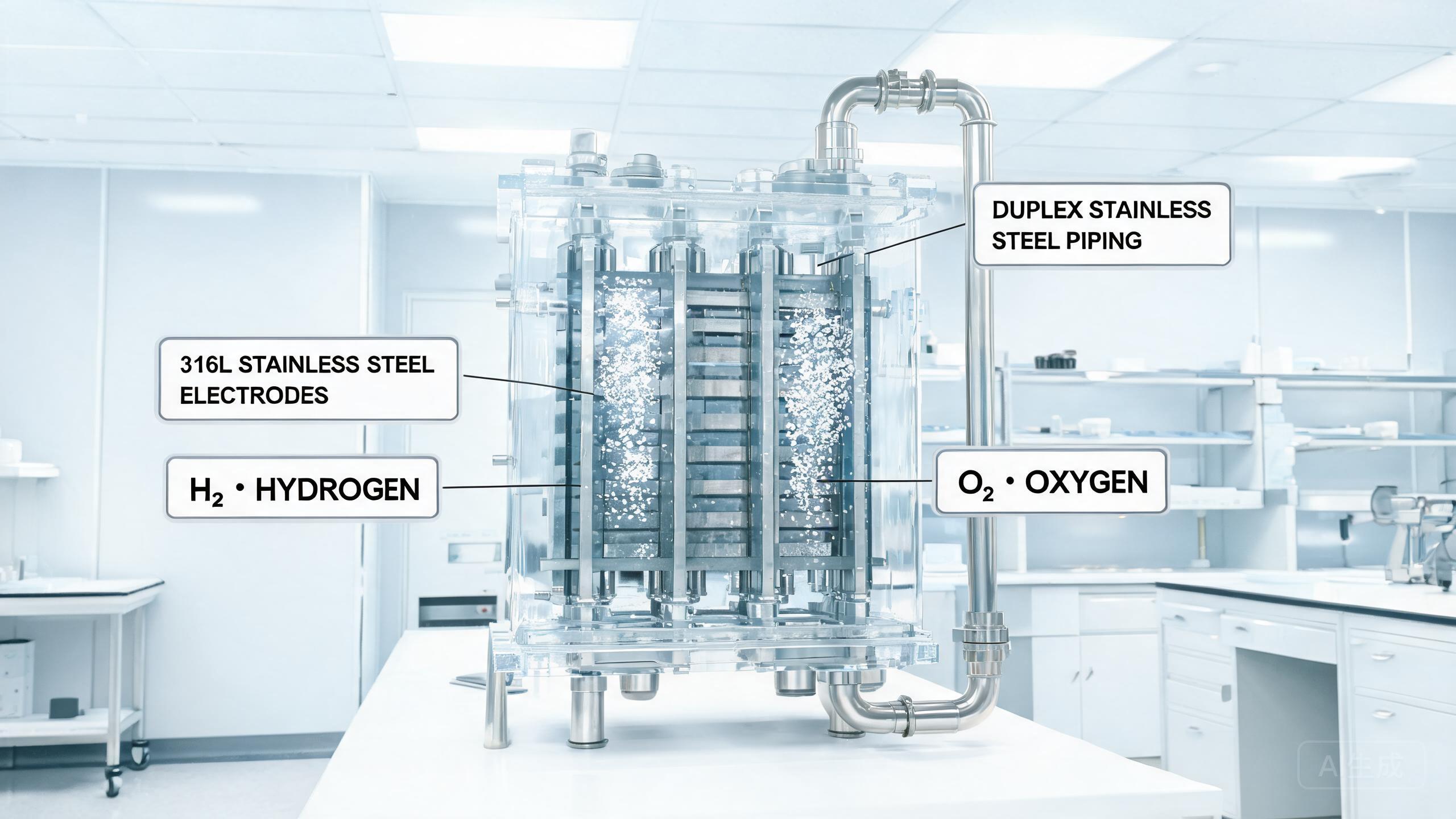
Alkaline Water Electrolysis (AWE) is the dominant mature hydrogen production technology, representing 70% of global electrolyzer capacity, and stainless steel plays three distinct roles in each electrolyzer stack. 316L (UNS S31603) forms the cathode substrate — nickel-plated to boost hydrogen evolution kinetics. Duplex 2205 (UNS S32205) handles cell frames and bipolar plates, where its high strength and alkaline corrosion resistance are both critical. 304 (UNS S30400) is acceptable for outer tanks and piping where corrosion rates are less demanding. The global AWE stainless market grew 40% in 2025, driven by China’s “Hydrogen China” initiative targeting 100 GW of electrolyzer capacity by 2030. IEC 62282-3 and China’s GB/T 31985-2015 are the governing materials standards.
Quick Comparison
| Component | Recommended Grade | UNS | Corrosion in 30% KOH @ 80°C | Required Treatment | Operating Pressure |
|---|---|---|---|---|---|
| Cathode Substrate | 316L | S31603 | <0.01 mm/year | Nickel plating (5-10μm) | 30-50 bar |
| Cell Frame / Bipolar Plate | 2205 | S32205 | <0.015 mm/year | None (duplex structure) | 30-50 bar |
| Anode Current Collector | 316L | S31603 | <0.01 mm/year | Cobalt or iron plating (optional) | 30-50 bar |
| Outer Tank | 304 | S30400 | 0.05-0.10 mm/year | Passivation | Atmospheric to 10 bar |
| Piping (liquid) | 304L | S30403 | <0.02 mm/year | None | 10-30 bar |
| Gas Separator | 316L | S31603 | <0.01 mm/year | None | 10-30 bar |
What Buyers Should Evaluate
- Electrolyte concentration. Most AWE uses 25-30% KOH at 60-80°C. If operating at higher concentrations (>35%) or elevated temperatures (>90°C), upgrade 316L to 317L or duplex 2205 for the cathode substrate.
- Cell pressure. Pressurized AWE operates at 30-50 bar. Duplex 2205’s 450 MPa yield strength is non-negotiable for cell frames to maintain pressure containment.
- Nickel plating specification. The cathode nickel layer must be 5-10μm thick per ASTM B680. Thicker plating (>10μm) wastes nickel without performance benefit; thinner plating (<5μm) develops porosity.
- China-specific note. CNPC and Sinopec’s electrolyzer projects standardize on 316L cathode substrates from TISCO/Baosteel and 2205 cell frames from Tsingtao Iron & Steel. Lead times are typically 4-6 weeks for duplex components.
- GB/T compliance. Verify material meets China’s GB/T 31985-2015 electrolyzer standard, which mirrors IEC 62282-3.
Common Purchasing Mistakes
Mistake: Using 304 for cathode substrates “to save cost.” A Shandong electrolyzer manufacturer tried 304 instead of 316L for 10MW AWE cathode substrates in 2024. The 304 corroded at 0.08 mm/year — nickel plating delaminated within 12 months, cathode performance dropped 30%, and the full 10MW system needed overhaul. Fix: 316L is mandatory for AWE cathode substrates. The 30-40% higher material cost is 10x offset by the performance and reliability benefits.
Mistake: Chinese factory trick — downgraded 316L with low nickel content. Some mills in Jiangsu supply “316L” for electrolyzer use with nickel running at 8-9% instead of the 10-14% minimum per ASTM A240. Lower nickel means worse alkaline corrosion resistance — 30% KOH at 80°C corroded these substrates at 0.03-0.05 mm/year instead of <0.01 mm/year. Solution: PMI (Positive Material Identification) spectroscopy on every coil — nickel content must be ≥10.0%. Insist on EN 10204 3.1 mill test certificates that list exact Ni and Mo content. Run a 7-day immersion test in 30% KOH at 80°C — weight loss must be <0.5 mg/cm².
Mistake: Using un-stabilized 304 for welded AWE tanks. 304 tanks without post-weld annealing develop intergranular corrosion in the heat-affected zone within 2-3 years of KOH service. Use 304L (low-carbon, ≤0.03% C) for welded components — no post-weld annealing required.
Mistake: Skipping surface passivation. All stainless components for AWE must be passivated per ASTM A380 before assembly. A passive chromium oxide film (1-3nm thick) forms naturally, but acid pickling in nitric acid solution accelerates this process and ensures uniform corrosion resistance across the entire surface.
Recommended RFQ Wording
Grade: ASTM A240 / UNS S31603 (316L) for cathode substrates
  OR: ASTM A240 / UNS S32205 (2205) for cell frames
  OR: ASTM A240 / UNS S30400 (304) for outer tanks
Application: [AWE electrolyzer cathode / cell frame / tank / pipe]
Operating medium: [30% KOH, 80°C, 30-50 bar]
Form: [sheet / plate / strip]
Thickness: [exact mm]
Surface: 2B mill finish, pickled and passivated per ASTM A380
Post-processing: Nickel plating 5-10μm (for cathodes, per ASTM B680)
Quantity: [metric tons]
Certification required:
  - EN 10204 3.1 mill test certificate (Ni ≥10% and Mo ≥2% for 316L)
  - PMI spectroscopy on every heat
  - Corrosion test report: 7-day immersion in 30% KOH @ 80°C
  - GB/T 31985-2015 compliance statement
  - ASTM A380 passivation verification report
Additional: Material must comply with IEC 62282-3 electrolyzer material requirements.
FAQ
Why is 316L preferred over 304 for AWE electrolyzer cathodes?
Alkaline Water Electrolysis (AWE) operates in 30% KOH at 60-80°C. In strong alkaline solutions, 316L (UNS S31603) has a corrosion rate of <0.01 mm/year while 304 (S30400) corrodes at 0.05-0.10 mm/year — 5-10x faster. The difference comes from 316L’s higher nickel (10-14% vs 8-10.5%) and molybdenum (2-3% vs ≤0.5%) content, which stabilize the passive oxide film in high-pH environments.
Why are AWE cathodes nickel-plated?
Stainless steel cathodes have poor inherent hydrogen evolution reaction (HER) kinetics — the overpotential is 300-400 mV higher than nickel. Electroplating a 5-10μm nickel layer onto 316L cathodes reduces HER overpotential to ~150 mV, dramatically improving electrolyzer efficiency and reducing electricity cost per kg of hydrogen produced. Duplex 2205 cell frames are not nickel-plated — their high strength and corrosion resistance alone are sufficient.
What is the role of duplex 2205 in AWE electrolyzers?
Duplex 2205 (UNS S32205) handles the structural components of AWE cell stacks — bipolar plates and cell frames that separate the anode and cathode compartments. These components operate under mechanical pressure (30-50 bar) and must resist both KOH corrosion and galvanic coupling with adjacent nickel-plated components. 2205’s high yield strength (~450 MPa) allows thinner frames while maintaining dimensional tolerance.
CTA + Technical References
Send your grade, dimensions, annual volume and application to vip@still-steel.com, or contact us. We supply 316L and 2205 per ASTM A240 for alkaline water electrolyzer projects across China’s Hydrogen China initiative.
References:
- IEC 62282-3: Fuel cell technologies — Part 3: Fuel cell power systems for stationary applications
- GB/T 31985-2015: Alkaline water electrolysis hydrogen generator
- ASTM A240 / A240M: Standard specification for chromium and chromium-nickel stainless steel plate, sheet, and strip
- ASTM A380: Standard practice for cleaning, descaling, and passivation of stainless steel parts
- ASTM B680: Standard specification for autocatalytic nickel-phosphorus plating
- See also: Hydrogen storage stainless steel
Technical References
- ASTM A240M - Standard Specification for Chromium and Chromium-Nickel Stainless Steel Plate, Sheet and Strip
- EN 10088-2 - Stainless steels. Technical delivery conditions for sheet/plate and strip
- ASM International - Handbook Series, Volume 1: Properties and Selection: Irons, Steels, and High-Performance Alloys