
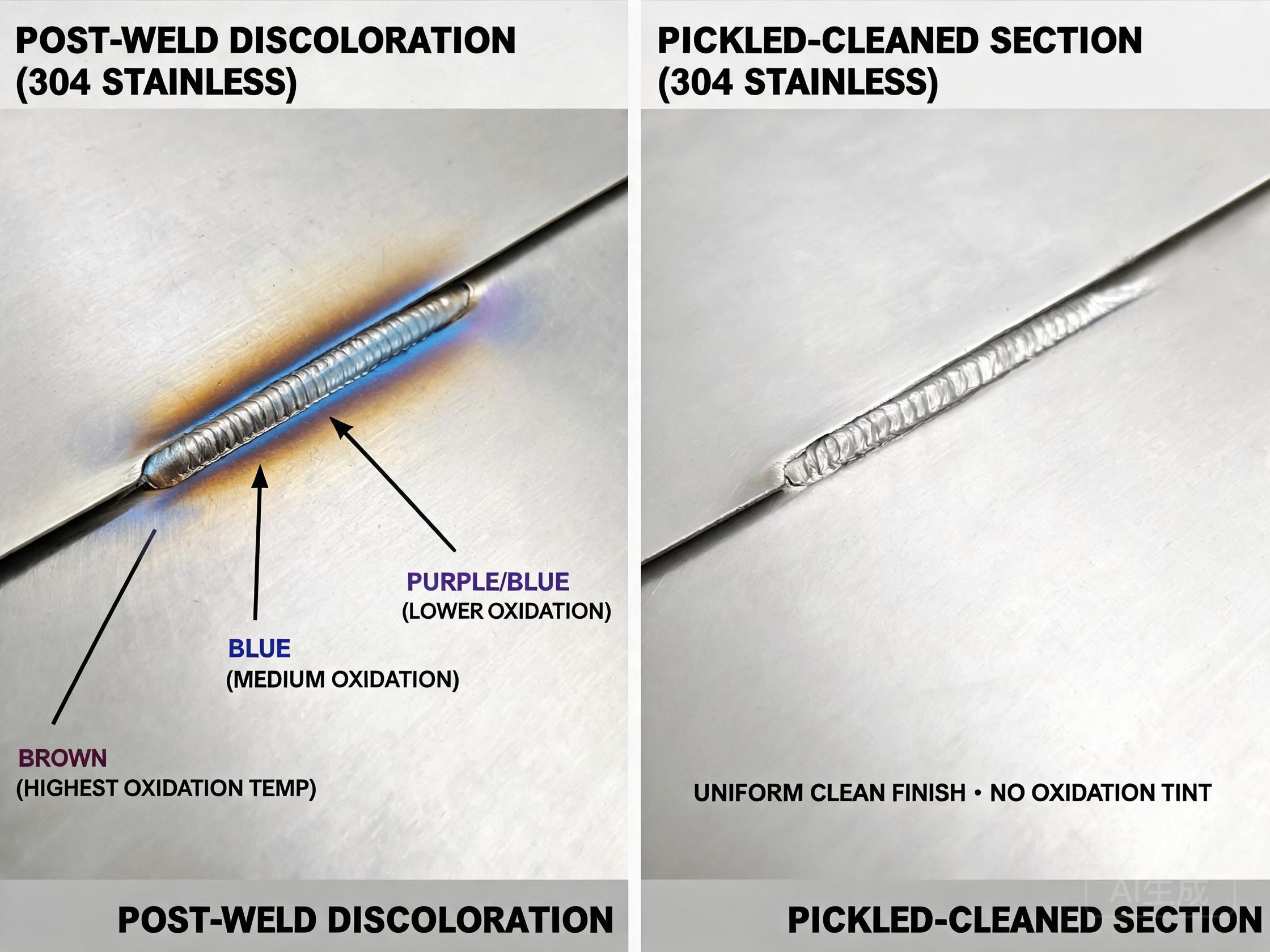
Short answer: That blue-brown discoloration you see next to a weld is not just ugly — it is chromium-depleted metal that will rust in service. Post-weld cleaning removes heat tint and restores full corrosion resistance. The rules are simple: stainless steel brush (not carbon), pickling paste for heavy tint, glass bead blasting for cosmetic parts, and no carbon steel tools anywhere near the weld area. Skip this and your stainless steel weld rusts before the rest of the plate.
Heat tint is the number one cause of stainless steel weld failure in service. A 304 plate with 18% chromium is fully corrosion-resistant. Heat tint reduces surface chromium to 8-10%, below the 12% minimum needed for passivity. Every weld you make creates a heat-tinted zone. Clean it.
Quick Comparison
| Cleaning method | Use case | Pros | Cons |
|---|---|---|---|
| Stainless steel wire brush | Light heat tint, after pickling | Fast, no chemicals | Can leave deep scratch lines |
| Pickling paste (HNO3 + HF) | Heavy heat tint, duplex stainless | Most effective for tint removal | Toxic fumes, must neutralize |
| Glass bead blasting | Cosmetic parts, architectural | Produces uniform satin finish | High cost, not for tight tolerances |
| Citric acid passivation | Food/pharmaceutical | Safe, no toxic waste | Only passivates, does not remove heavy tint |
| Nitric acid passivation | Marine, industrial | Strong passivation | Corrosive, PPE required |
| Stainless steel grinding disc | Heavy slag/spatter removal | Fast material removal | Can overheat, create new tint |
Pickling paste is the gold standard for heat tint removal. Apply with a brush, wait 15-30 minutes, rinse with water and neutralize with baking soda. For duplex stainless (2205/2507), use a stronger formulation — standard austenitic paste may not fully remove duplex heat tint.
What Buyers Should Evaluate
- Does the fabricator have a dedicated post-weld cleaning station with stainless steel brushes only?
- Do they store carbon steel tools completely separate from the stainless welding area?
- Can they provide a heat tint removal test coupon — welded, cleaned, then sprayed with copper sulfate solution (a 15-second color change indicates contamination)?
- For food/pharma applications, do they follow ASTM A380 (cleaning and passivation of stainless steel parts)?
- Is pickling paste disposal handled properly, or is it dumped down the drain illegally? Illegal dumping from small factories is common — ask for a disposal receipt.
A copper sulfate spot test is the fastest contamination check. If the cleaned weld area turns red-brown within 15 seconds of applying copper sulfate, iron contamination (from a carbon brush or disc) is present.
Common Purchasing Mistakes
- A China factory trick: using carbon steel wire brushes on stainless welds, then spraying a “stainless steel coating” on top. The coating flaks off in 6 months, and underneath is rust from the carbon brush contamination. Specify “dedicated 304 stainless steel brushes only” and require a copper sulfate spot test on every batch.
- Skipping pickling paste because “the fabricator says it’s not needed for 304.” Heat tint is heat tint — it forms on every stainless steel weld regardless of grade. The fabricator just wants to save ¥5 per part in paste cost. Add cleaning cost to your budget, not your scrap cost.
- Confusing glass bead blasting with sand blasting. Sand blasting uses silica sand with iron oxide impurities that embed in stainless steel. Glass bead blasting uses pure glass spheres. Specify “glass bead blasting only, no silica sand, no steel shot.” All three give a similar visual finish but only glass bead is stainless-safe.
- Applying pickling paste without rinsing and neutralizing. Residual pickling paste eats through the passive layer and causes pitting corrosion within 12 months. The cleaning procedure must include: paste application → 15-30 min → rinse → baking soda neutralization → final rinse → passivation.
Recommended RFQ Wording
“Please supply cold rolled 304L/316L stainless steel sheet per EN 10088-2 with EN 10204-3.1 test reports. Post-weld cleaning requirements: all weld seams and heat-affected zones shall be cleaned of heat tint, slag and spatter using approved methods. Allowed tools: 304 stainless steel wire brushes (new or dedicated), pickling paste (HNO3-HF formulation), glass bead blasting with ≥200 mesh glass spheres, aluminum oxide abrasive discs. Prohibited: carbon steel brushes, steel wool, iron-based abrasives, silica sand. After pickling: rinse with deionized water, neutralize with 5% baking soda solution, rinse again. Passivation: citric acid 15% solution, 45°C, 30 minutes, per ASTM A380. Copper sulfate spot test required on 10% of parts to verify no iron contamination.”
Frequently Asked Questions
Why does stainless steel discolor after welding (heat tint), and does it matter?
Heat tint is the blue, brown or purple discoloration that forms within 50mm of a weld seam. It happens when welding heat reduces the chromium content in the surface layer (chromium depletion below 12%). Stainless steel needs 12% minimum chromium to form its protective chromium oxide passive layer. Heat tint has only 8-10% chromium, so it corrodes first — heat-tinted welds rust within 6-12 months in humid environments.
What tools are allowed and prohibited for post-weld cleaning?
Allowed: stainless steel wire brushes (304 or 316), pickling paste, nitric-hydrofluoric acid solution, glass bead blasting (not steel shot), abrasive discs with aluminum oxide or silicon carbide, passivation citric or nitric acid. Prohibited: carbon steel wire brushes, steel wool, iron-based abrasives, grinding discs used on carbon steel, sand with iron oxide. Even one stroke with a carbon brush leaves iron particles that cause rust.
Is post-weld passivation different from cleaning?
Yes. Cleaning removes visible contamination (heat tint, slag, grease, fingerprints). Passivation is a chemical treatment (citric acid 10-20% or nitric acid 20-30% solution) that restores the chromium oxide passive layer after cleaning. Cleaning is mandatory; passivation is recommended for food, pharmaceutical and marine applications where corrosion resistance must be verified.
How Still Steel Supports the Project
Still Steel supplies cold rolled stainless steel sheet and strip with pre-cut edges, beveling and pre-weld cleaning services so your fabricator can start welding immediately. We stock matching filler wires (ER308L, ER316L, ER2209) and provide material traceability via EN 10204-3.1 test reports. Send your weld joint design, grade and thickness to vip@still-steel.com, or discuss on WhatsApp.
Technical References
- ASTM A380/A380M: Standard Practice for Cleaning, Descaling, and Passivation of Stainless Steel Parts, Equipment, and Systems
- AWS D1.6/D1.6M Clause 12: Post-Weld Cleaning Requirements
- ASME BPE (Bioprocessing Equipment): 2024 Edition — Sanitary Weld Guidelines
- ISO 15715: Steel and iron — Cleaning of welds