
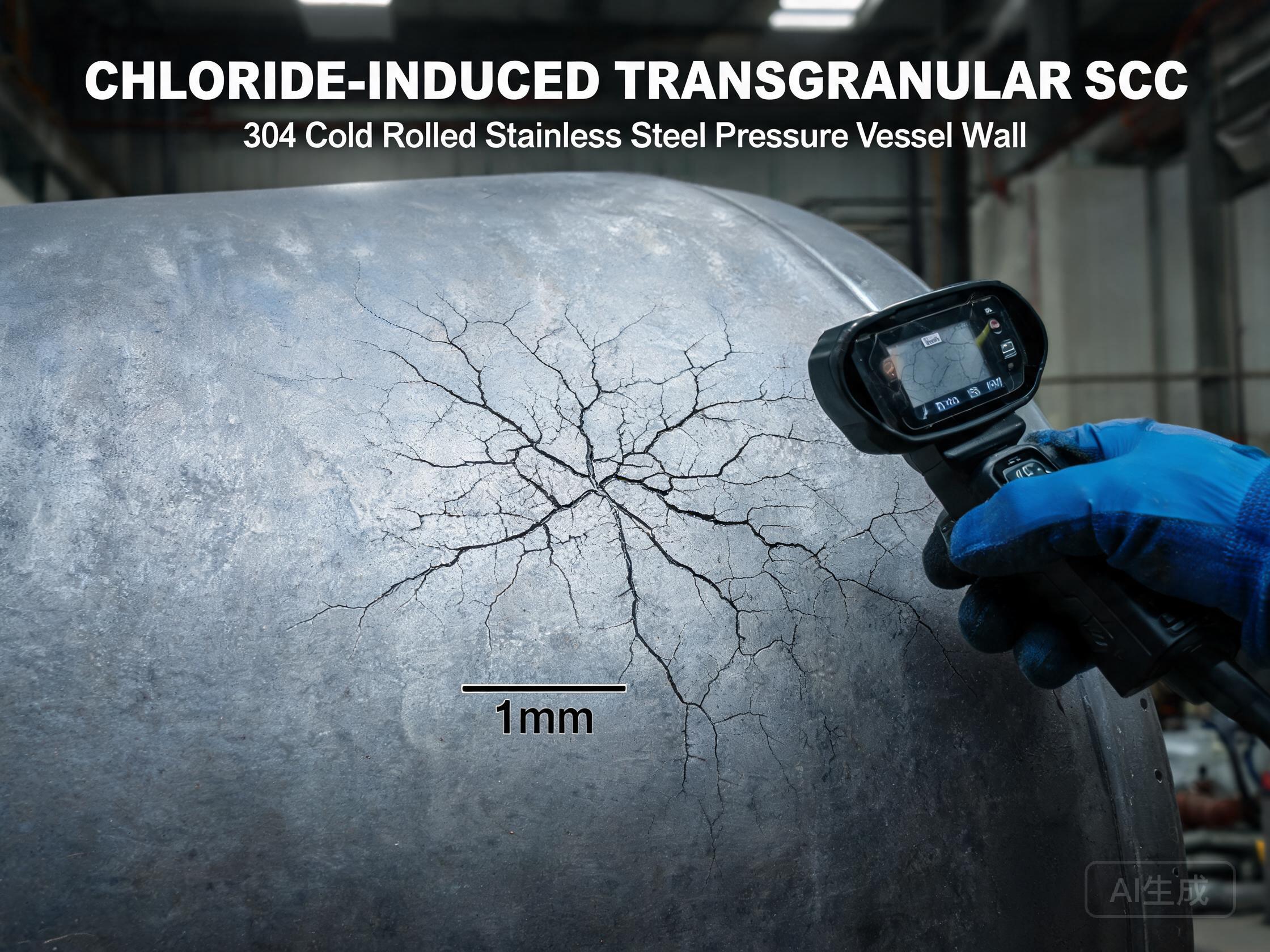
Short answer: Chloride stress corrosion cracking has hard numbers. As-delivered cold rolled 304 cracks at 10 ppm Cl⁻ and 80 °C. That is the chloride level of many municipal water supplies. Cold rolling locks in residual stress at 60-80% of yield, and that stress is enough to drive SCC at chloride levels that would be safe for hot rolled or annealed material. Stress relief annealing is not an option for cold rolled 304 in any chloride environment — it is the difference between a 2-year life and a 20-year life.
Duplex 2205 cracks at roughly 500 ppm Cl⁻ under the same conditions — 50× the 304 threshold. If your process water exceeds 10 ppm Cl⁻ at 60 °C, stop buying cold rolled 304 and either stress-relieve it or upgrade the grade.
Quick Comparison
| Grade | Chloride SCC threshold (80 °C, as-delivered CR) | With stress relief anneal | H2S + Cl⁻ combined service |
|---|---|---|---|
| 304 / 304L | ~10 ppm Cl⁻ | ~50 ppm Cl⁻ | Fail |
| 316 / 316L | ~100 ppm Cl⁻ | ~500 ppm Cl⁻ | Fail |
| 317L | ~200 ppm Cl⁻ | ~1000 ppm Cl⁻ | Marginal |
| 2205 duplex | ~500 ppm Cl⁻ | >2000 ppm Cl⁻ | Good |
| 2507 super duplex | ~2000 ppm Cl⁻ | >5000 ppm Cl⁻ | Excellent |
Temperature accelerates SCC. For every 20 °C increase above 50 °C, the chloride threshold drops by approximately 50%. At 100 °C, 304 SCC threshold is only 2-3 ppm.
What Buyers Should Evaluate
- Measure chloride level in your process water — every ppm matters. Do not guess; have a water analysis.
- For any cold rolled sheet that will operate above 50 °C with chlorides, require stress relief annealing at 1050 °C minimum.
- If H2S is present with chlorides (oil and gas, biogas, anaerobic digestion), skip austenitic grades and go straight to duplex 2205 or 2507.
- Keep operating stress below 20% of yield for 304/316 in chloride environments. Calculate it — do not assume.
Common Purchasing Mistakes
- Using cold rolled 304 for a hot water tank with 15 ppm Cl⁻. Municipal water in many regions runs 20-50 ppm Cl⁻. The cold rolled residual stress plus 80 °C water means SCC initiates in the weld heat-affected zone within 18 months. Specify 316L stress-relieved minimum.
- Skipping stress relief annealing and relying on grade upgrade. 316L without stress relief still cracks at 100 ppm Cl⁻. Annealed 304 survives 50 ppm. The annealing is cheaper than the grade jump.
- Assuming 304L is different from 304 for SCC. The “L” only addresses sensitization. Cold rolled 304L has the same residual stress and the same chloride SCC threshold as 304. You need annealing, not just low C.
- Ordering “fully annealed” sheet from a cheap mill without verifying the temperature. A 700 °C anneal relieves some stress but leaves Cr23C6 precipitated. It lowers the SCC threshold compared to a proper 1050 °C anneal. Demand annealing temperature on the EN 10204 3.1 cert.
Recommended RFQ Wording
“Cold rolled stainless steel sheet, grade 316L (EN 10088-2, ASTM A240). Solution stress relief annealed at 1100 °C minimum, water quenched. Annealing temperature recorded on EN 10204 3.1 certificate. Residual stress <10% yield strength verified by hole-drilling method. Mo minimum 2.0%. Surface 2B. Thickness 2.0mm. Application: hot water heat exchanger, chloride 80-120 ppm, operating temp 70-85 °C.”
How Still Steel Supports the Project
Still Steel supplies cold rolled stainless steel in 304/304L/316/316L/317L/2205/2507/904L with full EN 10204-3.1 material test reports. We verify PREN, Mo, Cr and Ni content by PMI before dispatch and match the grade to your corrosion environment (chloride level, temperature, pH). Send your corrosion data and grade requirement to vip@still-steel.com, or discuss on WhatsApp.
Frequently Asked Questions
What chloride concentration causes SCC in 304 stainless steel?
The threshold for as-delivered cold rolled 304 (with residual stress from cold rolling) is approximately 10 ppm Cl⁻ at 80 °C. At higher temperatures, the threshold drops further. For stress-relieved 304 (annealed at 1050 °C), the threshold rises to about 50 ppm.
Is 316 more resistant to chloride SCC than 304?
Moderately. 316 and 316L have about 5-10× the chloride threshold of 304 — roughly 100 ppm Cl⁻ at 80 °C for as-delivered, 500 ppm for stress-relieved. Mo improves pitting and crevice corrosion but only marginally improves SCC resistance. Duplex grades (2205, 2507) are the real upgrade for high chloride SCC environments.
What is stress relief annealing and when do I need it?
Stress relief annealing heats the stainless steel to 1050-1150 °C, holds for 1 minute per mm of thickness, then quenches rapidly to room temperature. This dissolves Cr23C6, eliminates residual stress from cold rolling and cold forming, and raises the chloride SCC threshold by 5-10×. You need it whenever you have cold rolled sheet, cold formed parts, or chloride levels approaching the grade threshold.
Technical References
- ASTM G123 Standard Test Method for Stress-Corrosion of Stainless Steels
- ASTM G36 Standard Practice for Stress Corrosion Testing in Boiling MgCl2
- EN ISO 7539 Corrosion of metals and alloys — Stress corrosion testing
- NACE SP0204 Stress corrosion cracking control measures
Reference documents support general selection and fabrication principles. The final material decision must follow the applicable contract, standard, regulation and engineering review for the specific product.