
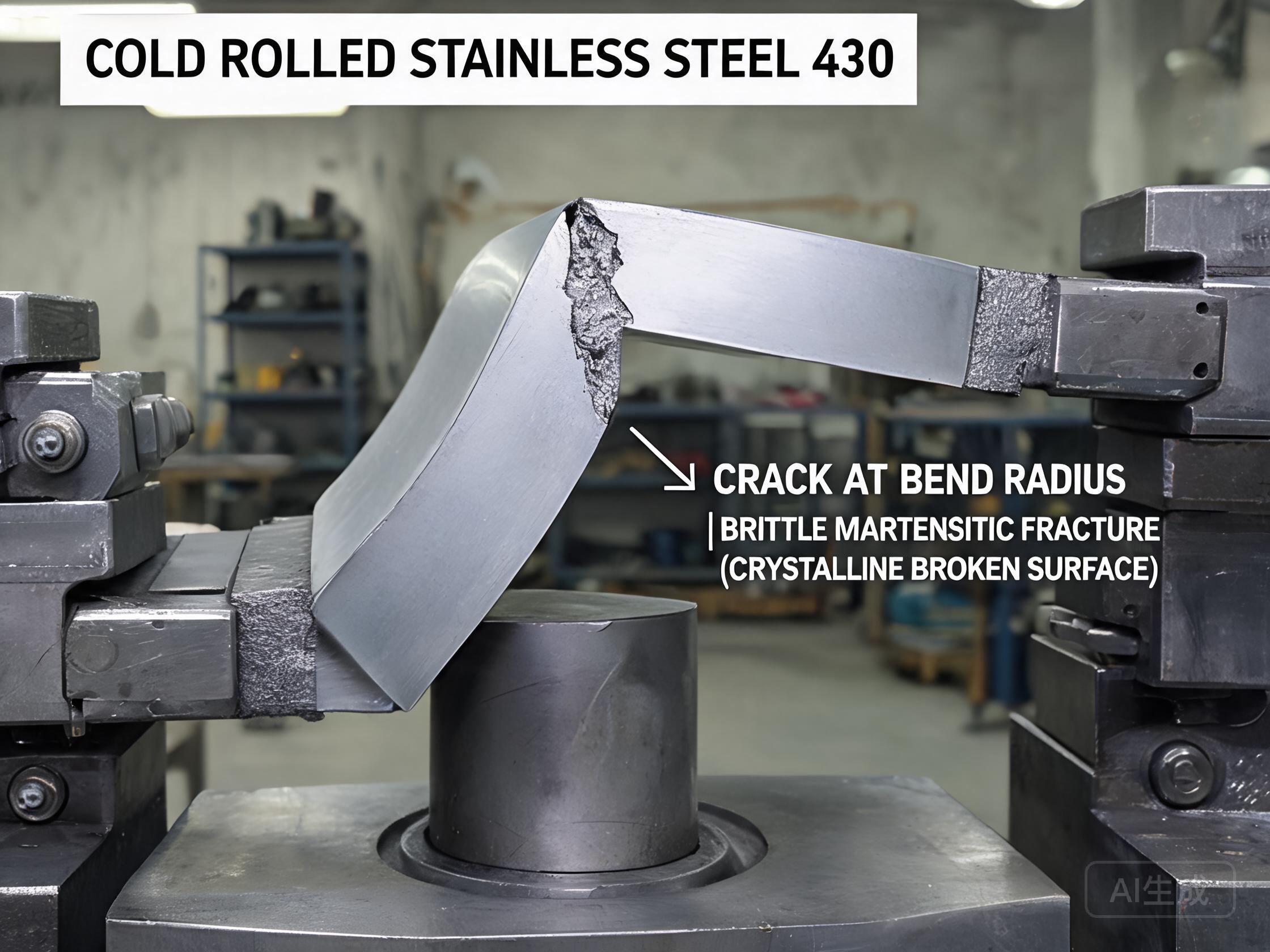
Short answer: Bend cracking is almost always one of three things: bend radius too small, bend direction wrong, or the temper is not actually annealed. 304 needs a minimum bend radius of 2t across grain, 4t with grain; 430 is better at 1.5t across grain, 3t with grain. If you crack at 2t on a label that says “annealed 304,” check the hardness — a Chinese mill may have labeled 1/4H temper as annealed.
You bend at the minimum radius that worked last week, and the new coil cracks right through the outside fiber. Same grade, same gauge, same die. Nothing changed — except the material. The problem is not the press.
Quick Comparison
| Grade | Annealed, transverse bend | Annealed, longitudinal bend | 1/4H temper, transverse |
|---|---|---|---|
| 304 / 304L | 2t | 4t | 3t |
| 316 / 316L | 2.5t | 5t | 4t |
| 430 | 1.5t | 3t | 2.5t |
| 201 | 2.5t | 5t | 4t |
| 2205 duplex | 3t | 6t | N/A (hot rolled only) |
t = material thickness. All values assume R is the inner bend radius, punch angle 90°, standard press brake speed.
What Buyers Should Evaluate
- Specify both the bend radius and the required bend direction (transverse vs longitudinal) on the drawing, then buy material accordingly. If all your bends are transverse to the grain, you have more flexibility on minimum R.
- Ask for actual yield strength and elongation at fracture from the tensile test. Annealed 304 should have yield ≤ 240 MPa and elongation ≥ 55 %. Numbers above yield 280 MPa or below 50 % elongation mean residual cold work.
- Run one bend test blank from each new coil before volume production. Bend at your target R, then un-bend and bend back — if it cracks, reject the coil.
- For tight-radius applications, consider 430 instead of 304 when corrosion resistance allows, or 301 in a full-hard temper for spring-back resistance where ductility matters less.
Common Purchasing Mistakes
- Trusting the “annealed” label from a Chinese mill without verifying. 1/4H 304 has yield 350–400 MPa, cracks at R = 4t transverse, and is 10–15 % cheaper than properly annealed 304. The mill sells it labeled “CR 304” because it technically is cold rolled — but that is not the same as annealed. Test hardness on every incoming coil and reject anything above HRB 85 for annealed 304. Always specify PMI + EN 10204 3.1 with yield strength data.
- Designing the part with all bends parallel to rolling direction. In a typical stamping layout you can rotate the blank 90° to put most bends transverse to grain. Most buyers never check this and waste 20 % of parts on cracking. Review the blank layout before finalizing the die.
- Using full-hard 301 (1100 MPa yield) for a part that needs to bend 90° at R = 2t. That will crack every time. 301 full hard is for springs, not shaped parts. Use annealed 301 for forming, then temper after.
- Ignoring surface scale after annealing. A poorly pickled anneal leaves a thin chromium oxide layer on the surface that acts as a stress concentrator. Cracks start in the oxide, not the metal. Specify “bright annealed” (BA) or “2B with pickle passivation” to ensure the surface is clean.
Recommended RFQ Wording
Grade 304L (Werkstoffnummer 1.4307), annealed temper, 2B surface, thickness 1.0 mm ±0.02 mm, width 1250 mm coil. Hardness HRB 70–85, yield strength ≤ 240 MPa, elongation ≥ 55 %. Bend test requirement: 90° bend at R = 2t transverse to rolling direction, no cracking, no orange peel. EN 10204 3.1 certificate with PMI, tensile and bend test data from coupons taken at both edges and center of the coil. Application: 3-bend L-shaped brackets, all bends transverse to grain.
How Still Steel Supports the Project
Still Steel supplies cold rolled stainless steel sheet and strip in 304/304L/316/316L/430/201 with tight gauge and temper control. We provide pre-annealing, skin-pass and level-flatten processing to improve forming performance before you stamp, draw or bend. Send the grade, gauge, form (sheet or strip) and your specific forming problem to vip@still-steel.com, or discuss on WhatsApp.
Frequently Asked Questions
What is the minimum bend radius for 304 vs 430 stainless steel?
For annealed material bent perpendicular to rolling direction (across grain): 304 / 304L = 2t, 430 = 1.5t, 201 = 2.5t, 316L = 2.5t. For bends parallel to rolling direction (with grain), multiply by 2: 304 = 4t, 430 = 3t. If you crack at 2t on 304 transverse, either the temper is wrong (1/4H instead of annealed), the gauge is thicker than specified, or the surface has a cold-rolled skin that was not removed by annealing.
Why does rolling direction matter for bending?
Cold rolling creates elongated grains and a brass-type {110}<112> texture in austenitic stainless steel. When you bend across the grain (transverse bend), the crack has to propagate perpendicular to the elongated grains and the crack tip blunts — ductility is better. When you bend with the grain (longitudinal bend), the crack can run cleanly along the grain boundaries, giving 30–40 % lower bend ductility. The difference shows up most clearly in 430 and 201, and is minimal in well-annealed 304L.
How do I know if a Chinese mill faked the anneal?
Three red flags. One: hardness > HRB 95 on 304 that is labeled “annealed” (correct annealed 304 is HRB 70–85). Two: bend test transverse to grain cracks at R = 3t when the standard says 2t. Three: the EN 10204 certificate lists annealing temperature < 1020 °C for 304 — the mill did a “stress relief” at 900 °C and called it annealed. Always run your own hardness spot check on the incoming coil and demand tensile data with yield ≤ 240 MPa for annealed 304.
Technical References
- EN 10088-2 Stainless steels — Part 2: Material chemical composition and physical properties
- ASTM A666/A666M Standard specification for austenitic stainless steel sheet and strip for forming
- ASTM A240/A240M Standard specification for chromium and chromium-nickel stainless steel plate, sheet, and strip
- ISO 7438 Metallic materials — Bend test
- Werkstoffnummer 1.4307 (304L), 1.4016 (430)
Reference documents support general selection and fabrication principles. The final material decision must follow the applicable contract, standard, regulation and engineering review for the specific product.