
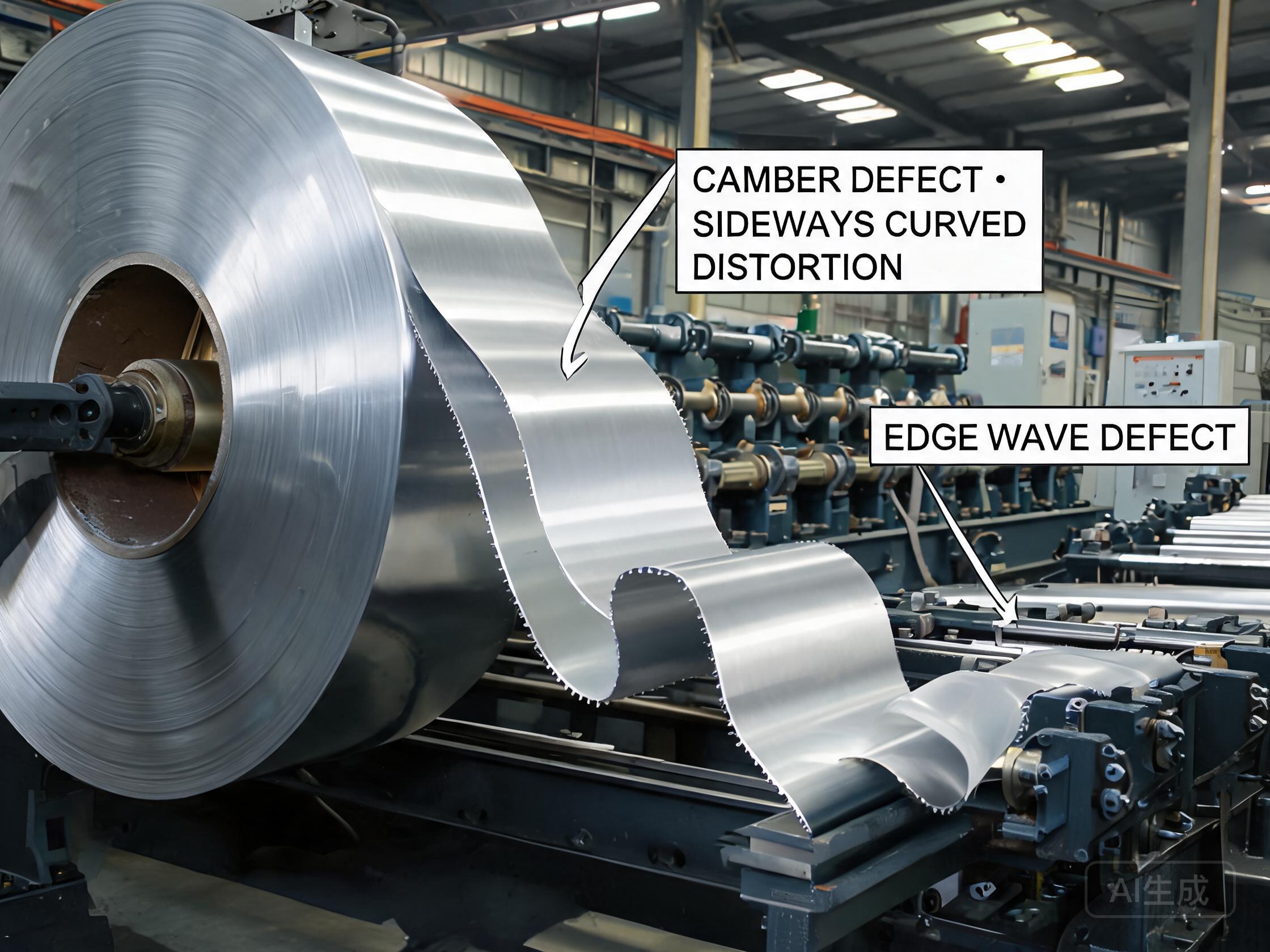
Short answer: Roll forming defects — camber, edge wave, cross bow — are almost never the roll former’s fault. They trace back to residual stress and flatness in the incoming cold rolled strip. 430 ferritic rolls form better because it has lower yield and less work hardening; 304 austenitic needs pre-annealing and level-flatten processing to deliver consistent runs. Specify flatness ≤ 5 mm/m and residual stress measurement on your RFQ, and run a trial of 500 m of strip before locking in volume.
Roll forming feeds narrow strip through 15–20 pairs of rolls that progressively bend it into channels, tubes, frames or profiled sections. It is the highest-speed forming operation — 40–80 m/min is normal — which means every defect in the incoming strip gets amplified. If the strip enters the first stand with 3 mm/m camber, it exits the last stand with 5 mm/m camber because each roll pair adds a little more stress.
Quick Comparison
| Defect | What it looks like | Primary cause | Affected grades |
|---|---|---|---|
| Camber | Horizontal side bow | Uneven coil tension, unlevel strip | 304, 430, 201 |
| Edge wave | Vertical ripple at strip edges | Excessive roll pressure, edge stress | 304 > 430 |
| Cross bow | Curved strip (arc end-on view) | Asymmetric cold rolling stress | 304, 201 |
| Springback | Section opens up after last pass | High temper, high yield | 304, 301 hard |
All four defects are stress-driven, and all four can be traced back to the material before it enters the roll former.
What Buyers Should Evaluate
- Specify flatness, not just gauge. Roll forming strip needs flatness ≤ 5 mm/m across the entire width. Measure it with a straight edge on the coil sheet-off. Reject any strip with > 8 mm/m flatness — it will cause camber or edge wave before the 10th forming stand.
- Ask whether the strip has been level-flatten or tension-leveled. Level-flatten reduces residual stress and improves flatness; 430 benefits from a light level-flatten, 304 needs it. Without level-flatten, a 10 t coil can have 150 MPa of compressive residual stress at the center, which shows up as cross bow in the section.
- For high-speed lines (> 60 m/min), prefer 430 or 201 over 304. Austenitic stainless work-hardens 30–50 % per stand, which means you either slow the line to 30 m/min or add intermediate annealing. Ferritic 430 work-hardens only 10–20 % per stand and handles 70–80 m/min consistently.
- Specify coil set — the natural curvature when the strip is off the coil. For roll forming, you want tight coil set (small inner diameter, so the strip is naturally curved into the forming direction, not against it). Chinese mills often ship wide-open coil set that fights the first stand.
Common Purchasing Mistakes
- Buying slit strip from a coil that was level-flatten before slitting. The slitting operation itself introduces edge stress — after slitting, you need another light level-flatten pass (0.2–0.3 % reduction) to remove the slitting-induced residual stress. A Chinese supplier that skips this step will deliver strip with edge wave that shows up at stand 3.
- Specifying “cold rolled strip” without any forming-relevant requirements, then fighting camber for 3 weeks on the roll former. Put flatness (≤ 5 mm/m), residual stress (≤ 50 MPa, center vs edge), temper (annealed or 1/8H, not 1/4H), level-flatten processing and coil ID (tight vs open) on the RFQ. Do not rely on verbal promises. Demand PMI + EN 10204 3.1 with flatness and stress data.
- Using 304 1/4H temper “for strength” in a roll formed section. Roll forming 1/4H 304 adds 40–60 % springback after the last pass — you either over-bend and get edge wave, or under-bend and the section does not hold shape. Use annealed 304L and add a post-forming temper or age hardening (if 17-4PH) step.
- Ignoring the effect of width-to-thickness ratio. A 50 mm wide × 0.5 mm strip will camber more easily than 100 mm × 1.0 mm because the edge area is proportionally larger. Adjust your flatness target accordingly — narrower strip needs tighter flatness, not looser.
Recommended RFQ Wording
Grade 430 (Werkstoffnummer 1.4016), annealed temper, 2B surface, thickness 0.8 mm ±0.015 mm, width 80 mm slit strip, coil ID 500 mm max. Flatness ≤ 4 mm/m across full width, residual stress ≤ 50 MPa edge vs center. Strip must be level-flatten (0.3 % reduction) after slitting. Edge condition: slit edge ≤ 0.05 mm burr, ≤ 0.1 mm camber per 5 m. EN 10204 3.1 certificate with PMI, tensile, flatness and slit edge report. Application: 18-stand roll formed U-channels, 60 m/min line speed.
How Still Steel Supports the Project
Still Steel supplies cold rolled stainless steel sheet and strip in 304/304L/316/316L/430/201 with tight gauge and temper control. We provide pre-annealing, skin-pass and level-flatten processing to improve forming performance before you stamp, draw or bend. Send the grade, gauge, form (sheet or strip) and your specific forming problem to vip@still-steel.com, or discuss on WhatsApp.
Frequently Asked Questions
What causes camber and how do I prevent it?
Camber is the side-to-side bow of the strip in the horizontal plane. It comes from either residual stress in the incoming coil (uneven tension during cold rolling) or uneven pressure across the roll forming stands. To prevent it: (1) specify flatness ≤ 5 mm/m on incoming strip measured edge to edge, (2) run a level-flatten or tension leveling pass before roll forming, (3) adjust roll pressure so the left and right edges see equal reduction. For 430 ferritic with low yield, camber disappears quickly after tension leveling; for 304 austenitic with higher yield, level-flatten is mandatory.
Why does 430 ferritic roll form better than 304 austenitic?
430 has lower yield strength (230 MPa annealed vs 260 MPa for 304), higher coefficient of friction with the rolls, and most importantly, it does not work-harden as fast. This means the strip flows more uniformly through the forming stands without springing back. 304 work-hardens by 30–50 % per forming pass, so you need more intermediate annealing or a slower line speed. 304 also has higher residual stress from cold rolling, which shows up as edge wave if the strip was not properly leveled. For high-speed roll forming (>60 m/min), 430 is the easier choice; for corrosion-sensitive parts, 304L with a pre-annealed + level-flatten treatment works.
What is cross bow and how is it different from edge wave?
Cross bow is a curved profile across the width of the strip — it looks like a shallow U or an arc when viewed end-on. Edge wave is a vertical ripple along the strip edges. Cross bow comes from uneven residual stress across the strip width (center different from edges), usually from an improperly set cold rolling pass or a slitting operation that introduced asymmetric shear. Edge wave comes from too-tight roll pressure or strip tension during forming. Fix cross bow with a level-flatten that applies higher center reduction; fix edge wave by reducing roll pressure or increasing blank holder tension.
Technical References
- EN 10088-2 Stainless steels — Part 2: Material chemical composition and physical properties
- ASTM A480/A480M Standard specification for flat-rolled stainless and heat-resisting steel plate, sheet, and strip
- ASTM A666/A666M Standard specification for austenitic stainless steel sheet and strip for forming
- Werkstoffnummer 1.4307 (304L), 1.4016 (430), 1.4372 (201)
Reference documents support general selection and fabrication principles. The final material decision must follow the applicable contract, standard, regulation and engineering review for the specific product.