
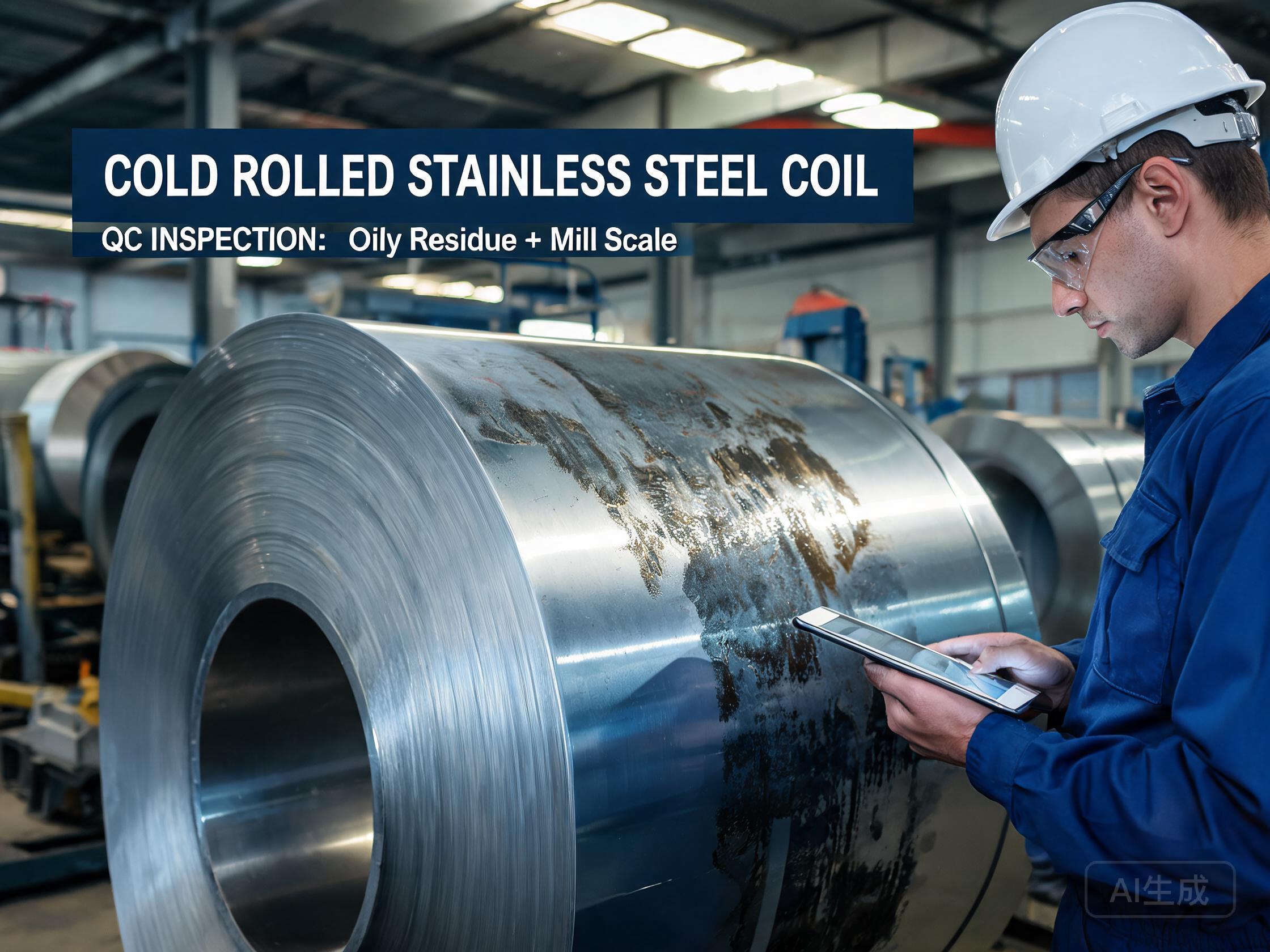
Short answer: Oil residue on cold rolled stainless steel is a factory cleaning failure, not an unavoidable part of the process. If your PVD coating peels, your TIG welds have porosity, or your powder coating chips off, look first at whether the sheet arrived with a film of rolling oil or stamping lubricant still on it. The Chinese factory trick is to peel the film in a hurry, touch the sheet with oily gloves, ship it, and blame your downstream process.
We see this every month. An importer orders 2000 m² of 304 8K for a colored PVD job. The sheet arrives with protective film. They peel the film, load it straight into the PVD chamber, and the coating peels. The PVD vendor says “the substrate is contaminated.” The sheet vendor says “we shipped clean.” Who is lying? Both, usually — the sheet vendor touched it with lubricated gloves at the slit line.
Quick Comparison
| Oil type | Source | Removal difficulty | Effect on downstream |
|---|---|---|---|
| Mill rolling oil | Cold rolling stand | Easy — burns off during anneal if done correctly | Carbon smudges if not removed |
| Mill residual oil | Incomplete annealing or degrease | Medium — alkaline degrease required | Weld porosity, PVD adhesion failure |
| Stamping lubricant (synthetic) | Forming die | Hard — trapped in burrs | Powder coating peel, weld contamination |
| Stamping lubricant (mineral) | Forming die | Medium — vapour degrease best | Same as synthetic, plus fire hazard |
| Human skin oil | Handling | Easy — just wipe with alcohol | Minor fingerprint haze only |
What Buyers Should Evaluate
- Specify “no residual rolling oil” on the PO, and require a water-break test report per lot.
- For sheet going to PVD, powder coat or weld, the mill must apply an extra degrease pass after slitting. Standard cold rolled sheet leaves the mill with an oil emulsion for rust protection — this must be removed before secondary processes.
- Insist on lint-free gloves and handling from slitting through packaging. The factory worker who eats lunch and then picks up a sheet leaves skin oil that you will later blame on the mill.
- For high-volume runs, ask for a sample of the degreased sheet before protective film is applied. Insist on the water-break test and a Ra measurement.
Common Purchasing Mistakes
- Buying from the cheapest slitter in China and expecting clean sheet. Many regional slitters do not have a continuous degrease line — they slit the coil with residual mill oil still on, lay protective film on top, and ship it. The film hides the oil perfectly. The real mill rolling cost saving is 3 RMB (0.4 USD) per m²; your downstream PVD reject cost is 200 RMB (28 USD) per m².
- Specifying “2B surface” without noting the coil was pickled and passivated after rolling. A 2B surface is supposed to be clean, but if the mill skipped the degrease step before pickling, the oil turns into a thin, carbonised film that looks fine but ruins adhesion.
- Skipping a simple incoming-inspection water-break test. It takes 60 seconds and saves you from discovering contamination at the PVD shop after 2 weeks of processing time.
Recommended RFQ Wording
Grade: AISI 304L / EN 1.4307, cold rolled, 2B surface Gauge: 1.0 mm ± 0.02 mm, width 1250 mm Surface treatment: Pickled, passivated and alkaline degreased after slitting, no residual rolling oil Cleanliness test: Water-break test shall show continuous water film (no beading) over the full width Packaging: Protective film applied over clean, dry surface, no hand contact with sheet surface after degrease Certificate: EN 10204 3.1 + water-break test report per coil
How Still Steel Supports the Project
Still Steel supplies cold rolled stainless steel sheet and strip in 304/304L/316/316L/430 with 2B, BA, No.4 and 8K surfaces. We handle pickling passivation, electropolishing and PVD coating under one roof so your surface tolerance stays consistent. Send the grade, gauge, width and your specific surface problem to vip@still-steel.com, or discuss the requirement on WhatsApp.
Frequently Asked Questions
What is the difference between mill rolling oil and stamping lubricant, and why does it matter?
Mill rolling oil is a light, low-viscosity emulsion applied during cold rolling to cool the rolls and reduce friction. It must be fully removed before annealing — if not, it burns off and leaves carbon smudges on the surface. Stamping lubricant is a heavier, synthetic or mineral-based fluid applied before forming to reduce die wear. It must be removed after forming before welding, coating or powder painting, or it will poison the weld or prevent adhesion.
How can I detect oil residue on incoming stainless steel sheet before peeling the film?
Three quick checks before you peel the protective film: (1) look for oily fingerprints or smudges on the film’s underside — lift a corner; (2) wipe a white cotton rag across the edge of the sheet — a black or brown stain means residual oil; (3) do the water-break test: spray a small area with DI water. If the water beads up, oil is present. If it sheets out uniformly, the surface is clean.
What cleaning method should I specify for pre-weld or pre-coat stainless steel parts?
For mill oil residue: alkaline degrease at 60 °C (pH 10–12), followed by 3-stage DI water rinse and forced-air dry. For stamping lubricant: the same alkaline degrease, but add a final 5-minute vapour degrease with trichloroethylene (or equivalent) to remove trapped lubricant in stamping burrs. Never use chlorinated solvents on unventilated surfaces.
Technical References
- ASTM A380/A380M cleaning, descaling and passivation of stainless steel
- ASTM A240/A240M flat-rolled stainless steel sheet
- SAE J429 cleanliness of steel surfaces for adhesive bonding
Reference documents support general selection and fabrication principles. The final material decision must follow the applicable contract, standard, regulation and engineering review for the specific product.