
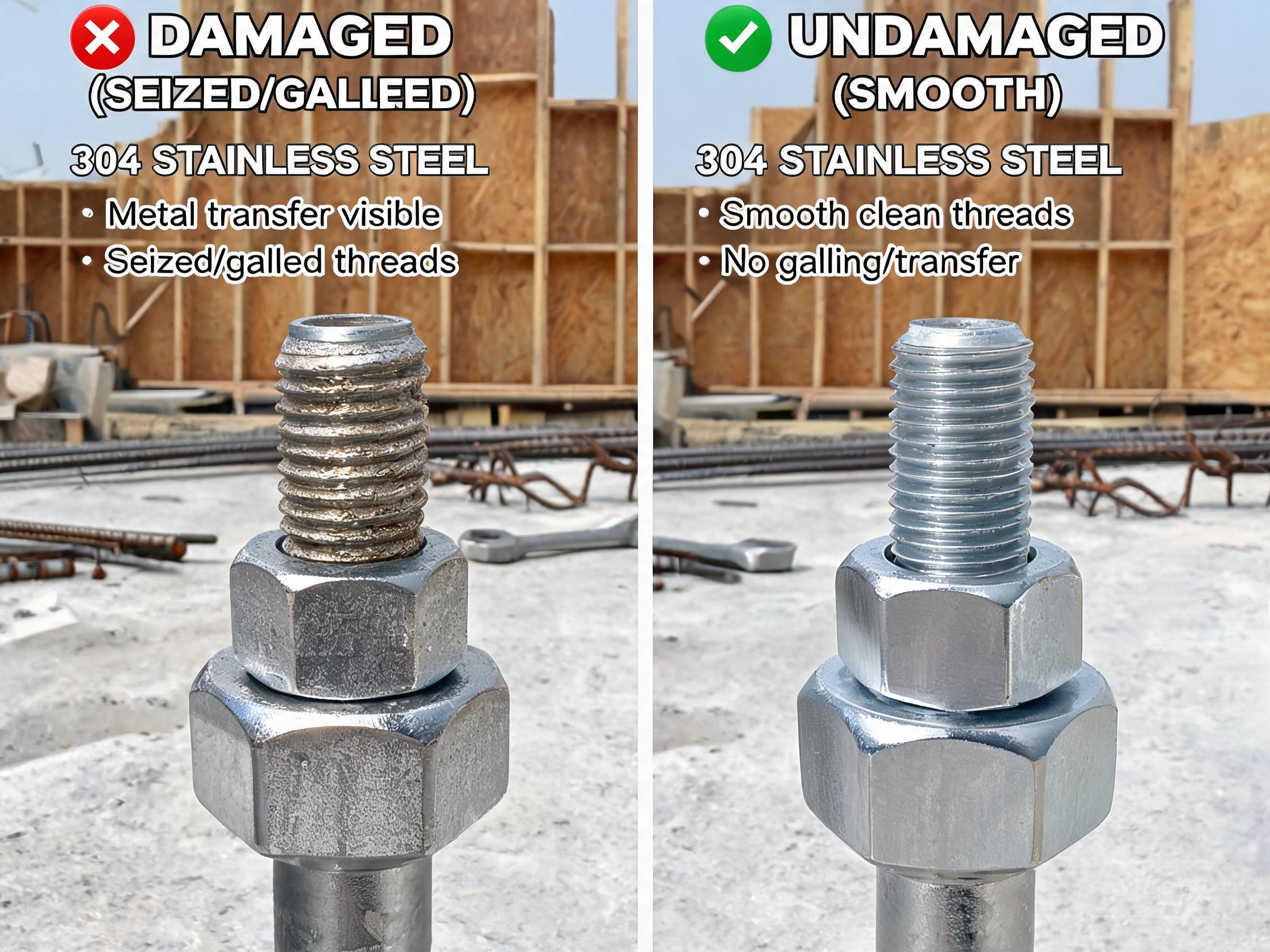
Short answer: Stainless steel construction fasteners gall because both the bolt and the nut are the same austenitic grade (304 or 316). Two identical metals rubbing under high pressure weld microscopically. The solution is not more lubricant. It is one of three things: different grades for bolt and nut, switch to 410 martensitic, or use molybdenum-based anti-seize and torque to 80% of proof load. Pick the right one before you seize a bolt on the 30th floor and your crew spends four hours drilling it out.
Construction sites install 100,000+ cold rolled stainless steel fasteners per high-rise. Each bolt carries structural load. When galling happens mid-torque, the fastener freezes at half the required tension. The joint is loose. The inspector rejects it. You grind the head off, drill the shaft, replace with a new fastener, lubricate, cross your fingers. The next one galls too. This is not a lubrication problem. It is a material selection problem.
Quick Comparison
| Fastener grade | Nut grade | Galling probability | Corrosion resistance | Cost |
|---|---|---|---|---|
| 304 (A2-70) | 304 (A2-70) | 45–60% | Good | Low |
| 304 (A2-70) | 316 (A4-70) | 10–20% | Good | Mid |
| 316 (A4-70) | 316 (A4-70) | 35–50% | Excellent | High |
| 410 (C1-70) | 410 (C1-70) | <5% | Fair | Low |
| 316 (A4-70) | 316 + Mo anti-seize | <5% | Excellent | High + lubricant |
The key insight: same-grade austenitic pairings gall 10x more than dissimilar pairings or martensitic pairings. 410 martensitic is gall-free indoors but rusts outdoors. 316 with proper anti-seize works everywhere.
What Buyers Should Evaluate
- First, pair dissimilar grades. 304 bolt + 316 nut, or 316 bolt + 304 nut. This alone drops galling from 50% to 15%.
- For dry, indoor construction: 410 martensitic is gall-proof and cheaper. Do not use 410 outdoors or in coastal areas.
- For outdoor or coastal construction: 316 bolt + 316 nut + molybdenum disulfide anti-seize. Galling rate drops to below 5%.
- Thread pitch: coarse pitch (M16 × 2 vs M16 × 1.5) gall 40% less. Use coarse pitch for structural joints whenever the specification allows.
- Torque control: never torque above 80% of proof load. Calibrate your torque wrench daily. Over-torque is the #1 cause of galling.
Common Purchasing Mistakes
- Buying identical 304 bolts and 304 nuts because “304 is good enough.” 304-on-304 galling at 60% is a $50,000 problem on a 10-storey building. Spend the 5% premium on 316 nuts and avoid the gall entirely.
- Using aluminum-based anti-seize compound. Aluminum electrochemically attacks stainless steel in the presence of water. After 12 months, every fastener in a coastal site is corroded beyond removal. Use copper or nickel-based compounds only.
- Specifying fine pitch threads for “better holding power.” Fine pitch gall more, require more torque, and strip the nut easily. Coarse pitch has 25% less galling and is stronger for structural loads.
- Skipping EN 10204-3.1 and PMI. A mill can label 410 on a 201 fastener — both are magnetic, but 201 galling rate is 70% because it is austenitic. Get the chemical analysis.
- Ordering “construction grade” without specifying the corrosion class. 304 fasteners corrode in 2–3 years in coastal construction. 316 is required if you are within 5 km of the ocean.
Recommended RFQ Wording
Cold rolled stainless steel construction fasteners, specification: M16 × 2 coarse pitch hex bolt grade 304 (A2-70) + hex nut grade 316 (A4-70), zinc-plated or copper-based anti-seize compound per request, surface plain, mechanical properties per EN ISO 898-1, EN 10088-2 for material, EN 10204-3.1 test report with PMI analysis, torque certification, quantity 50,000 sets, destination [your site], delivery within 30 days.
State the construction environment (indoor, outdoor, coastal, industrial) so the supplier can recommend the grade pairing and anti-seize. Put the bolt-nut grade pairing and the anti-seize type on the order — same-grade pairs gall every time.
Frequently Asked Questions
Why do my 304 stainless steel bolts and nuts keep galling even though I lubricate the threads?
Galling happens when two identical austenitic stainless steels (both 304) rub under pressure. The surface welds microscopically. Standard 304 galling rate is 60% for coarse threads and 30% for fine threads under 1000 Nm. Use dissimilar materials or switch to 410 martensitic.
Should I use 410 martensitic instead of 304 or 316 for construction fasteners?
Yes, if corrosion risk is low (indoor, dry climates). 410 martensitic galling rate is below 5%. But 410 corroded in coastal or humid outdoor environments. Use 316 with a molybdenum-based anti-seize compound if you need corrosion resistance and low galling.
What anti-seize compound and thread pitch should I specify to prevent galling?
Use a copper-based or nickel-based anti-seize (never aluminum — it electrochemically attacks stainless steel). Fine pitch threads (24 TPI vs 20 TPI) gall more, so use coarse pitch for structural joints. Keep torque below 80% of proof load.
How Still Steel Supports the Project
Still Steel supplies cold rolled stainless steel sheet and strip in the right grade and thickness for your construction fasteners with EN 10204-3.1 test reports. We provide slitting, cut-to-length, surface finishing and protective film application so you receive process-ready material. Send your specification and quantity to vip@still-steel.com, or discuss on WhatsApp.
Technical References
- ASTM A276 / A276M stainless steel bars and shapes
- EN ISO 898-1 mechanical properties of fasteners
- EN 10088-2 cold rolled stainless steel sheet and strip
- ASTM G98 galling resistance of metallic materials
- AISC 360 steel construction manual
- ICC building code stainless steel fastener requirements
Reference documents support general selection and fabrication principles. The final material decision must follow the applicable contract, standard, regulation and engineering review for the specific product.