
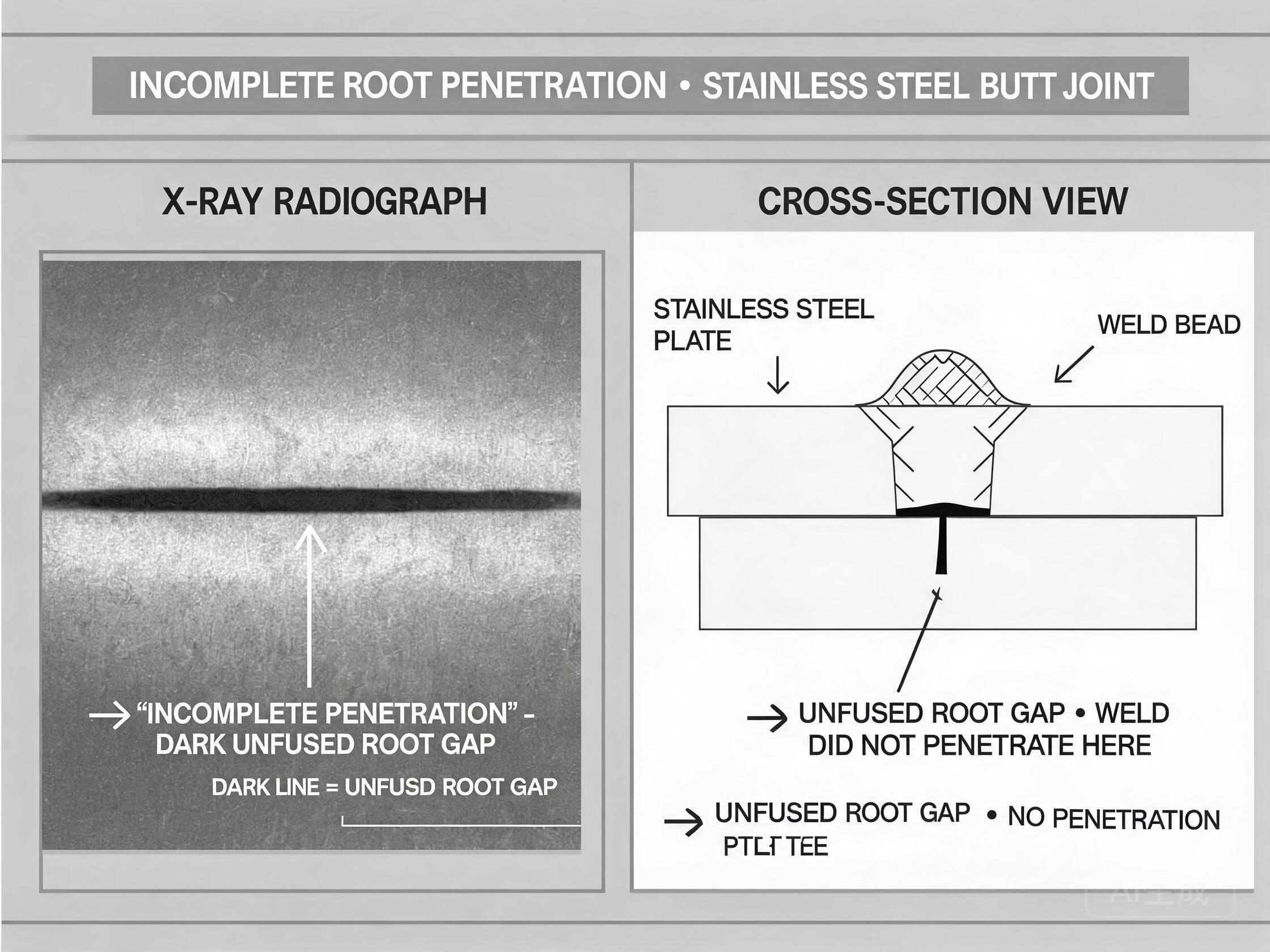
Short answer: Incomplete penetration is the gap you see at the bottom of a weld joint when the welder did not fully fuse through to the root. The causes are predictable: root gap too tight, groove angle too narrow, or back purge with O2 above 10 ppm. Specify a 2-2.5mm root gap, 60° V-groove, and verify back purge with a paper test. Get these right and you will never see IP again.
Incomplete penetration is an inspection reject on AWS D1.6 and ASME IX. It is also one of the most common fabricator shortcuts — welders tighten the root gap or skip back purge to save time, hoping VT will miss it. Root gaps show up on radiography as a dark straight line at the bottom of the weld, and on UT as a strong echo at a fixed depth. Any qualified inspector will catch it.
Quick Comparison
| Joint type | Material | Thickness | Root gap | Groove angle | Back purge |
|---|---|---|---|---|---|
| Square butt (TIG) | 304/316 sheet | 2-4mm | 1.5-2.5mm | None | Required, O2 <10 ppm |
| V-groove (TIG/MIG) | 304/316 plate | 6-12mm | 2-3mm | 60-75° | Required, O2 <10 ppm |
| V-groove (duplex) | 2205/2507 | 6-15mm | 2.5-3.5mm | 70° | Required, O2 <5 ppm |
| Double V | 304/316 | >15mm | 2-3mm | 60° each | Intermittent purge |
| Lap joint | All | Any | None (overlap) | None | Not required |
Back purge O2 levels matter more on duplex stainless steel than on austenitic. Duplex welds need O2 <5 ppm at the root to maintain the balanced ferrite-austenite ratio. Even small O2 spikes cause nitride formation and reduce toughness.
What Buyers Should Evaluate
- Did the fabricator lay out the root gap and groove angle on the part before welding, or just mark a center line?
- Do they verify back purge O2 with a meter, or just “assume it’s good”?
- For plate >12mm, do they use double-sided back gouging or one-sided TIG? One-sided TIG on thick plate has a higher IP risk.
- Have they done a macro etch cross-section on a test weld to verify root fusion before production?
- Is the welder using the specified wire diameter (1.6mm for root pass, 2.4mm for fill passes)? Too large a wire on the root gap prevents full penetration.
A test weld with macro etch is non-negotiable for anything thicker than 6mm. It takes 30 minutes on a setup weld and saves you from rework on a 100-part production run.
Common Purchasing Mistakes
- A China factory trick: the fabricator sets a 1mm root gap on 8mm plate, then blames “your drawing was wrong” when you get IP. The drawing may say “full penetration required” but never specifies root gap or groove angle. If the root gap is not on the drawing, the welder picks whatever fits — and 1mm gap with 2.4mm wire guarantees incomplete root fusion. Specify every dimension on your weld symbol per AWS A2.4.
- Skipping back purge to save argon. Back purge on a 10-meter weld joint takes 5-10 minutes of purge time and 0.5-1 m³ of argon. Many fabricators skip it entirely for MIG welds. For TIG, no back purge = root oxidation = no fusion. Add back purge time and gas consumption to your production cost calculation — it’s cheaper than rework.
- Confusing “complete joint penetration” with “full penetration.” CJP per AWS D1.6 means root fusion with no unfused root face. Full penetration can still leave a 1mm unfused root face — acceptable in some applications but not in pressure vessels or structural steel. Know the difference and specify exactly what you need.
- Using MIG spray transfer on the root pass of thick plate. Spray transfer (GMAW-S) has deep penetration but also creates a turbulent root that traps slag and can cause lack of fusion. Use TIG (GTAW) for the root pass on plate >6mm, or MIG pulse transfer (GMAW-P) which is more stable.
Recommended RFQ Wording
“Please supply cold rolled 304L or 316L stainless steel plate per EN 10088-2 with EN 10204-3.1 test reports. Weld joint preparation: V-groove 60-75° included angle, 2-3mm root gap, 2mm root face for plate 6-12mm. Root pass shall be TIG (GTAW) with 1.6mm filler wire. Back purge argon shielding with O2 verified <10 ppm via purge paper test. All welds shall have complete joint penetration (CJP) per AWS D1.6 clause 5.3. Macro etch cross-section verification required on first article. Radiography (RT) at 100% for pressure containment welds.”
Frequently Asked Questions
What is incomplete penetration in welding?
Incomplete penetration (IP) occurs when the weld metal does not fuse completely to the root of the joint. In a V-groove or square-butt joint, this leaves an unfused gap at the bottom. IP is a major defect because it reduces weld strength and acts as a stress concentrator — it propagates fatigue cracks 3x faster than a fully penetrated weld.
How much root gap and groove angle should I specify?
For TIG welding 304/316 sheet 2-6mm, use a square butt joint with 1.5-2.5mm root gap. For plate >6mm, use V-groove with 60-75° included angle, 2mm root face, and 2-3mm root gap. AWS D1.6 clause 10 has complete joint design tables. Duplex stainless steel (2205/2507) needs slightly wider root gap (2.5-3.5mm) because of higher thermal conductivity.
Why does back purge oxygen level matter for root penetration?
If root-side oxygen is above 10 ppm, the molten weld metal picks up nitrogen, which causes weld metal porosity and reduced ductility. More critically, high O2 levels at the root oxide the base metal surface, preventing the molten weld metal from wetting and fusing. The result looks like a “cold lap” at the root — visible on cross-section as a thin unfused line.
How Still Steel Supports the Project
Still Steel supplies cold rolled stainless steel sheet and strip with pre-cut edges, beveling and pre-weld cleaning services so your fabricator can start welding immediately. We stock matching filler wires (ER308L, ER316L, ER2209) and provide material traceability via EN 10204-3.1 test reports. Send your weld joint design, grade and thickness to vip@still-steel.com, or discuss on WhatsApp.
Technical References
- AWS D1.6/D1.6M Clause 10: Joint Design for Stainless Steel
- AWS A2.4: Standard Symbols for Welding, Brazing, and Nondestructive Examination
- ASME IX QW-462: Weld Joint Designs
- EN 1011-3: Arc welding of stainless steels — joint preparation guidance