
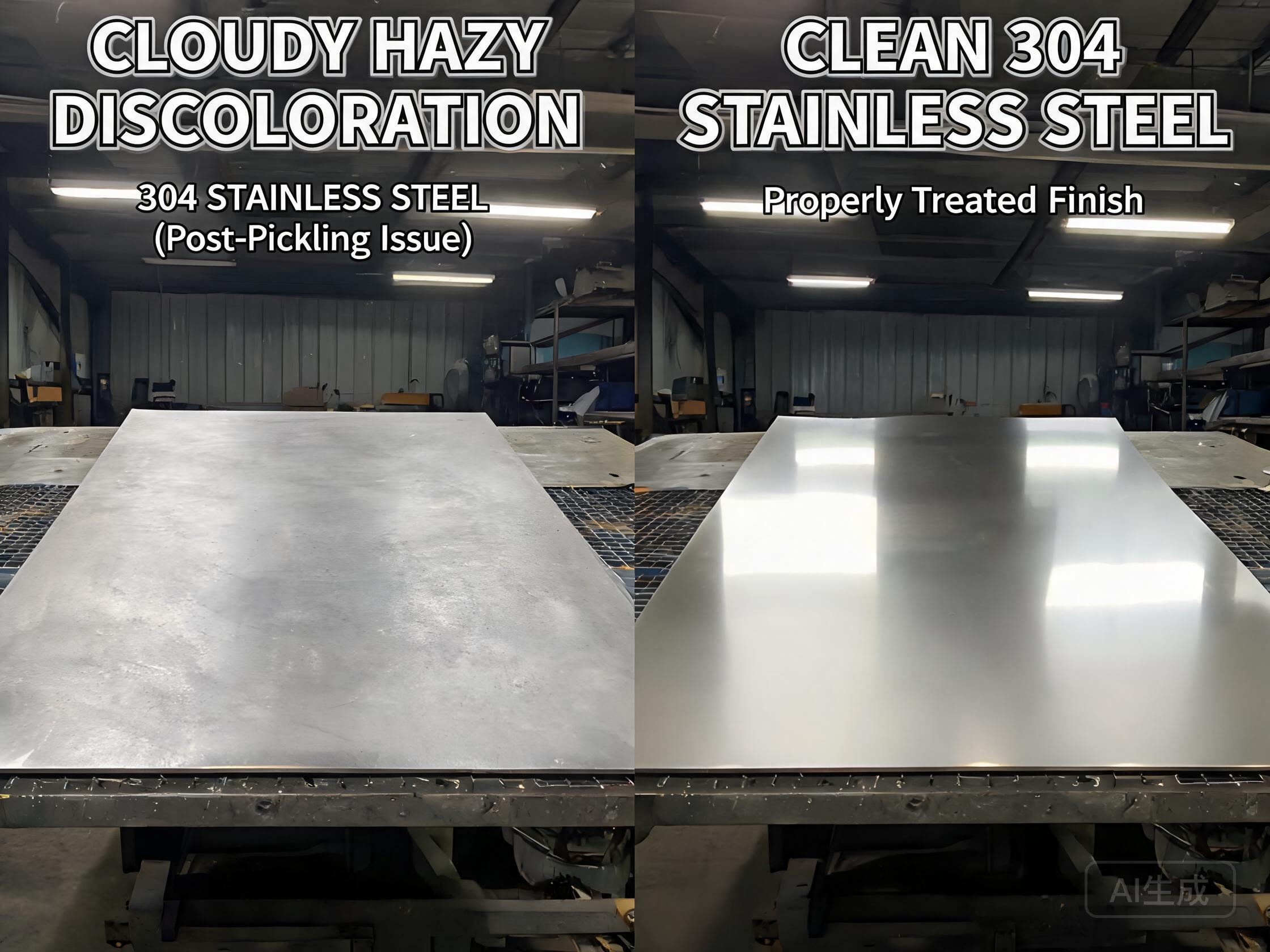
Short answer: Clouding after pickling or passivation is almost always a rinse water problem, not a chemical problem. If your 304 sheet comes out of the passivation tank looking milky or patchy, the factory rinsed it with tap water or skipped the final DI rinse. Fix it upstream by writing rinse water specifications on the PO.
This defect shows up on architectural panels, food equipment and pharmaceutical tanks three days after delivery. One side looks dull, the other side looks fine. The mill blames the passivation chemicals. They are wrong. Check the rinse water.
Quick Comparison
| Grade | Clouding risk (tap water rinse) | Clouding risk (DI water rinse) | Recommended rinse |
|---|---|---|---|
| 304 / 304L | High — chloride attacks passive layer | Very low | DI water ≤ 1 ppm chloride, 50 µS/cm max |
| 316 / 316L | Medium — Mo stabilises layer | Very low | DI water, same standard |
| 430 ferritic | Very high — thinner passive layer | Medium | DI water + alcohol final rinse |
| Duplex 2205 | Low — alloyed for chloride | Very low | DI water, same standard |
The rinse water temperature also matters. Warm rinse (40–50 °C) evaporates faster and leaves fewer mineral residues than cold rinse. Ask for warm DI water at the final station.
What Buyers Should Evaluate
- Confirm the factory has a measured water quality certificate for the passivation line. The mill should test conductivity and chloride daily — ask for a recent log.
- Distinguish pickling passivation (acid-based, removes scale, forms passive layer) from electrochemical passivation. Electrochemical is gentler on polished surfaces and less likely to cause clouding if rinsed properly.
- For 304 or 430 parts that will sit for weeks before assembly, specify a final alcohol wipe (99 % isopropanol) after the DI rinse. It displaces water film and prevents mineral spotting during storage.
- Match the passivation standard. ASTM A380 covers passivation of stainless steel, with strict rinse and drying requirements. Insist on compliance.
Common Purchasing Mistakes
- Buying from a low-cost Chinese passivation subcontractor who rinses with well water or tap water to save on DI resin replacement. A 20 cent per m² saving on DI water leaves you with 200 m² of clouded panels worth thousands of dollars. Require a conductivity meter reading and a chloride test certificate with every batch.
- Specifying “passivation” without defining the method. Nitric acid passivation, citric acid passivation and electrochemical passivation all produce different surface results. Name the method on the PO.
- Accepting “normal clouding” as a byproduct of the process. There is no such thing. Properly rinsed and dried stainless will be uniform and clear.
Recommended RFQ Wording
Grade: AISI 304L / EN 1.4307, cold rolled sheet, BA surface Gauge: 0.8 mm ± 0.02 mm Passivation: Electrochemical passivation per ASTM A380, followed by 3-stage DI water rinse Rinse water specification: Chloride ≤ 1 ppm, conductivity ≤ 50 µS/cm, temperature 40–50 °C Final step: Forced-air dry with oil-free compressed air, 99 % isopropanol wipe optional Certificate: EN 10204 3.1 + passivation batch report with water quality log
How Still Steel Supports the Project
Still Steel supplies cold rolled stainless steel sheet and strip in 304/304L/316/316L/430 with 2B, BA, No.4 and 8K surfaces. We handle pickling passivation, electropolishing and PVD coating under one roof so your surface tolerance stays consistent. Send the grade, gauge, width and your specific surface problem to vip@still-steel.com, or discuss the requirement on WhatsApp.
Frequently Asked Questions
Why does 316 stainless resist post-passivation clouding better than 304?
316 contains 2–3 % molybdenum, which stabilises the passive layer in the presence of chloride. If your rinse water has even a trace of chloride (common in coastal cities or from tap water), 304 forms a patchy, hydrated oxide film that looks cloudy. 316 keeps a tighter, more uniform passive layer that rinses clean.
Can I fix clouding that already appeared, or do I have to re-passivate?
Light clouding from improper rinsing can sometimes be polished out with a soft cloth and a pH-neutral stainless steel cleaner. Heavy or patchy clouding (usually from chloride contamination) requires a short re-passivation cycle — 20 minutes in 25 % nitric acid at 40–50 °C, followed by a full DI water rinse and forced-air dry.
What is the correct rinse water quality after pickling or passivation?
ASTM A380 calls for rinse water with chloride content below 1 ppm and a conductivity below 50 µS/cm. That means deionised water, not tap water. Tap water can run 50–200 ppm chloride depending on the city, which is guaranteed to leave clouding or spot rust within weeks.
Technical References
- ASTM A380/A380M cleaning, descaling and passivation of stainless steel parts
- ASTM A240/A240M flat-rolled stainless steel sheet
- EN 10088-2 stainless steels — Part 2: Sheet, strip and plate
Reference documents support general selection and fabrication principles. The final material decision must follow the applicable contract, standard, regulation and engineering review for the specific product.