
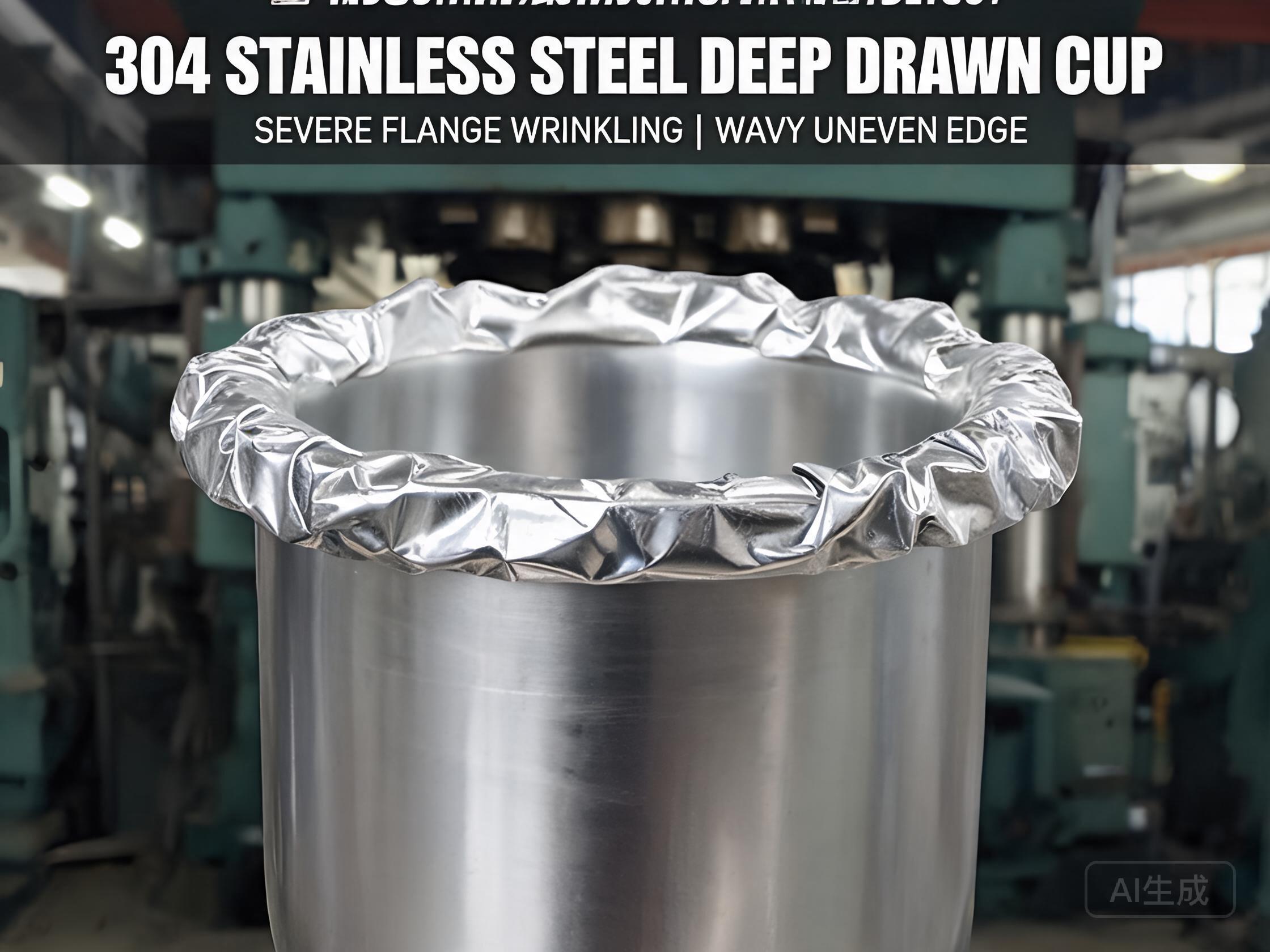
Short answer: Wrinkling in deep drawing happens when the flange has too much freedom to buckle, which means your blank holder force is too low or your die radius is too flat. 304 stainless draws well when BHF is 30–40 % of total drawing force and the m value is ≥0.01, but even 304 wrinkle if you skip the redraw pass or run the first-pass reduction ratio above 45 %. Measure the BHF on your press, test one blank, and lock it in before running the batch.
You see it after the first pull: the flange around the cup has ripple folds, the wall is uneven, and the outside diameter measures three different values. Wrinkling is not a cosmetic defect — it creates wall thickness variations that cause tears on the next draw pass and leak points in cookware or pressure vessels.
Quick Comparison
| Grade | Typical m value | LDR (first pass) | BHF as % of F draw |
|---|---|---|---|
| Annealed 304 / 304L | 0.010 | 2.1–2.3 | 30–40 % |
| Annealed 316 / 316L | 0.020 | 2.2–2.4 | 30–38 % |
| Annealed 430 | 0.005 | 1.8–2.0 | 20–25 % |
| Annealed 201 | 0.008 | 1.9–2.1 | 25–35 % |
| 1/4H 304 | 0.008 | 1.6–1.8 | 35–45 % |
LDR = limit drawing ratio, the maximum blank-diameter-to-punch-diameter ratio you can draw in one pass without tearing or wrinkling. Austenitics beat ferritics here because their higher m value distributes strain better.
What Buyers Should Evaluate
- Ask for the m value and n value (strain hardening exponent) from the supplier’s test report. These two numbers predict drawability better than tensile strength alone. If the supplier does not have m value data, ask them to send a 2 kg sample for a forming test at your facility.
- Confirm the material is fully annealed, not just “soft.” A “half-annealed” or “bright annealed but lightly cold rolled” coil will have a lower m value and wrinkle in the same die that worked on a previous coil. Demand the hardness value (HRB 70–85 for annealed 304, HRB 65–75 for 430).
- Specify blank holder force measurement. Many Chinese presses have BHF that drifts during a 4-hour run because of hydraulic drift — ask whether the press has closed-loop BHF control.
- Check the coil’s flatness and residual stress before drawing. A coil with high edge wave has uneven blank thickness after leveling, which creates local wrinkling hot spots.
Common Purchasing Mistakes
- Using a 304 1/4H temper for deep drawing “because it is stronger.” The temper raises yield strength, lowers m value from 0.010 to 0.008, and reduces LDR from 2.2 to 1.7. The buyer then runs the first pass at the same reduction ratio, gets wrinkling and tears, and blames the die. Always use annealed temper for deep drawing and add a post-forming temper operation if strength is needed.
- Buying a cheaper Chinese coil without m value documentation. The mill labels it “304 annealed” but the m value is actually 0.007 because the annealing temperature was 30 °C too low and there is residual cold work. Test three blanks from three different positions across the coil before releasing volume production. Specify PMI + EN 10204 3.1 with a dedicated m value test.
- Setting BHF too high to “prevent wrinkling” and getting wall tears. There is a narrow operating window: minimum BHF to eliminate wrinkles and maximum BHF below which the punch force does not exceed the cup wall’s tensile strength. Test the minimum force first, then increase in 5 % steps.
- Drawing 430 at an LDR above 2.0. Ferritic stainless steel has a much lower m value, so it cannot distribute strain around the flange. Split the job into two redraw passes instead of forcing one.
Recommended RFQ Wording
Grade 304L (Werkstoffnummer 1.4307), fully annealed temper, 2B surface, hardness HRB 70–85, thickness 0.8 mm ±0.015 mm, width 1250 mm coil. Forming test requirement: m value ≥0.010, n value ≥0.30, LDR ≥2.1 as per Erichsen deep drawing test with 35 % reduction ratio. EN 10204 3.1 certificate with full forming data (m, n, yield, tensile, elongation) required. Application: 3-pass deep drawn cookware, final cup diameter 120 mm.
How Still Steel Supports the Project
Still Steel supplies cold rolled stainless steel sheet and strip in 304/304L/316/316L/430/201 with tight gauge and temper control. We provide pre-annealing, skin-pass and level-flatten processing to improve forming performance before you stamp, draw or bend. Send the grade, gauge, form (sheet or strip) and your specific forming problem to vip@still-steel.com, or discuss on WhatsApp.
Frequently Asked Questions
What blank holder force should I use for 304 deep drawing?
As a starting point, set blank holder force at 30–40 % of the total drawing force for annealed 304, and 20–25 % for 430. Total drawing force for the first pass is roughly F = π·d·t·σy·(D/d − 1.3), where D is blank diameter, d is punch diameter, t is thickness and σy is yield strength. Too low BHF and the flange wrinkles; too high and the wall tears. The sweet spot is usually 5–10 % above the minimum force that just eliminates visible wrinkles on a test blank.
What is the m value and why does it matter for 304 drawability?
The m value is the strain rate sensitivity exponent in the power-law equation σ = K·εⁿ·(\dot{\varepsilon})ᵐ. For deep drawing, m measures how the material resists necking when strain concentrates — a higher m means the cup wall deforms more uniformly. Annealed 304 has m ≈ 0.01, annealed 316 ≈ 0.02, annealed 430 ≈ 0.005, and 201 ≈ 0.008. All are low compared to aluminum, so stainless drawing needs more passes and lower reduction ratios.
What punch and die radius should I use for 304 deep drawing?
Standard recommendation: punch radius Rp = 5–10 × t, die radius Rd = 7–12 × t for the first pass. A sharp die radius (< 5t) concentrates strain at the lip and causes tears; a too-flat radius (>15t) lets the flange wrinkle. For 430, use slightly larger radii (Rp = 7–12t, Rd = 10–15t) because ferritic has less uniform elongation. After each redraw, reduce the radius by 20–30 %.
Technical References
- EN 10088-2 Stainless steels — Part 2: Material chemical composition and physical properties
- ASTM A666/A666M Standard specification for austenitic stainless steel sheet and strip for forming
- ISO 11531 Sheet metal — Deep drawing — Test method for the determination of limit drawing ratio (LDR)
- Werkstoffnummer 1.4307 (304L), 1.4404 (316L), 1.4016 (430), 1.4372 (201)
Reference documents support general selection and fabrication principles. The final material decision must follow the applicable contract, standard, regulation and engineering review for the specific product.