
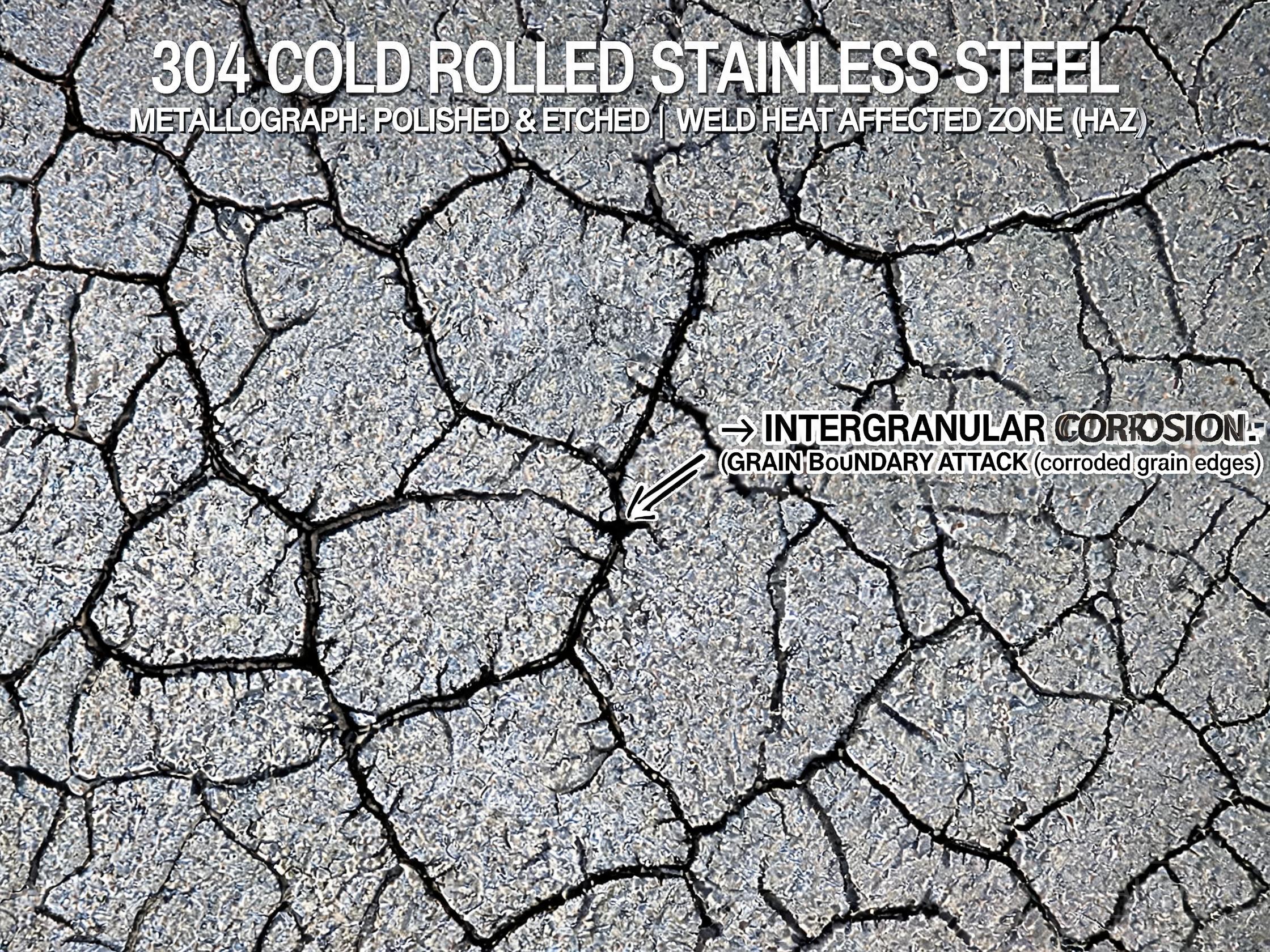
Short answer: Intergranular corrosion is a grain boundary failure. When cold rolled stainless steel spends time at 400-800 °C — during welding, annealing, or even hot service — Cr23C6 carbides precipitate at grain boundaries and steal the nearby Cr. The result: a Cr-depleted zone that corrodes in any mild acid. Buy 304L (C ≤ 0.03%) or 321 (stabilized with Ti) and you will never have this problem.
Cold rolled sheet starts clean. But if the mill does a cheap, low-temperature anneal (700 °C instead of 1050 °C), or if your fabricator welds without proper heat input control, sensitization happens. The grain boundaries become a corrosion highway. In a 0.8mm cold rolled sheet, IGC can propagate through the full thickness in 6 months when exposed to even mild process water.
Quick Comparison
| Grade | C content max | Sensitization risk at 400-800 °C | IGC resistance | Stabilizer |
|---|---|---|---|---|
| 304 | 0.08% | High — sensitizes in minutes | Poor when sensitized | None |
| 304L | 0.03% | None — Cr23C6 cannot form | Excellent | None (low C only) |
| 321 | 0.08% | None — TiC forms instead of Cr23C6 | Excellent | Ti (0.4-0.8%) |
| 316 | 0.08% | High — same as 304 | Poor when sensitized | None |
| 316L | 0.03% | None | Excellent | None (low C only) |
| 347 | 0.08% | None — NbC forms instead | Excellent | Nb (0.8-1.2%) |
The temperature danger zone is 400-800 °C. Time at temperature matters: 10 minutes at 700 °C fully sensitizes 304; 2 hours at 500 °C does the same. Solution annealing at ≥1050 °C followed by rapid cooling dissolves Cr23C6 and restores full Cr to grain boundaries.
What Buyers Should Evaluate
- For any cold rolled sheet that will be welded, specify 304L or 316L, not 304 or 316.
- Check the annealing temperature on the EN 10204 3.1 certificate. It must be ≥1050 °C. Anything lower means the mill saved energy and left Cr23C6 in the sheet.
- For service at 350-400 °C for long periods, use 321 or 347 stabilized grades — even 304L can sensitize at very long hold times near 400 °C.
- Require ASTM A262 practice A test on the first heat if you suspect a mill is cutting corners.
Common Purchasing Mistakes
- Buying “304 annealed” from a Chinese mill that did a 680 °C anneal to save energy. The sheet looks bright, but it is sensitized. ASTM A262 will show intergranular cracking within 24 hours. Always demand annealing temperature on the cert.
- Specifying 304 for a welded tank. Even a single weld pass heats the HAZ to 600 °C. The 304 HAZ sensitizes and corrodes in service — the tank leaks at the weld line within a year.
- Confusing “fully annealed” with “bright annealed.” Bright annealing (BA) is done at lower temperature in a protective atmosphere. It does not dissolve Cr23C6. If you need solution annealing, specify it explicitly — not just “annealed.”
- Assuming 304L with 0.03% C is always safe. Some mills ship 304L with C = 0.03% exactly, which is the upper limit. Always demand C ≤ 0.02% on the EN 10204 3.1 for critical applications.
Recommended RFQ Wording
“Cold rolled stainless steel sheet, grade 304L (EN 10088-2, ASTM A240). Chemical: C ≤ 0.02%, Cr 18.0-20.0%, Ni 9.0-13.0%. Solution annealed at 1050 °C minimum, water quenched. Annealing temperature recorded on EN 10204 3.1 certificate. ASTM A262 practice A test certificate required. Surface 2B. Thickness 1.2mm. Application: welded food processing tank, service temp 80 °C.”
How Still Steel Supports the Project
Still Steel supplies cold rolled stainless steel in 304/304L/316/316L/317L/2205/2507/904L with full EN 10204-3.1 material test reports. We verify PREN, Mo, Cr and Ni content by PMI before dispatch and match the grade to your corrosion environment (chloride level, temperature, pH). Send your corrosion data and grade requirement to vip@still-steel.com, or discuss on WhatsApp.
Frequently Asked Questions
What is sensitization in stainless steel?
Sensitization is the formation of Cr23C6 chromium carbide precipitates at grain boundaries when stainless steel is held in the 400-800 °C range. This depletes Cr near the grain boundaries, making those areas prone to intergranular corrosion. The material “sensitized” because it has lost its corrosion resistance at the grain boundaries.
What is the difference between 304 and 304L for sensitization?
304 has C ≤ 0.08%. It sensitizes when held at 400-800 °C. 304L has C ≤ 0.03% — the lower carbon means Cr23C6 cannot form enough to deplete grain boundary Cr. 304L is not susceptible to IGC from sensitization, even after welding or annealing in the danger zone.
How do I test if stainless steel is sensitized?
ASTM A262 practice A (boiling H2SO4 + CuSO4 test) is the standard. If the sample bends 180° without cracking, it passes. If it cracks, it is sensitized. ASTM G108 is an electrochemical test that measures the degree of sensitization more precisely.
Technical References
- ASTM A262 Standard Practices for Detecting Susceptibility to Intergranular Attack
- ASTM G108 Standard Test Method for Electrochemical Reactivation
- EN ISO 3651 Determination of resistance to intergranular corrosion
- EN 10088-2 Chemical composition and heat treatment data sheets
Reference documents support general selection and fabrication principles. The final material decision must follow the applicable contract, standard, regulation and engineering review for the specific product.