
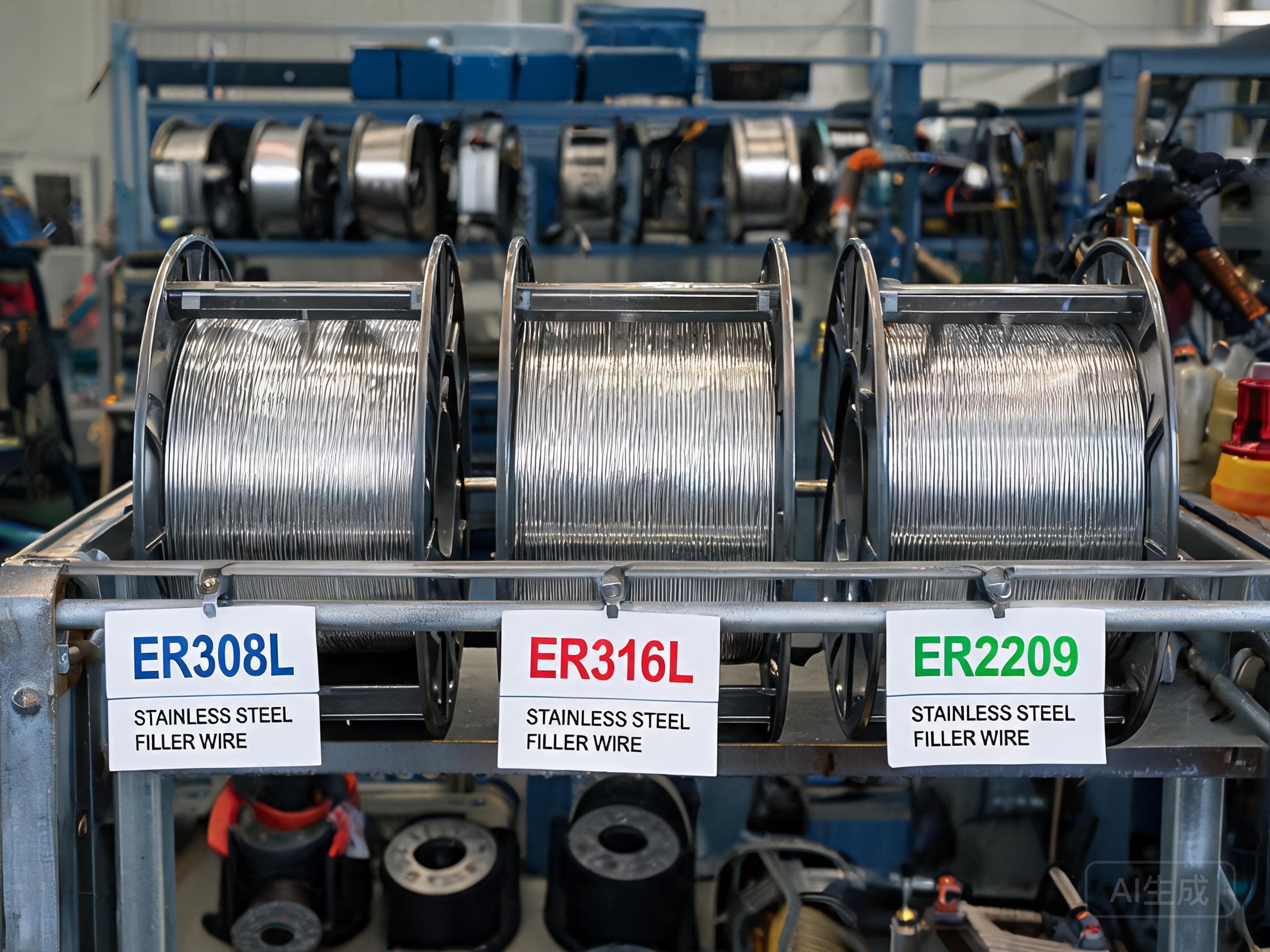
Short answer: Picking the wrong filler wire for stainless steel is a common and expensive mistake. ER304 filler for 304 gives you hot cracking risk and no ferrite. ER316 filler for 316 gives you carbide precipitation risk. The correct choices are ER308L for 304, ER316L for 316, and ER2209 for duplex — always matching PREN between base and filler. The L-grade filler costs ¥2 more per kg and saves you from weld corrosion that fails inspection.
Filler metal selection is not a cost item. It is a corrosion and cracking insurance item. A spool of ER308L costs ¥15/kg in China vs ¥12/kg for ER304. That ¥3/kg difference on 100kg of wire is ¥300. The cost of reworking 200 meters of cracked weld? ¥30,000. Do the math once.
Quick Comparison
| Base metal | Correct filler | PREN range | Ferrite content | Notes |
|---|---|---|---|---|
| 304 / 304L | ER308L | 19-22 | 5-10% | Standard for 304 welding |
| 304H | ER308H | 19-22 | 5-10% | Higher carbon, match 304H |
| 316 / 316L | ER316L | 24-28 | 3-8% | Mo addition for pitting resistance |
| 316H | ER316H | 24-28 | 3-8% | Higher carbon match |
| 321 / 347 | ER347 | 18-20 | 3-8% | Nb-stabilized filler for stabilized base metal |
| 2205 duplex | ER2209 | 35-40 | 40-60% | Matching duplex filler for balanced microstructure |
| 410 martensitic | ER410L | 13-17 | Martensitic | Low-hydrogen filler required |
| 17-4PH | ER630 | 16-20 | Martensitic + Cu | Match copper precipitation |
Note: PREN formula is %Cr + 3.3×%Mo + 16×%N. A filler with PREN equal to or slightly higher than the base metal is always correct. Lower PREN = weld corrodes first.
What Buyers Should Evaluate
- Does the fabricator have a qualified WPS specifying filler wire brand, heat number and PREN?
- Can they provide a material test report (MTR) for every spool of filler wire used?
- Have they tested the weld ferrite content with a ferrite meter (magnetic method)? Target 5-10% for austenitic.
- Do they match PREN within ±2 between base and filler? A PREN mismatch >4 guarantees weld corrosion failure in chloride environments.
- Do they use L-grade fillers (ER308L, ER316L) for all welding, or just “whatever they have in stock”?
Every spool of wire should come with a certificate. If the fabricator cannot show you a COA (Certificate of Analysis), they are using unbranded wire from a no-name mill — skip it.
Common Purchasing Mistakes
- A China factory trick: the fabricator quotes ER308L filler but uses cheaper ER304L on the shop floor to save ¥3 per kg. ER304L deposits fully austenitic weld metal with no ferrite, guaranteeing hot cracking risk. Catch this by requiring filler wire heat numbers on the WPS and a ferrite meter spot-check on produced welds (good welds are slightly magnetic — austenitic-only welds are non-magnetic).
- Using ER309L for 304 welding “because it’s cheaper for thick plate.” ER309L (23% Cr, 13% Ni) is for welding 304 to carbon steel, not 304 to 304. The higher nickel content makes the weld prone to sigma phase formation and reduces ductility. ER308L is correct for 304 regardless of thickness.
- Matching duplex base metal with austenitic filler. If you weld 2205 duplex with ER308L, the weld metal has no ferrite — losing 50% of duplex’s strength and corrosion resistance. ER2209 duplex filler (22% Cr, 9% Ni, 3% Mo) deposits balanced ferrite-austenite weld metal. Always match duplex with duplex filler.
- Ignoring the filler wire specification when dissimilar grades meet. Welding 304 to 316 needs ER309L (PREN ~25) as a compromise — it contains enough nickel for the 316 side and enough chromium for corrosion resistance. Document this on your WPS, do not let the welder choose filler by eye.
Recommended RFQ Wording
“Please supply cold rolled 304L or 316L stainless steel sheet per EN 10088-2 with EN 10204-3.1 test reports including full chemical composition and PREN. Fabrication filler metal requirements: Base metal 304/304L → ER308L filler, PREN ≥20, ferrite 5-10%. Base metal 316/316L → ER316L filler, PREN ≥25, ferrite 3-8%. Base metal duplex → ER2209 filler, PREN ≥36. PREN mismatch between base and filler shall not exceed ±2 per side. All filler wire shall be brand-named (e.g., ESAB, Lincoln, Oerlikon), supplied with Certificate of Analysis (COA), heat number logged on WPS. Spot-check ferrite content with magnetic ferrite meter on 10% of welds.”
Frequently Asked Questions
Why use ER308L instead of ER304 filler wire for welding 304 stainless steel?
ER304 filler wire has the same chemical composition as 304 base metal (18% Cr, 8% Ni) and deposits fully austenitic weld metal — no ferrite. Fully austenitic welds are prone to hot cracking from sulfur and phosphorus impurities. ER308L has slightly higher chromium (20%) and lower carbon (≤0.03%) than ER304, so it deposits 5-10% delta ferrite in the weld metal. This ferrite breaks up grain boundaries and prevents hot cracking. ER308L is the correct filler for 304, not ER304.
How do I calculate PREN and why must filler match base metal?
PREN (Pitting Resistance Equivalent Number) = %Cr + 3.3 × %Mo + 16 × %N. The base metal and filler metal PREN must be within ±2 to ensure the weld metal has equal or better corrosion resistance than the base metal. A 304 base metal with PREN ~19 needs ER308L filler with PREN ~20. If you use a filler with lower PREN (e.g., ER304 PREN ~18), the weld corrodes first in chloride environments — visible as pitting starting at the weld.
What is the difference between ER316 and ER316L filler wire?
ER316 has carbon ≤0.08% while ER316L has carbon ≤0.03%. The lower carbon in ER316L prevents chromium carbide precipitation during welding (intergranular corrosion in the HAZ), which is critical for 316L base metal and for welds in acidic environments. Always use ER316L (or ER308L for 304L) for any stainless steel welding — the L-grade premium is ¥1-2 per kg but prevents weld decay that costs thousands to repair.
How Still Steel Supports the Project
Still Steel supplies cold rolled stainless steel sheet and strip with pre-cut edges, beveling and pre-weld cleaning services so your fabricator can start welding immediately. We stock matching filler wires (ER308L, ER316L, ER2209) and provide material traceability via EN 10204-3.1 test reports. Send your weld joint design, grade and thickness to vip@still-steel.com, or discuss on WhatsApp.
Technical References
- AWS D1.6/D1.6M Clause 9: Filler Metal Selection for Stainless Steel
- ASME IX QW-404: Filler Metals for Welding Procedures
- EN 1011-3: Arc welding of stainless steels — filler metal recommendations
- ISO 15614-1: Welding procedure qualification — PREN matching criteria