
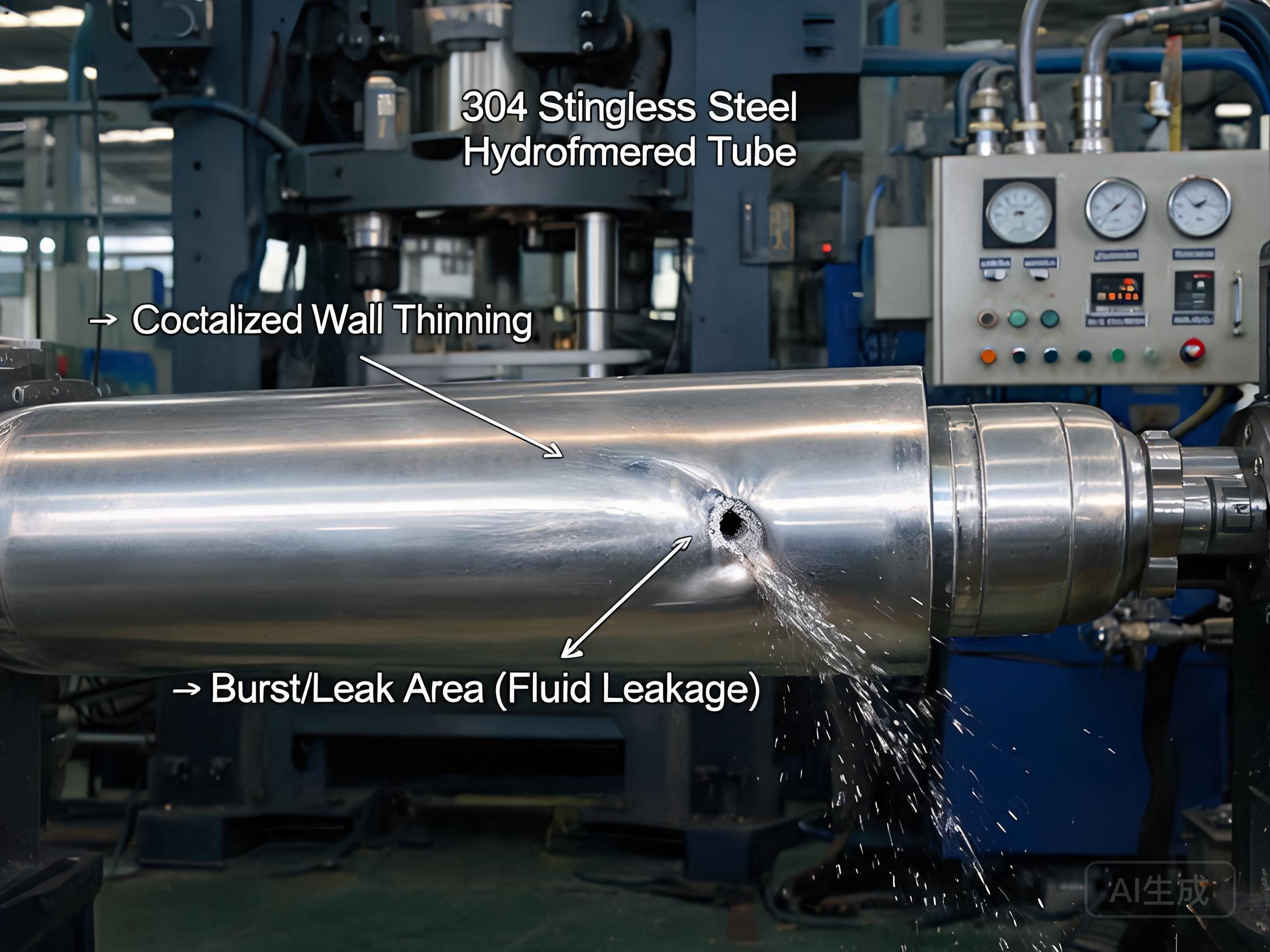
Short answer: Hydroforming leaks almost always come from local wall thinning that exceeds the material’s ductility — not from weld failures or equipment problems. 304 and 316 both handle 15–20 % thinning if you keep the corner radius ≥ 2t and use a pressure set-point below 85 % of theoretical burst pressure. Test wall thickness on the first sample, and if you see 22 % thinning at a corner, either increase the radius, lower the forming pressure, or switch from 304 to 316.
Hydroforming takes a straight or pre-bent tube, seals both ends, and pumps high-pressure water internally while closing external dies to shape it into intricate hollow parts — automotive subframes, exhaust headers, pressure vessels. The water replaces 100 tons of press tonnage, and the material flows to follow the die contours instead of stretching over a punch. But when the pressure spike at a corner hits 2000 bar and the wall goes from 1.5 mm to 1.1 mm, you get a leak.
Quick Comparison
| Parameter | Annealed 304 / 304L | Annealed 316 / 316L | Annealed 201 |
|---|---|---|---|
| Yield strength (MPa) | 210–260 | 210–270 | 260–310 |
| Tensile (MPa) | 540–620 | 580–650 | 520–600 |
| Safe thinning limit | 10–15 % | 15–20 % | 10–15 % |
| Recommended pressure | ≤ 800 bar | ≤ 1200 bar | ≤ 600 bar |
| Minimum corner R | 2t | 2t | 2.5t |
201 is not recommended for hydroforming — lower nickel content means lower n value, more anisotropy and higher risk of pinhole leaks at the weld seam.
What Buyers Should Evaluate
- Measure incoming tube wall thickness and eccentricity. A 1.0 mm tube with ±0.03 mm eccentricity will show 25 % thinning on the thin side during hydroforming at the same pressure that produces 15 % on the thick side. Specify wall thickness tolerance ≤ ±5 % and eccentricity ≤ 5 % on the RFQ.
- Ask for the forming pressure set-point as a percentage of theoretical burst pressure. Running above 85 % of burst pressure leaves zero safety margin — any local stress concentration creates a leak. Specify ≤ 75 % of burst as the normal operating set-point.
- For tube hydroforming, the weld seam matters. A poor ERW weld with residual stress will thin 2x faster than the parent metal. Specify welded tube with a post-weld anneal (or choose seamless) and demand a weld macro photo in the EN 10204 3.1 package.
- Test a coupon in the actual forming pressure range before committing to the full run. Measure wall thickness every 10 mm along the expansion zone. Do this in the first week of the program, not at trial 3.
Common Purchasing Mistakes
- Buying the cheapest 304 welded tube with no post-weld heat treatment. The ERW seam has residual stress from the welding process, and during hydroforming it thins 2–3x faster than the parent metal, creating a tiny pinhole leak that only shows up after 500 pressure cycles. Specify welded tube with a bright anneal after welding, or use seamless tube for high-pressure applications. Chinese suppliers often skip the post-weld anneal to save energy — demand a weld microstructure photo with no martensite or carbide stringers.
- Running 304 tube at high pressure (1500 bar) “because 304 is strong.” The theoretical burst pressure of 1 mm thick × 30 mm OD annealed 304 tube is around 1800 bar — so 1500 bar is 83 % of burst, too close. Step down to 900 bar (50 % of burst) and see if the part fills properly. If not, increase corner radius first; do not chase pressure.
- Using low-pressure hydroforming for a part with R = 1.5t corners. Low pressure (< 400 bar) cannot push the tube material into sharp corners, so it localizes thinning at the corner tip until the wall bursts. Step up to high pressure (1000 bar) or redesign the corner to R ≥ 2t.
- Assuming all 316 is equal. Low-nickel 316L with 9–10 % Ni (instead of 10–14 %) and molybdenum at 2.0–2.5 % instead of 2.5–3.0 % performs worse in hydroforming — lower n value, more anisotropy, more thinning spikes. Specify full-compliant 316L per EN 10088-2 with Ni ≥ 10 % and Mo ≥ 2.5 %.
Recommended RFQ Wording
Grade 304L (Werkstoffnummer 1.4307), annealed temper, 2B surface, seamless tube, OD 50 mm × 1.5 mm wt ±0.03 mm, wall eccentricity ≤ 5 %. Forming requirement: hydroformed to 60 mm OD expansion (20 % increase) with 2t corner radii, operating pressure ≤ 900 bar (50 % of burst pressure). Wall thinning ≤ 15 % post-forming at expansion and corner zones. Burst test: 10 % of batch tested to failure, minimum pressure ≥ 1600 bar. EN 10204 3.1 certificate with PMI, tensile, wall thickness profile and burst test data. Application: automotive exhaust header hydroforming.
How Still Steel Supports the Project
Still Steel supplies cold rolled stainless steel sheet and strip in 304/304L/316/316L/430/201 with tight gauge and temper control. We provide pre-annealing, skin-pass and level-flatten processing to improve forming performance before you stamp, draw or bend. Send the grade, gauge, form (sheet or strip) and your specific forming problem to vip@still-steel.com, or discuss on WhatsApp.
Frequently Asked Questions
What is the typical wall thinning limit for stainless steel hydroforming?
As a safe starting point, design for 10–15 % maximum wall thinning on annealed 304 / 304L, and 15–20 % on annealed 316 / 316L. 316 has slightly better n value (0.35 vs 0.32) and resists necking a little more. Going above 20 % thinning on any stainless grade risks rupture or, worse, a “leak before burst” failure that shows up as a tiny pinhole. Always measure wall thickness at the expansion zone after the first sample run — do not trust your FEA model alone because residual stress in the blank can shift the thinning pattern.
Does 304 or 316 have better burst pressure in hydroforming?
304 has higher yield-to-tensile ratio (0.55–0.60 vs 0.50–0.55 for 316) but 316 has slightly higher tensile strength (580–650 MPa vs 540–620 MPa for annealed). In practice, burst pressure depends more on tube wall thickness, hydroforming pressure set-point, and corner fill than on the grade alone. For the same tube geometry and forming pressure, 316 will have a slightly higher burst pressure after forming because it strain-hardens more uniformly. For exhaust applications that also need corrosion resistance, 316 is the safer pick.
When should I use high pressure vs low pressure hydroforming?
Low pressure (≤ 400 bar) is for simple expansion (10–15 % diameter increase) with straight or gently curved sections, typical wall thinning 10–15 %. High pressure (800–2000 bar) is for aggressive expansion (25–30 % diameter increase) with sharp corners (R ≤ 2t), typical wall thinning 15–20 %. If your tube needs 30 % expansion and a corner bend of R = 1.5t, use high pressure and consider a two-stage forming process with intermediate annealing. Low pressure on a sharp corner will always cause thinning spikes at the radius.
Technical References
- EN 10088-2 Stainless steels — Part 2: Material chemical composition and physical properties
- ASTM A240/A240M Standard specification for chromium and chromium-nickel stainless steel plate, sheet, and strip
- ASTM A269/A269M Standard specification for seamless and welded austenitic stainless steel tubing for general service
- ISO 11986 Automotive — Tube hydroforming — Test method for determination of forming limits
- Werkstoffnummer 1.4307 (304L), 1.4404 (316L)
Reference documents support general selection and fabrication principles. The final material decision must follow the applicable contract, standard, regulation and engineering review for the specific product.