
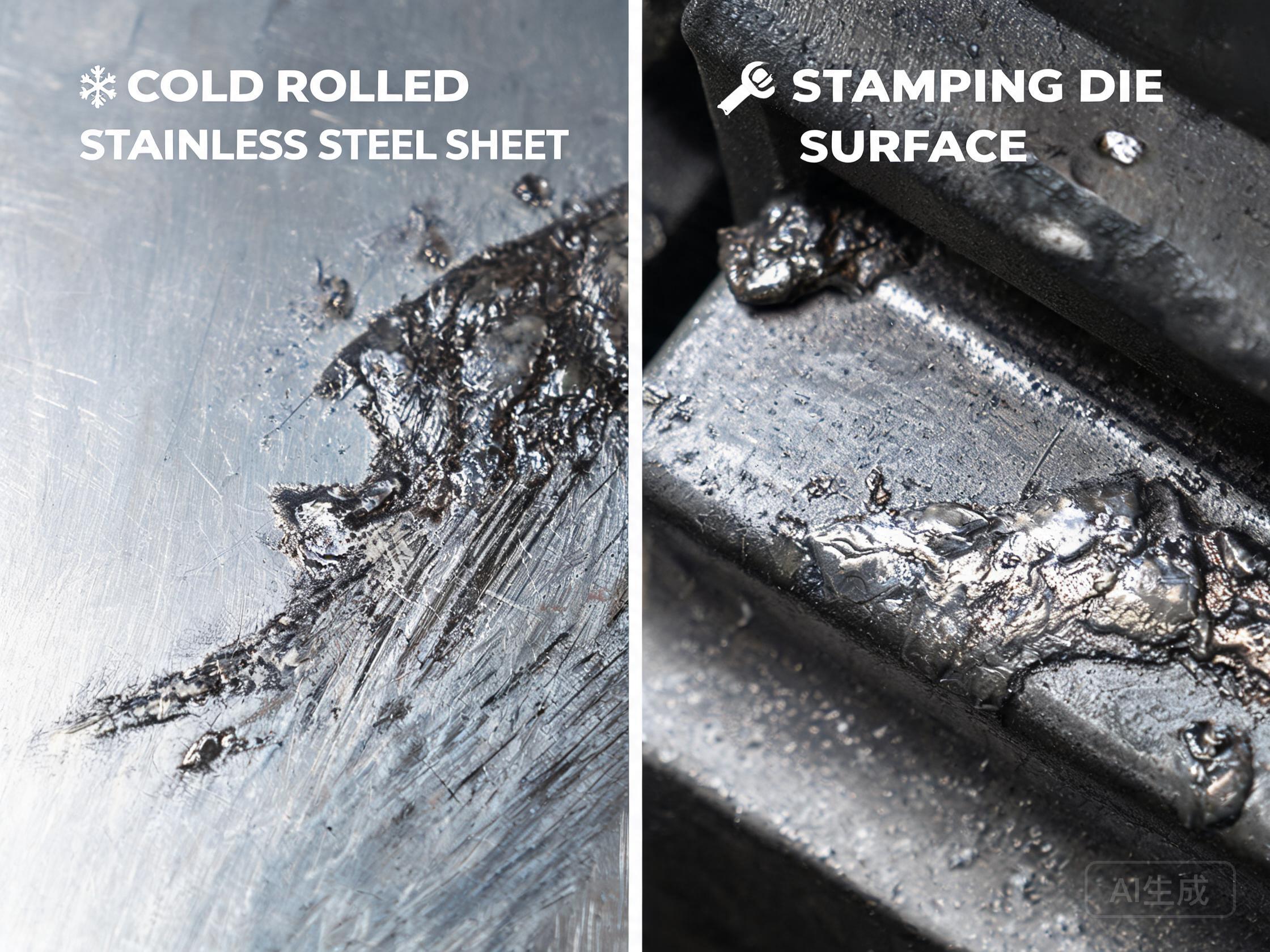
Short answer: Galling is when stainless steel cold-welds tiny chunks onto your die face, then tears chunks off the next blank and ruins both surfaces. 304 galling is roughly three times worse than 430 because of the face-centered cubic lattice and nickel content. Stop it by pairing a powder-metallurgy D2 or SKD11 die with a proper drawing compound or dry lubricant, and coat the die surface with TiCN or CrN for long runs.
Every stamping operator knows the first 50 hits look perfect, then a thin line appears on the punch radius, then the blanks start showing tiny shiny transfer spots, then the whole run has to stop while you polish the die. That line is galling — the worst form of adhesive wear. And stainless steel is the worst offender.
Quick Comparison
| Stainless grade | Galling tendency | Root cause | Die recommendation |
|---|---|---|---|
| 304 / 304L | High | FCC lattice, 8–10.5 % Ni | D2 PM + TiCN coating + sulfurized lube |
| 316 / 316L | High | Same as 304, Mo adds nothing | Same as 304, increase coating thickness |
| 430 | Medium | BCC lattice, no Ni | D2 + thin CrN coating, standard lube |
| 201 | Medium-High | Lower Ni, higher C | D2 PM + standard lube |
| 2205 duplex | Medium | Mixed lattice, Mo + N | D2 PM, watch for edge galling |
Galling rate also scales with contact pressure, die surface roughness and forming speed. A polished surface (Ra < 0.1 μm) actually gall more than a slightly textured surface (Ra 0.2–0.4 μm) because it has more real contact area.
What Buyers Should Evaluate
- Specify the stainless grade and the expected tool life, then ask the supplier what die steel and coating they plan to use. A Chinese supplier that says “we use Cr12MoV” might be using an air-hardened tool steel with coarse carbides — push for D2 (1.2379) in powder metallurgy or a documented equivalent.
- Ask about lubrication. Will the blank be pre-treated? What compound? What is the post-forming cleaning method? Galling is not just a tool problem — bad lubrication is 60 % of the cause.
- Confirm the surface roughness Ra of the incoming blank. A mirror-polished 2B surface gall more than a properly prepared 2B with a controlled Ra of 0.3–0.5 μm.
- For high-volume runs (>200,000 hits), demand a trial run of 1,000 blanks with both the die and the lubrication to validate galling performance before mass production.
Common Purchasing Mistakes
- Buying the cheapest die from a Chinese toolmaker. “Cr12” tool steel (a low-carbon, coarse-carbide cousin of D2) costs half, gall in 5,000 hits, and leaves transfer marks that ruin 10 % of the parts. Specify D2 PM or Werkstoffnummer 1.2379 and demand a hardness report (58–62 HRC) and a coating thickness report (≥2 μm TiCN or ≥3 μm CrN).
- Running stainless 304 dry or with plain mineral oil. The buyer skips the cost of drawing compound to save pennies per part, then scrapes 15 % of the batch because of galling scratches. The lubrication cost is typically 0.2–0.5 % of the part cost — the scrap is 10–30 %.
- Confusing corrosion resistance with galling resistance. 316 is more corrosion-resistant than 304 but gall exactly the same. Molybdenum does not help adhesion at the cold interface.
- Using 430 when the part needs weldability or corrosion resistance, just because 430 gall less. The material has to survive after the press, not just during it.
Recommended RFQ Wording
Grade 304L (Werkstoffnummer 1.4307), annealed temper, 2B surface, thickness 1.2 mm ±0.02 mm, width 600 mm slit strip. Die tooling: D2 powder metallurgy steel, hardness 58–62 HRC, TiCN coating ≥2 μm on punch and die radii. Lubrication: sulfurized drawing compound applied at 10 g/m² on both sides, post-forming alkaline cleaning. Acceptance criteria: 1,000-blank trial, no visible galling transfer on either die or part after trial. EN 10204 3.1 certificate with PMI and tensile test required.
How Still Steel Supports the Project
Still Steel supplies cold rolled stainless steel sheet and strip in 304/304L/316/316L/430/201 with tight gauge and temper control. We provide pre-annealing, skin-pass and level-flatten processing to improve forming performance before you stamp, draw or bend. Send the grade, gauge, form (sheet or strip) and your specific forming problem to vip@still-steel.com, or discuss on WhatsApp.
Frequently Asked Questions
Why is 304 more prone to galling than 430?
Austenitic 304 has a high nickel content (8–10.5 %) and a face-centered cubic lattice that makes cold welding to the die surface easy under high contact pressure. Ferritic 430 has no nickel, a body-centered cubic lattice, and slightly lower adhesion energy, so it gall less. 201 sits in between 304 and 430. 316 with molybdenum behaves similarly to 304 — molybdenum improves corrosion resistance but does not reduce galling tendency.
What die material should I use for stainless steel forming?
For production stamping, D2 (AISI D2, Werkstoffnummer 1.2379) in powder metallurgy form with 58–60 HRC is the standard choice. SKD11 (JIS, similar to D2) is common in Asia but has slightly wider carbide distribution. For runs over 100,000 hits, switch to Vanadis 4 Extra or Vancron 40 powder metallurgy, or a cemented carbide (WC-Co) insert in the critical radius. H11/H13 hot work tool steel is only for hot forming, not cold stamping.
Does lubrication really make a difference?
Yes, and it is cheaper than reworking a die. For 304 use a chlorinated or sulfurized drawing compound (not plain mineral oil) at 10–15 % coverage, or a PTFE-impregnated strip. For clean-room or food-grade parts where residue matters, use a dry lubricant film (molybdenum disulfide, boron nitride, or polymer coating) applied to the blank before forming. Never run stainless dry.
Technical References
- ASTM A666/A666M Standard specification for austenitic stainless steel sheet and strip for forming
- ASTM A480/A480M Standard specification for flat-rolled stainless and heat-resisting steel plate, sheet, and strip
- EN 10088-2 Stainless steels — Part 2: Material chemical composition and physical properties
- AISI D2, SKD11, Vanadis tool steel datasheets
- Werkstoffnummer 1.2379 / 1.4301 / 1.4016 / 1.4404
Reference documents support general selection and fabrication principles. The final material decision must follow the applicable contract, standard, regulation and engineering review for the specific product.