
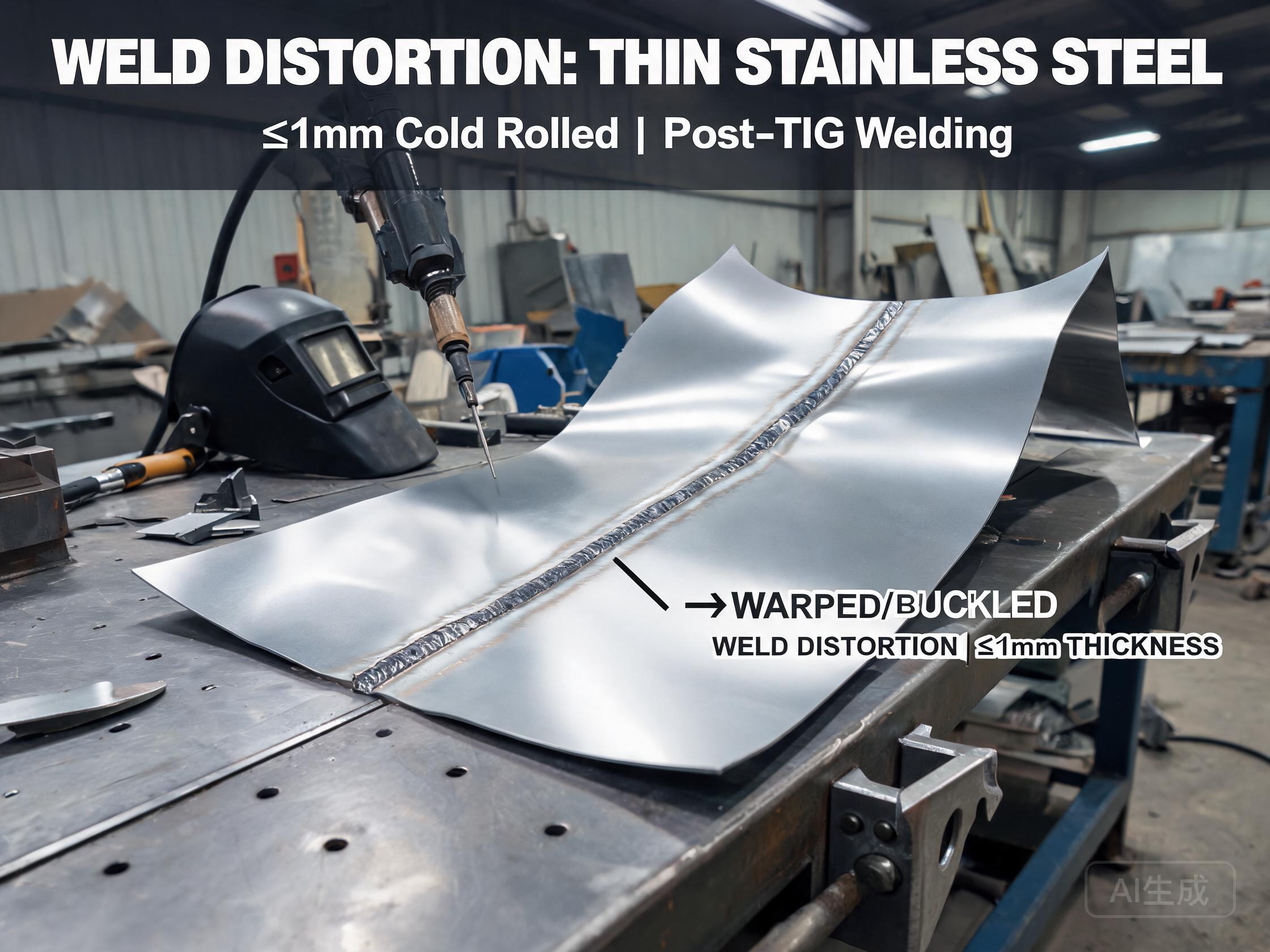
Short answer: Welding 0.4mm thick 304 sheet continuously along one edge will make the edge curl 5mm within minutes. Thin stainless sheet has almost no stiffness to resist thermal contraction forces. The solution is skip welding (25mm weld, 75mm skip), copper backing for heat sinking, and hold-down clamps at 50mm spacing. Get these three right and your distortion drops from 5mm to under 1mm.
Distortion is not just cosmetic. On appliance panels, a buckled edge means the door won’t close or the screw holes don’t align. On automotive parts, distortion creates wind noise and poor fit. On food equipment, distorted welds trap food particles and make cleaning impossible. Every millimeter of distortion costs money — either in straightening time or in scrap.
Quick Comparison
| Technique | Application | Heat input reduction | Distortion reduction | Notes |
|---|---|---|---|---|
| Continuous welding | Thick plate >3mm | None | Baseline | Never use on ≤1mm sheet |
| Skip welding (1:3 ratio) | ≤1mm sheet | 50-60% | 60-70% | Standard practice |
| Skip welding + copper backing | ≤1mm sheet | 70-80% | 80-90% | Best result |
| Skip welding + heat sink paste | ≤1mm sheet | 65% | 75% | Alternative to copper |
| Laser welding | Any thin sheet | 30-40% | 50-60% | Higher equipment cost |
| Water-cooled backing bar | ≤1mm sheet | 75-85% | 85-95% | Maximum heat sinking |
The 1:3 skip ratio (25mm weld : 75mm skip) is standard for 0.8mm sheet. Adjust to 1:2 for 1mm sheet, 1:4 for 0.5mm sheet. Always start from the center and weld outward — this balances contraction forces.
What Buyers Should Evaluate
- Does the fabricator have copper backing bars for thin sheet welding, or do they use steel? Steel backing conducts heat 3x worse than copper — it is almost useless for heat sinking.
- Do they use hold-down clamps along both sides of the weld seam at 50mm maximum spacing? Without clamps, even good technique will distort 0.4mm sheet.
- What is their skip welding pattern — do they start from the center and alternate sides, or weld from one end to the other? Welding from one end creates cumulative distortion.
- Can they provide a distortion test coupon welded on your material before starting production? Measure it with a straight edge and feeler gauge.
- Do they use a lower heat input process (TIG with 1.6mm wire at 30-50A) or a high heat input process (MIG with 2.4mm wire at 150A)? Lower heat input = lower distortion, always.
Common Purchasing Mistakes
- A China factory trick: quoting you “distortion ≤1mm” but using 3mm steel backing bars and continuous welding. When you inspect, distortion is 5mm. Require copper backing bars (≥20mm wide, ≥25mm thick) specifically in your PO. They cost ¥80 each but reduce distortion by 80%.
- Specifying “stitch welding” without defining the ratio. Stitch welding can mean anything from 1:1 to 1:5. If you do not specify the weld length and skip length, the fabricator will use whatever speeds up production. Write: “Skip welding: 25mm weld length, 75mm skip length, alternating sides, starting from center.”
- Forgetting that even 2B surface stainless sheet distorts more than BA surface because 2B is cold rolled with higher residual stress. If you weld 2B sheet, you need more hold-down pressure. Specify surface finish with your distortion tolerance — BA surface is 20-30% less prone to distortion.
- Ignoring the contraction calculation. A 2-meter continuous weld on 0.8mm 304 sheet will contract approximately 1.5mm along the weld line. If your design expects zero contraction, you will have fit-up problems. Pre-plan the joint gap or use a clamp-to-gap technique.
Recommended RFQ Wording
“Please supply cold rolled 304 or 316 stainless steel sheet ≤1mm per EN 10088-2, 2B or BA surface. Provide EN 10204-3.1 test reports. Fabrication requirements: Welding shall use skip welding pattern — 25mm weld segment, 75mm skip, alternating sides, starting from center. Copper backing bars (≥20mm width, ≥25mm thickness) shall be used along weld seam. Hold-down clamps at maximum 50mm spacing on both sides. Welding process: TIG (GTAW) with 1.6mm filler wire, heat input controlled ≤1 kJ/mm. Distortion tolerance after welding: ≤1mm flatness deviation over any 100mm measurement length, verified with straight edge and feeler gauge.”
Frequently Asked Questions
Why does weld distortion happen in thin stainless sheet more than thicker material?
Thin sheet (≤1mm) has low rigidity — it cannot resist the thermal contraction forces from welding. When you weld continuously along an edge, the heated area expands during welding, contracts during cooling, and pulls the sheet edges up or buckles the center. Thicker plate has enough mass to resist these forces; thin sheet does not.
What is skip welding and how much does it help?
Skip welding (also called staggered welding or intermittent welding) means welding a short segment (20-30mm), then moving 80-100mm ahead, then welding another segment. This reduces the total heat input per unit length and allows adjacent areas to cool partially before welding. Combined with copper backing, skip welding can reduce distortion by 60-80% vs continuous welding.
How do I specify distortion tolerance on thin sheet?
State a maximum flatness deviation over a specified measurement length, e.g., “≤2mm distortion over any 100mm length after welding.” Use a standard straight edge (I-beam) and feeler gauge to verify. For cosmetic parts (appliance panels, decorative cladding), specify ≤1mm over 100mm. For structural parts, ≤3mm over 100mm is common.
How Still Steel Supports the Project
Still Steel supplies cold rolled stainless steel sheet and strip with pre-cut edges, beveling and pre-weld cleaning services so your fabricator can start welding immediately. We stock matching filler wires (ER308L, ER316L, ER2209) and provide material traceability via EN 10204-3.1 test reports. Send your weld joint design, grade and thickness to vip@still-steel.com, or discuss on WhatsApp.
Technical References
- AWS D1.6/D1.6M: Structural Welding Code — Stainless Steel (Clause 11: Distortion Control)
- ASME IX QW-410.7: Welding Distortion Considerations
- EN 1011-3: Arc welding of stainless steels — heat input guidelines
- Stainless Steel Sheet Metal Fabrication Handbook, 3rd Edition — Copper backing bar design data