
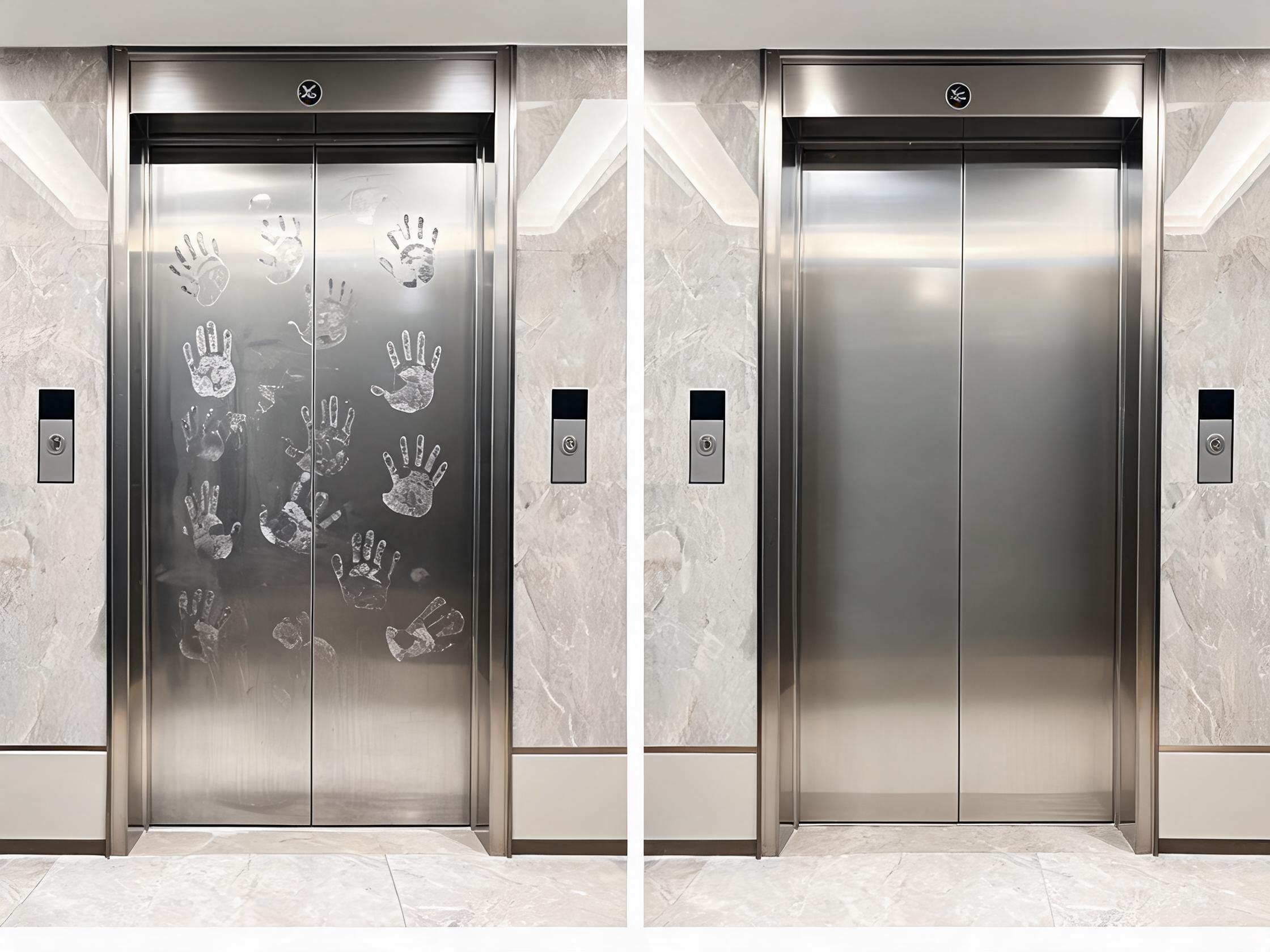
Short answer: Elevator handprints are not a cleaning problem. They are a surface finish and coating problem. 304 mirror finish is hydrophilic — every hand leaves skin oils and water that spread out as visible prints. The fix is an anti-fingerprint coating: PVD TiN or DLC lasts 5–10 years, SiO2 lasts 2–3 years, TiO2 needs UV light. If your contractor skips the coating, you will clean those panels every single day for ten years. Do not let them.
Every elevator lobby has the same problem. The stainless steel panel was polished to a perfect 8K mirror finish at the factory. By the end of day one, there are 40 handprints. By day three, it looks like a smudge wall. The cleaning crew comes every morning and by noon the prints are back. The building manager yells. The elevator OEM gets a warranty call. This is not a maintenance issue — it is a specification failure.
Quick Comparison
| Coating type | Cost (per m²) | Fingerprint resistance | Durability | Requires UV | Mirror visibility |
|---|---|---|---|---|---|
| None (raw 8K) | Baseline | None | N/A | No | Excellent |
| PVD TiN | +35 USD | Excellent | 5–10 years | No | Reduced (gold tint) |
| PVD DLC | +40 USD | Excellent | 5–10 years | No | Excellent (neutral black) |
| SiO2 sol-gel | +25 USD | Good | 2–3 years | No | Excellent |
| TiO2 photocatalytic | +20 USD | Good | 3–5 years | Yes | Excellent |
PVD DLC (Diamond-Like Carbon) is the premium choice — excellent fingerprint resistance, neutral dark finish that still shows mirror reflections, and lasts a decade. SiO2 sol-gel is the budget alternative for projects under 100 panels. TiO2 works only if the elevator lobby has a window or skylight.
What Buyers Should Evaluate
- Grade: 304 only. 316 is unnecessary for indoor elevators. 430 ferritic will rust in coastal lobbies within two years.
- Mirror finish: No.0 ground base → 8K polishes to Ra ≤0.05 μm. Start with a No.0 base sheet, not 2B. The difference is a 30% brighter mirror.
- Anti-fingerprint coating: mandatory. Choose based on lobby lighting and budget. If the lobby has no natural light, skip TiO2.
- Thickness: 1.5 mm minimum, 2.0 mm recommended for high-traffic buildings. Add a 0.5 mm PE or EPDM foam backing between the panel and the steel frame to reduce vibration noise and prevent denting from contact.
- Cleaning schedule: with PVD coating, clean once every 7–10 days with a microfiber cloth and 99% isopropyl alcohol. Without coating, you need daily cleaning.
Common Purchasing Mistakes
- Accepting “304 mirror finish” without specifying the base. One contractor polishes from a 2B base. Another starts with No.0. The difference is visible from across the lobby. Specify No.0 base + 8K polish, Ra ≤0.05 μm.
- Ordering SiO2 coating but skipping the bake cycle. SiO2 must cure at 150°C for 30 minutes. A Chinese mill might skip this to save time. The coating wipes off after six months with window cleaner. Get the bake cycle documentation.
- Specifying 1.0 mm thickness to “save weight.” The panel dents when a service cart hits it. You cannot flatten a dented mirror finish — you replace the whole panel. The 20% thickness premium saves you 300% in replacement cost over ten years.
- Forgetting to specify coating application before cutting. The factory coats the full sheet first, then cuts to panel size. If you cut first then coat, the edge is uncoated and will corrode. Specify “coated sheet, then cut.”
- Skipping EN 10204-3.1 and PMI. A mill can label 304 on a 201 coil — both polish to mirror finish, but 201 rusts in five years. Get the chemical analysis.
Recommended RFQ Wording
Cold rolled stainless steel sheet for elevator interior panels, grade 304, thickness 2.0 mm ±0.03 mm, width 1250 mm, No.0 ground base with 8K mirror polished Ra ≤0.05 μm, PVD DLC anti-fingerprint coating applied to full sheet before cutting, EN 10088-2, EN 10204-3.1 test report with PMI analysis, coating thickness report ≥1.5 μm, 0.5 mm EPDM foam backing applied, quantity 5 tonnes, destination [your factory], delivery within 25 days.
State the elevator traffic level (residential, office building, high-speed tower), lobby lighting condition (natural light / artificial only) and target cleaning interval so the supplier can confirm the coating type and thickness before slitting. Put the base finish (No.0 vs 2B) and the coating application step on the order — these are the two most commonly skipped specifications.
Frequently Asked Questions
Why does my 304 mirror stainless steel elevator panel show handprints no matter how often I clean it?
304 mirror finish is smooth but hydrophilic — water and skin oils spread out and become visible. Without an anti-fingerprint coating, handprints appear within 30 minutes of cleaning. You need a hydrophobic treatment: PVD coating, SiO2 sol-gel or TiO2 photocatalytic coating.
Which anti-fingerprint coating works best for elevator panels — PVD, SiO2 or TiO2?
PVD TiN or DLC is the most durable — lasts 5–10 years with monthly cleaning. SiO2 sol-gel is cheaper but wears off in 2–3 years. TiO2 photocatalytic is cheaper still but needs UV light to activate — works only in lobbies with natural sunlight.
What mirror finish and thickness should I specify for elevator car panels?
Grade 304 cold rolled, 8K mirror polished with No.0 ground base, thickness 1.5–2.0 mm. The No.0 base gives a deeper, brighter mirror than a base of 2B. Thickness below 1.2 mm dents easily when service carts hit the panel. Add a 0.5 mm foam backing for rigidity.
How Still Steel Supports the Project
Still Steel supplies cold rolled stainless steel sheet and strip in the right grade and thickness for your elevator interior panels with EN 10204-3.1 test reports. We provide slitting, cut-to-length, surface finishing and protective film application so you receive process-ready material. Send your specification and quantity to vip@still-steel.com, or discuss on WhatsApp.
Technical References
- ASTM A240 / A240M flat-rolled stainless steel for architectural applications
- EN 10088-2 cold rolled stainless steel sheet and strip
- ISO 8992 building and civil engineering works — stainless steel
- ANSI A17.1 Safety Code for Elevators and Escalators
- PVD coating standards ISO 14577 coating thickness measurement
- ASTM D4541 pull-off strength of coatings
Reference documents support general selection and fabrication principles. The final material decision must follow the applicable contract, standard, regulation and engineering review for the specific product.