
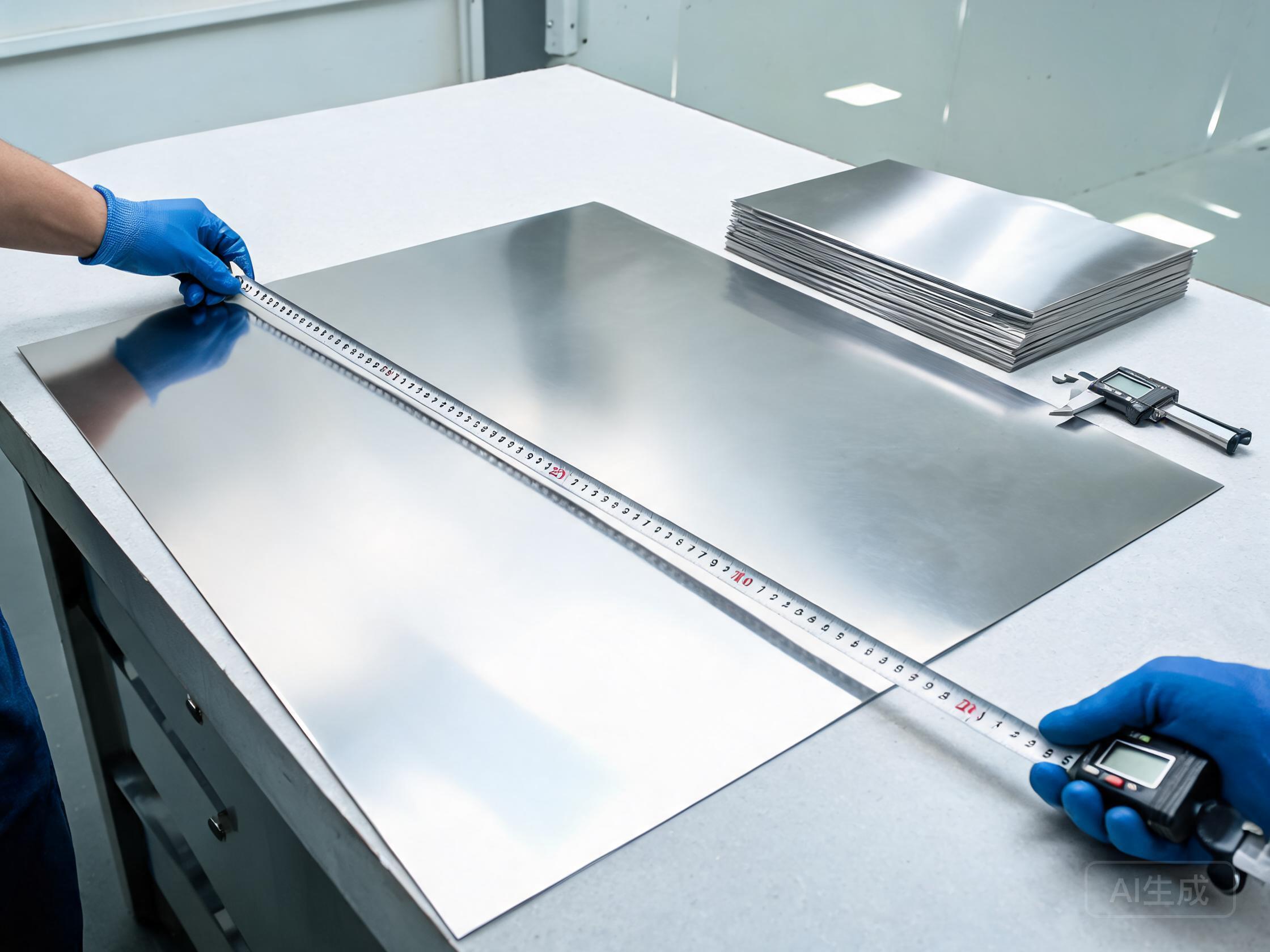
Short answer: Sheet squareness and diagonal difference decide how much of a stainless sheet survives nesting, shearing and press feeding. A sheet that meets nominal length and width can still be a parallelogram, and that skew becomes edge trim, short parts and line stoppages. Specify a diagonal limit, a measurement method and a reference corner, and inspect the first and last sheet of each bundle. In short, squareness is the yield killer that buyers forget to quote.
Length and width are the dimensions buyers check first. They are also the easiest for a supplier to satisfy while hiding skew, camber or a short corner. The diagonal is the check that exposes the shape of the sheet as a whole.
Quick Comparison
| Characteristic | What it describes | Where it hurts | What to specify |
|---|---|---|---|
| Squareness | Corner angle deviation from 90° | Nested parts, frame fit, welding gaps | Out-of-square limit over a stated length |
| Diagonal difference | Difference between the two diagonal measurements | Skewed nests, short parts, trim loss | Maximum difference in mm, with measurement method |
| Camber | Lateral curvature along the length | Coil feeding, roll forming, laser tracking | mm per metre over a stated length |
| Edge straightness | Local deviation of the cut edge | Butt welds, panel joints, guide clearance | mm over the sheet length |
| Length and width | Nominal cut size | Fit and weight | Tolerance per standard or drawing |
| Flatness | Deviation from a reference plane | Cutting bed contact, stacking, panel appearance | Limit on a flat table, unconstrained |
The values are not interchangeable. A sheet can be flat but skewed, or square but wavy. Each characteristic needs its own limit and its own measurement method.
What Buyers Should Evaluate
Define what “square” means
Squareness can be expressed as an out-of-square distance at the far corner, an angle deviation, or a diagonal difference. Pick one method and state it on the drawing. For most sheet buyers, diagonal difference is the simplest field check because it needs only a tape and two measurements.
Measure under the right conditions
Measure the sheet flat and unconstrained, at a consistent temperature, with a calibrated tape or gauge. Do not press a wavy sheet onto a table and call it square. Record both diagonals, the sheet size, the measurement positions and the instrument. For thick plate, allow for the measuring technique and the reference edge.
Match the limit to the cutting process
A laser or waterjet nest follows the sheet boundary. Shear and press lines also depend on a straight reference edge. If the first operation is a blanking press with a fixed guide, a small skew can become a jam. Set the squareness limit from the process capability, not from a generic catalogue tolerance.
Calculate the real yield
Yield is not nominal area minus part area. Add the trim needed to establish a straight reference edge, the rotation allowance for skew, the scrap from short corners and the extra handling. A 2 mm diagonal difference on a large sheet can be trivial for one layout and expensive for another. Ask the supplier to quote the cut size and the usable area, not only the nominal size.
Check the cut method and the edge condition
Shearing can introduce edge bow and burr; laser cutting leaves a different edge and a heat-affected zone. If the sheet is supplied cut-to-length, confirm whether the edges are sheared, laser-cut or slit. The edge condition affects both squareness and downstream welding.
Inspect the bundle, not only the top sheet
The top sheet may be perfect while lower sheets are damaged or shifted. Check the first and last sheet, the bundle corners and the packing. Corner protection and a stable pallet reduce handling damage that looks like a squareness problem at the customer.
Common Purchasing Mistakes
- Ordering “standard size” without a diagonal limit. Nominal length and width do not control skew. Add a diagonal difference and a measurement method.
- Checking only one diagonal. A single diagonal cannot reveal a parallelogram. Measure both and record the difference.
- Measuring a wavy sheet on a flat table by pressing it down. Flatness and squareness are different characteristics; pressing hides one and distorts the other.
- Buying mill-edge coil and shearing in-house without checking the edge. The incoming camber and edge condition can make your shear produce skewed sheets. Qualify the coil, not only the shear.
- Leaving no trim allowance. A drawing that demands the exact finished size from a skewed sheet forces the supplier to choose between short parts and a rejected order.
- Accepting a short length because the weight is correct. Some suppliers reduce length or width to hit a weight target. Check dimensions, diagonals and weight together; a correct weight does not prove a correct shape.
- Skipping the certificate and grade check. A geometrically perfect sheet can still be the wrong grade. Require EN 10204 3.1 and PMI the Cr, Ni and Mo values, particularly for 316L.
The acceptance rule: length, width, diagonal difference, camber and flatness must all be measured and recorded before the bundle is released.
Recommended RFQ Wording
Copy and adapt this clause:
Sheet size 1219 × 2438 mm, grade 304 per ASTM A240/A240M. Squareness: maximum diagonal difference 3 mm, measured on both diagonals with a calibrated tape on a flat, unconstrained sheet. Edge straightness: maximum 2 mm over the sheet length. Camber: maximum 3 mm per 1000 mm. Thickness tolerance per ASTM A480/A480M. Sheets to be supplied cut-to-length on a line qualified for this size. The first and last sheet of each bundle shall be measured, and the results included in the inspection record. Dimensions and weight to be checked together; short length is not acceptable as a weight adjustment. EN 10204 3.1 certificate and PMI for Cr, Ni and Mo required.
Adjust the numbers to your process capability. The important part is that the limit, method and record are all specified.
FAQ
Why does diagonal matter more than side length?
A sheet can meet its nominal length and width and still be a parallelogram. The diagonal difference exposes that skew, which then appears as short parts, edge trim and misfeeds in nesting or press operations.
Can laser cutting correct an out-of-square sheet?
No. The laser cuts relative to the sheet, so a skewed edge propagates into the nested layout. You can rotate the nest to reduce loss, but the scrap and programming time remain. Fix the incoming sheet, not the cutting program.
What diagonal tolerance is practical?
It depends on sheet size, thickness, cut method and supplier capability. For a 1219 × 2438 mm sheet, a diagonal difference in the low single-digit millimetres is a reasonable discussion point, but it must be confirmed on the actual line. Do not copy a number from a different size or gauge.
Does squareness affect delivered weight?
Not directly. A skewed sheet can still weigh the nominal amount. The loss appears later as trim, short parts or rejected nests, which is why the purchase order should control squareness rather than weight alone.
Technical References
- ASTM A480/A480M — general requirements, dimensions and tolerances for flat-rolled stainless steel
- EN 10088-2 — technical delivery conditions for stainless steel sheet and strip
- EN ISO 9445-2 — tolerances for cold-rolled stainless steel narrow strip and cut lengths
- ISO 2768 — general tolerances, where a drawing does not define a tighter requirement
Next Step
Send your cut size, nesting layout and current scrap rate to vip@still-steel.com. We can compare the sheet specification with the available cut-to-length capability and propose a diagonal and camber limit that fits your line. You can also send the drawing through our contact form or message us on WhatsApp at wa.me/8613867898840.
Ningbo Wanguang Stainless Steel Material CO., LTD. · Still Steel