
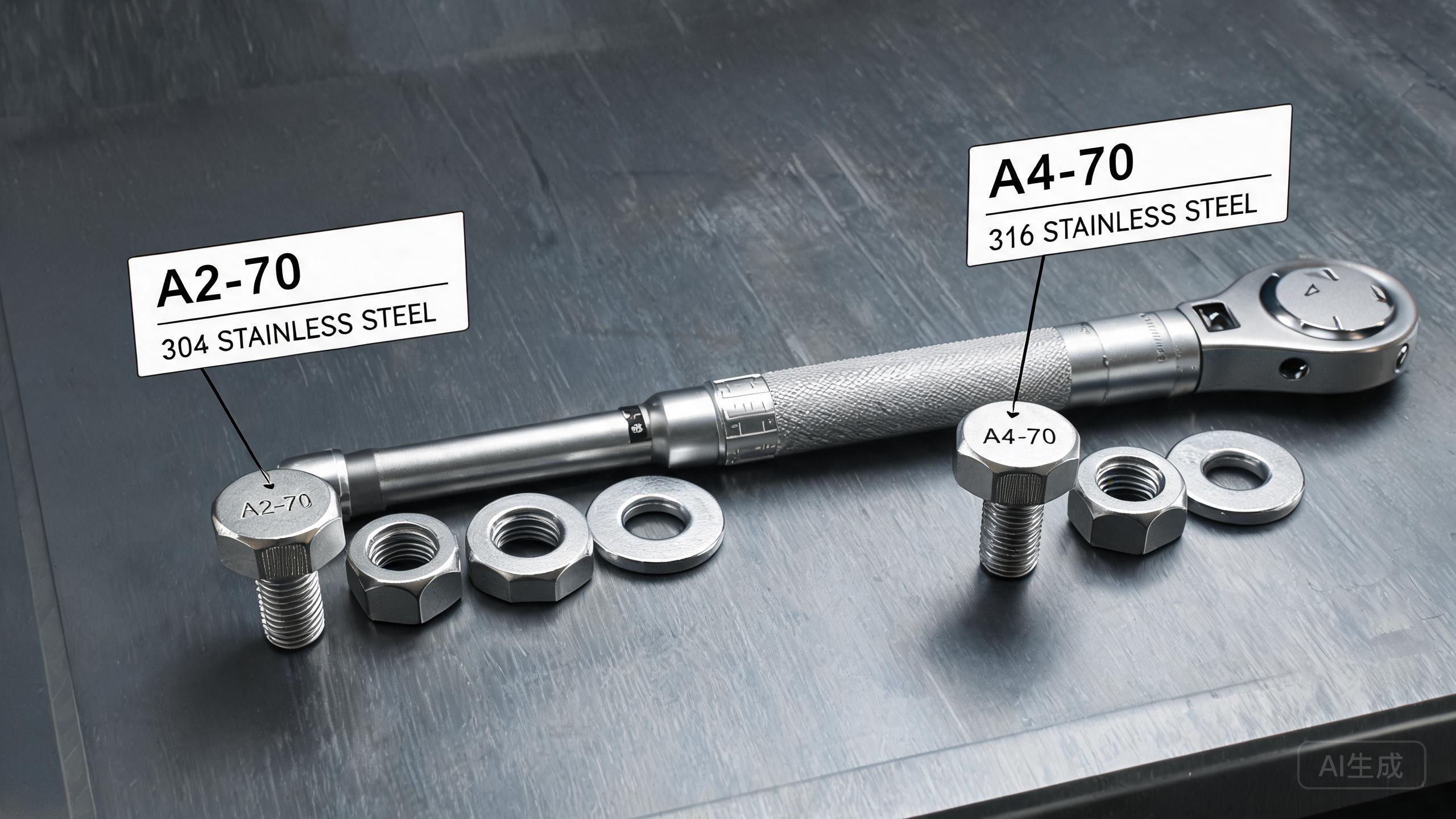
Short answer: Stainless steel fastener classes are defined in ISO 3506 (ASTM F594/F593 in US). A2-70 and A2-80 represent cold-worked austenitic 18-8 family (304-equivalent) at 700 or 800 MPa tensile strength; A4-70 and A4-80 are the molybdenum-bearing 316-equivalent for better chloride resistance. Thread galling, galvanic pairing and under-designed clamp load are the three most frequent purchaser mistakes.
This guide is written for stainless steel buyers, sourcing teams, engineers and product manufacturers. The purpose is not to declare one universal winner, but to turn a broad material question into a specification that a mill or service center can quote, process and inspect consistently.
Quick Comparison
| Option | Key point | Typical use or decision |
|---|---|---|
| A2-70 (304 type, 700 MPa TS) | Most common general-purpose class | Indoors, general structural, food equipment |
| A4-70 (316 type, 700 MPa TS) | Molybdenum addition for chloride resistance | Outdoor, coastal, mild chemical, marine trim |
| A2-80 / A4-80 | Higher cold work, higher strength | Higher clamp-load or thinner-diameter joints |
| 410 / B8 class martensitic | Hardenable, magnetic, high strength | Valve trim, high-temperature minor fasteners |
The table is a starting point. Actual performance depends on the governing standard, delivered condition, dimensions, surface finish, fabrication route and service environment. Commercial names should never replace a complete purchase specification.
What Buyers Should Evaluate
- Confirm the bolt, nut and washer material families are compatible to avoid galvanic or galling issues.
- Specify anti-seize or controlled lubrication if the assembly is torque-critical and repeated disassembly is expected.
- State the head marking and traceability certificate for regulated or structural use.
For production orders, share the end use rather than requesting a grade or finish in isolation. A supplier can then review corrosion exposure, forming severity, welding, visual requirements and packing before material is cut. This early review is usually less expensive than correcting a rejected shipment or unstable production trial.
Common Purchasing Mistakes
- Assuming all “stainless bolts” are marine-grade; A2-70 is not 316-grade and will not reliably survive coastal service
- Mixing A4 bolts with plain A2 nuts or carbon-steel washers without evaluating galvanic behavior
- Over-torquing 304/316 fasteners and suffering galling or thread stripping during installation
These mistakes are avoidable when drawings, approved samples, inspection methods and certificate requirements are agreed before production. For visual products, retain a signed master sample. For functional dimensions, define where and how measurements will be taken.
Recommended RFQ Wording
List the standard (ISO 4014/4017, DIN 931/933, ASTM A193 B8/B8M), class (A2-70, etc.), size, thread pitch, finish/passivation, any marking requirements, hardness or proof load test, and batch documentation.
Also include order quantity, acceptable quantity variation, destination, required delivery date and whether partial shipments are allowed. If a requirement is critical, make it measurable and place it on the purchase order rather than only in an email conversation. For material documentation, see how EN 10204 3.1 mill test certificates work and our stainless steel RFQ checklist.
How Still Steel Supports the Project
Still Steel supplies stainless steel coil, strip and sheet and provides slitting, cut-to-length, brushing, polishing and protective-film services. We can compare available mill material with your drawing, prepare trial quantities and preserve heat-number traceability through service-center processing.
Send the grade, dimensions, annual volume and application to vip@still-steel.com, or discuss the requirement on WhatsApp.
Frequently Asked Questions
What is the difference between A2-70 and A4-70?
A2 matches the austenitic 18-8 family (304 equivalent); A4 adds molybdenum (316 equivalent) for better chloride and crevice resistance. Both 70 classes require minimum 700 MPa tensile strength.
Why did my stainless bolts gall and seize?
Thread galling is common on 304/316 fasteners when tightened without lubrication or anti-seize, especially at high clamp load. Use proper torque, anti-seize paste or nickel-alloy plating in extreme cases.
Can I replace a high-tensile 8.8 carbon bolt with A2-70 one-for-one?
Check the clamp-load and proof stress. A2-70 proof strength is around 450 MPa vs 640 MPa for 8.8; direct substitution may lead to relaxation or bolt yielding in critical joints.
Technical References
Reference documents support general selection and fabrication principles. The final material decision must follow the applicable contract, standard, regulation and engineering review for the specific product.