
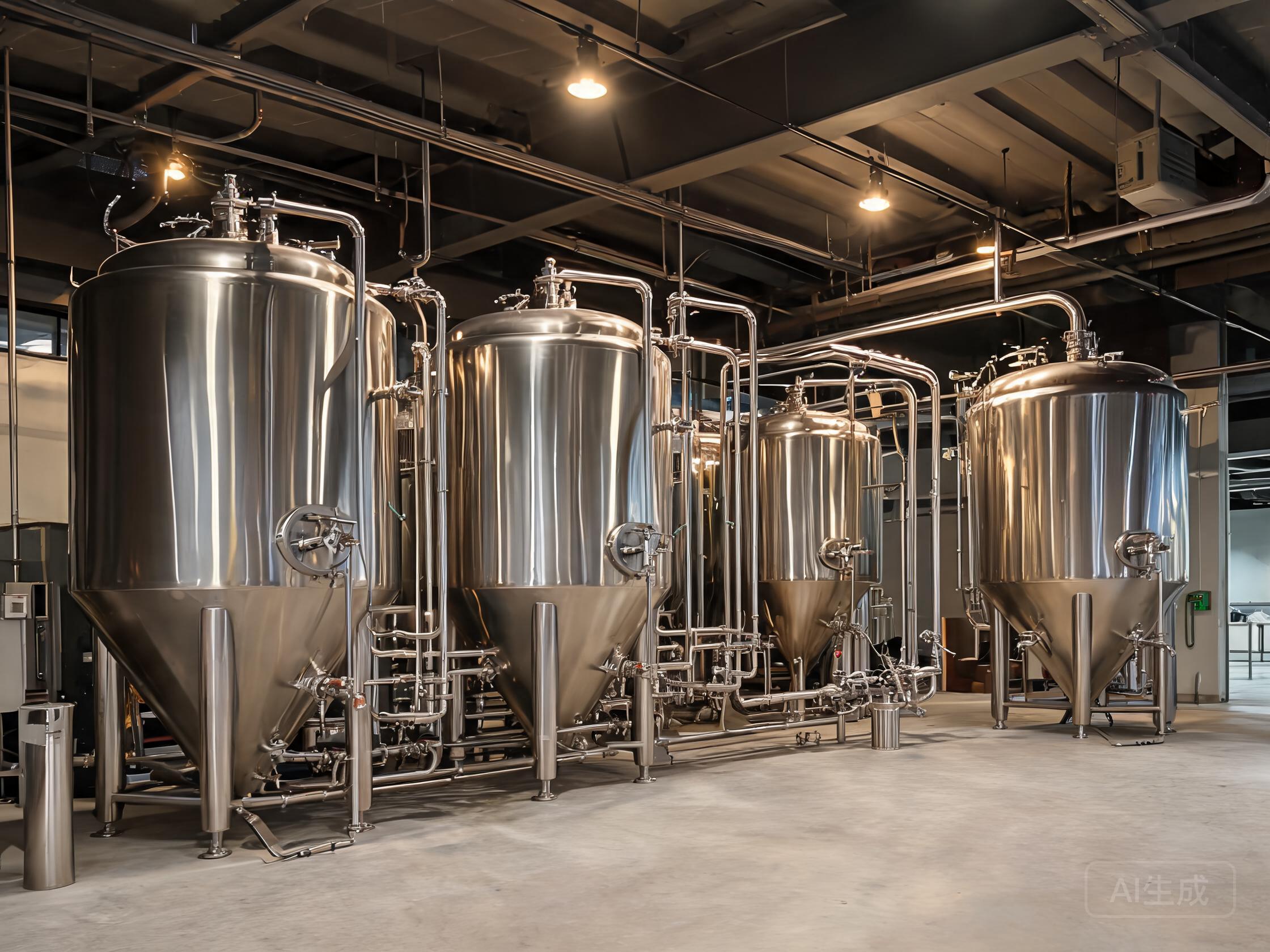
Short answer: Stainless steel for brewery and winery tanks is usually 304 or 304L for fermenters, bright tanks and most wine vessels. Move to 316L when chloride from water, cleaning chemicals or coastal air raises the pitting risk, or when a longer corrosion margin is required. Internal product-contact surfaces should be 2B or smoother, welds fully penetrated and passivated, and the vessel designed to drain without dead legs.
The grade decision is not the whole specification. A tank fails at a weld, a crevice, a stagnant pipe or a scratched surface long before it fails in the middle of a polished shell. This guide is written for brewery project buyers, winery owners, fabricators and sourcing teams who need a specification that can be quoted and inspected.
Quick Comparison
| Vessel or duty | Recommended grade | Internal finish | Key reason |
|---|---|---|---|
| Beer fermenter or bright tank | 304 / 304L | 2B, Ra ≤0.8 µm | General brewery service with controlled CIP |
| Winery fermentation or storage | 304 / 304L | 2B, Ra ≤0.8 µm | Most wine duties; cost-effective and easy to clean |
| High-chloride water or coastal plant | 316L | 2B or electropolished | Molybdenum improves pitting resistance |
| Aggressive CIP with hypochlorite | 316L, or change chemistry | 2B, smooth welds | 304 is more vulnerable to chloride pitting |
| Bright tank with visible front | 304 / 316L | BA or polished exterior | Appearance requirement, not corrosion requirement |
The table assumes atmospheric or low-pressure vessels. If the tank is a pressure vessel, the design code and inspection regime override the grade discussion.
What Buyers Should Evaluate
Product chemistry and cleaning chemistry
Start with the liquid, not the grade. Record pH, chloride content, sulfite or SO2 levels, organic acids and operating temperature. Then list every cleaning agent: caustic, acid, peracetic acid, hypochlorite and any chlorine-based sanitizer. Chloride is the decisive variable for pitting; temperature and stagnation make it worse.
304L versus 316L
304L is the workhorse for brewery and winery vessels. Its lower carbon content, 0.03% maximum, supports welded construction and reduces sensitization risk. 316L adds molybdenum, which raises pitting resistance in chloride-bearing service. The upgrade is justified by the environment, not by the belief that “316 is always better”. For most indoor breweries with controlled water and non-chlorine CIP, 304L is adequate.
Internal surface finish
Product-contact surfaces should be smooth enough to clean and drain. A 2B finish with Ra around 0.8 µm or better is a common target, but the actual value must be measured and agreed. Avoid sharp corners, crevices, dead legs and horizontal ledges. A mirror finish does not compensate for a poor weld or a stagnant pipe.
Weld quality and passivation
Welds are the most likely corrosion initiation sites. Require full penetration, good root protection, no undercut or overlap, and removal of heat tint. Pickle or passivate after welding and after any grinding or polishing that exposes fresh metal. Follow a recognized procedure such as ASTM A380 for cleaning and ASTM A967 for passivation, and keep the records.
Design for drainage and cleaning
Slope the floor to the drain, avoid dead legs, minimize crevices and use hygienic gaskets and fittings. A tank with a perfect surface finish but a horizontal pipe run will still collect residue and create a corrosion cell. If the plant follows EHEDG or 3-A sanitary design principles, include those requirements in the drawing.
External environment and cladding
A coastal brewery may need 316L for external cladding and supports even when the internal product side is 304L. Salt-bearing air, condensation and cleaning spillage attack the outside of the vessel too. Check the external grade, the insulation detail and the fasteners.
Certification and traceability
Require EN 10204 3.1 certificates for the shell, cone, dish and product-contact parts, with heat numbers traceable to the tags. Add PMI for Cr, Ni and Mo on receipt. For sanitary work, request the weld procedure specification, welder qualification and passivation records.
Common Purchasing Mistakes
- Using 304 with hypochlorite CIP. Chlorinated sanitizers can pit 304, especially in warm, stagnant or crevice conditions. Move to 316L, control concentration and contact time, or switch to a non-chlorine sanitizer.
- Specifying “mirror” and ignoring the weld. A polished shell can hide heat tint, incomplete penetration and crevices. Specify weld quality, passivation and Ra, and inspect the welds, not only the flat sheet.
- Skipping pickle or passivation after welding. Heat tint and iron contamination reduce corrosion resistance. Require cleaning and passivation after the final weld, and re-passivate if grinding or polishing follows.
- Leaving dead legs and horizontal runs. No grade survives a stagnant pipe. Design for drainability and include it in the acceptance checklist.
- Ignoring chloride in the water supply. Water used for rinsing or CIP can contain enough chloride to attack 304. Test the water and record the result before choosing the grade.
- Accepting 304 where 316L was ordered. The surface looks the same and the price difference is easy to hide. PMI the Mo value and compare the certificate with the heat number.
- Using 430 for wet parts. Ferritic 430 is economical for dry housings, not for product-contact or wet brewery components.
- Polishing after passivation without re-passivation. Abrasive polishing can remove the passive layer and embed contaminants. Sequence the surface work before the final passivation, or re-passivate afterwards.
The acceptance rule: grade, finish, weld quality, passivation record and certificate must all match before the tank is released for service.
Recommended RFQ Wording
Copy and adapt this clause:
Shell and product-contact parts: 304L per ASTM A240/A240M. Internal product-contact finish: 2B, Ra ≤0.8 µm at the agreed measurement position. Welds: full penetration, argon-purged root, no undercut, heat tint removed, pickled and passivated per ASTM A380/A967. Design to drain with no dead legs; slope and drain point to be shown on the drawing. EN 10204 3.1 certificate with heat numbers for each product-contact component; PMI required for Cr, Ni and Mo. Weld procedure and welder qualification records to be supplied. No grade substitution without written approval. For chloride-bearing CIP, confirm 316L supply and chloride limits in the cleaning schedule.
For winery vessels, add the cleaning and sulfite exposure details. For coastal sites, specify the external grade and fastener material.
FAQ
Is 304 or 316L better for beer fermenters?
304 or 304L is the usual choice for beer fermenters and bright tanks when the cleaning chemistry is controlled. Choose 316L when the water, cleaning agents or coastal environment carry enough chloride to create a pitting risk, or when the buyer wants a larger corrosion margin.
Do winery tanks need 316L?
Not automatically. Many winery vessels work well in 304L. 316L becomes relevant when chloride exposure, aggressive cleaning or a long service life with uncertain water quality justifies the molybdenum-bearing grade.
Is a mirror finish required inside a tank?
No. A clean 2B finish with smooth, fully penetrated and passivated welds is often sufficient. Mirror polishing adds cost and can hide weld defects if the surface is measured only by appearance. Specify Ra and weld quality rather than the finish name alone.
What certificates should accompany a brewery tank order?
Require EN 10204 3.1 mill certificates with heat numbers for the shell, cones and any product-contact parts, plus PMI results for Cr, Ni and Mo. For sanitary work, request weld procedure, welder qualification and passivation records.
Technical References
- ASTM A240/A240M — stainless steel plate, sheet and strip for vessels
- EN 10088-2 — technical delivery conditions for stainless steel sheet and strip
- ASTM A380 — cleaning, descaling and passivation of stainless steel parts
- ASTM A967 — chemical passivation treatments for stainless steel parts
- EHEDG and 3-A sanitary design guidelines, where applicable
- EN 10204 — inspection documents, including 3.1
Next Step
Send the vessel drawing, duty, cleaning schedule and water analysis to vip@still-steel.com. We can review the grade, finish and weld requirements against the available sheet and strip before fabrication starts. You can also send the tank specification through our contact form or message us on WhatsApp at wa.me/8613867898840.
Ningbo Wanguang Stainless Steel Material CO., LTD. · Still Steel