
Short answer:
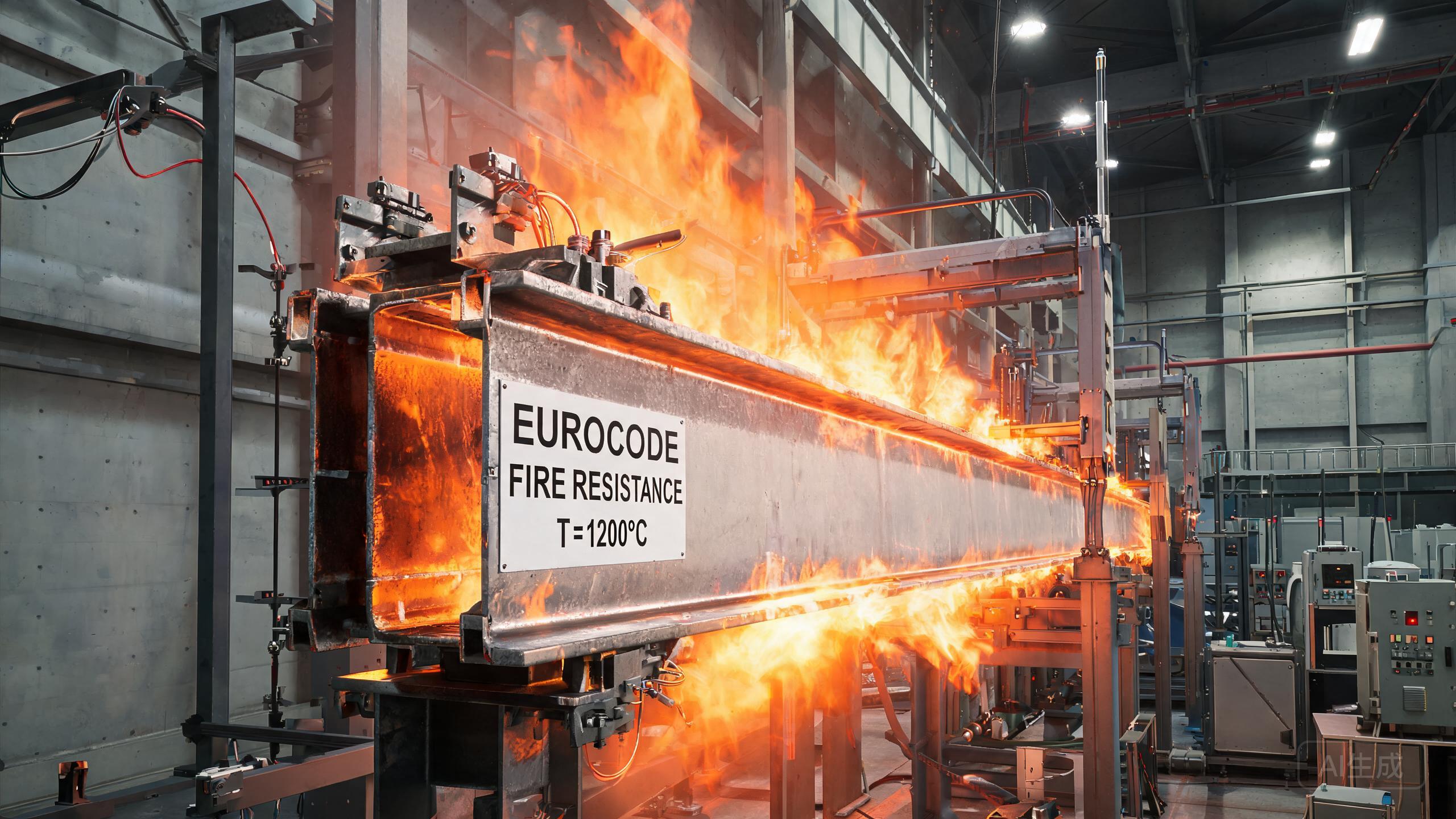
Structural stainless steel’s superior fire resistance is one of its most underappreciated value propositions — and Eurocode 3 Part 1.2 (EN 1993-1-2) has the design equations to prove it. 304 austenitic stainless retains 50% of its room-temperature strength at ~800°C, while carbon steel hits that same threshold at only ~550°C. Add in stainless steel’s 3x lower thermal conductivity (heat penetrates 3x slower) and the result is that unprotected 304 sections can often achieve R30 (30-minute fire resistance) where equivalent carbon steel needs full insulation. This matters for cost: structural stainless costs 2-3x more than carbon steel, but if it eliminates fire protection (which adds 30-50% to carbon steel structure cost), the total project cost can be comparable. Duplex 2205/2507 is the best performer, hitting 50% strength at ~900°C.
Quick Comparison
| Property | Carbon Steel S235 | 304 Austenitic | 316 Austenitic | 2205 Duplex | 430 Ferritic |
|---|---|---|---|---|---|
| 50% Strength Retention Temp | ~550°C | ~800°C | ~850°C | ~900°C | ~850°C |
| Thermal Conductivity | ~50 W/(m·K) | ~16 W/(m·K) | ~16 W/(m·K) | ~19 W/(m·K) | ~24 W/(m·K) |
| Room-Temp Tensile | ≥360 MPa | ≥500 MPa | ≥500 MPa | ≥620 MPa | ≥450 MPa |
| Unprotected R30 Achievable | No (needs insulation) | Yes (with calculation) | Yes (with calculation) | Yes (with calculation) | Yes (with calculation) |
| Typical Fire Protection Required | 50mm insulation or 3mm intumescent | 0-0.5mm intumescent or none | 0-0.5mm intumescent or none | None for R30, 0.5mm for R60 | Similar to 304 |
What Buyers Should Evaluate
- Required fire resistance period. Eurocode 3 Part 1.2 defines R30, R60, and R90 based on ISO 834 standard fire exposure. Determine your local building code requirement first.
- Section slenderness. The advantage of stainless steel diminishes for very slender sections (λ > 100). For stubby columns and wide-flange beams, the fire benefit is maximized.
- Eurocode calculation. Eurocode 3 Part 1.2 Section 6.4 provides specific methods for stainless steel fire design — the strength reduction factors are tabulated for each grade. Always use these, not carbon steel factors.
- China-specific note. China’s GB 51249-2017 code covers structural steel fire resistance. Eurocode 3 principles apply but local annexes provide additional factors. Verify compliance with both Eurocode and GB codes for export projects.
- Cost comparison analysis. Request your engineer to run total cost analysis: structural stainless steel premium vs eliminated/reduced fire protection cost. In many industrial and architectural applications, the total cost is within 10% of carbon steel.
Common Purchasing Mistakes
Mistake: Using carbon steel fire design methods for stainless steel. We’ve seen five engineering firms in 2024 apply carbon steel strength reduction factors (0.5× strength at 550°C) to stainless steel — this dramatically under-designs the stainless structure, causing unnecessary over-specification and cost waste. Fix: Eurocode 3 Part 1.2 Section 6.4 provides specific, more favorable strength reduction factors for stainless steel. Use these and request a calculation from your steel supplier or structural engineer.
Mistake: Chinese factory trick — standard structural steel labeled “fire-resistant stainless.” Some mills in Jiangsu sell low-nickel 200-series stainless or even coated carbon steel labeled “fire-resistant structural stainless steel.” These materials fail to meet Eurocode 3 Part 1.2 strength retention requirements — 200-series austenitic loses 50% strength at ~700°C, 100°C lower than genuine 304. Solution: PMI (Positive Material Identification) spectroscopy confirms it’s genuine 304/316L duplex chemistry. Insist on EN 10204 3.1 mill test certificates with explicit UNS number. Additionally, require a fire test report per ISO 834 on a witness coupon — 304 must retain ≥50% strength at 800°C, verified by a third party.
Mistake: Ignoring section heating rate. Stainless steel’s lower thermal conductivity means it heats up slower than carbon steel. But the temperature still rises — it just takes longer. For R60/R90 requirements, you still need protection. The Eurocode calculation accounts for this; don’t assume unprotected stainless handles everything.
Mistake: Using unapproved intumescent coatings. Not all intumescent coatings work on stainless steel. Some formulations designed for carbon steel have poor adhesion to stainless or don’t intumesce properly on stainless’s smoother surface. Specify coatings that are tested and certified for stainless steel substrates per EN 13381-3.
Recommended RFQ Wording
Grade: ASTM A240 / UNS [S30400 (304) / S31603 (316L) / S32205 (2205 duplex)]
Application: [structural beam / column / bracing / facade support]
Fire resistance required: [R30 / R60 / R90 per EN 1993-1-2]
Form: [plate / hot-rolled section / welded box column]
Dimensions: [exact cross-section, length]
Certification required:
  - EN 10204 3.1 mill test certificate
  - PMI spectroscopy on every heat
  - Eurocode 3 Part 1.2 compliance statement (strength reduction factors verified)
  - ISO 834 fire test report (third-party certified)
Additional: Fire protection coating specification (if required) must be certified per EN 13381-3 for stainless steel substrates.
FAQ
Why does stainless steel perform better than carbon steel in fire?
Two key reasons: (1) Higher strength retention at elevated temperatures — 304 retains 50% of room-temperature tensile strength at ~800°C, while carbon steel (S235) reaches 50% strength at only ~550°C. Above 550°C, carbon steel undergoes recrystallization and rapid softening. (2) Lower thermal conductivity — stainless steel conducts heat at ~16 W/(m·K) vs ~50 W/(m·K) for carbon steel, meaning heat penetrates structural sections 3x slower.
Does stainless steel structural steel need fire protection?
It depends on the fire resistance period required. For R30 (30 minutes fire resistance), unprotected 304/316 stainless steel sections of sufficient size often qualify — Eurocode 3 Part 1.2 provides calculation methods. For R60 and R90, thin-film intumescent coatings (0.5-1.0mm) or insulation may still be required, but the coating thickness is 30-50% less than for carbon steel. Duplex stainless steel has the best fire performance.
Is fire resistance the same for all stainless steel grades?
No. 316 (Mo-containing) performs better than 304 in fire — molybdenum retards the recrystallization process that causes softening. Duplex 2205/2507 is even better, with 50% strength retention at ~900°C. Ferritic grades (430, 439L) have better fire performance than austenitics in some cases, but lower room-temperature strength. Always use Eurocode 3 Part 1.2 material factors for your specific grade.
CTA + Technical References
Send your grade, dimensions, annual volume and application to vip@still-steel.com, or contact us. We supply Eurocode-compliant structural stainless steel for industrial and architectural fire-resistant applications.
References:
- EN 1993-1-2: Eurocode 3 — Design of steel structures — Part 1-2: Structural fire design
- ISO 834: Fire-resistance tests — Elements of building construction
- GB 51249-2017: Code for fire safety design of steel structures
- EN 13381-3: Test methods for determining the contribution to the fire resistance of structural members — Part 3: Applied reactive protection to steel structures
- See also: Best stainless steel for marine applications
Technical References
- ASTM A240M - Standard Specification for Chromium and Chromium-Nickel Stainless Steel Plate, Sheet and Strip
- EN 10088-2 - Stainless steels. Technical delivery conditions for sheet/plate and strip
- ASM International - Handbook Series, Volume 1: Properties and Selection: Irons, Steels, and High-Performance Alloys