
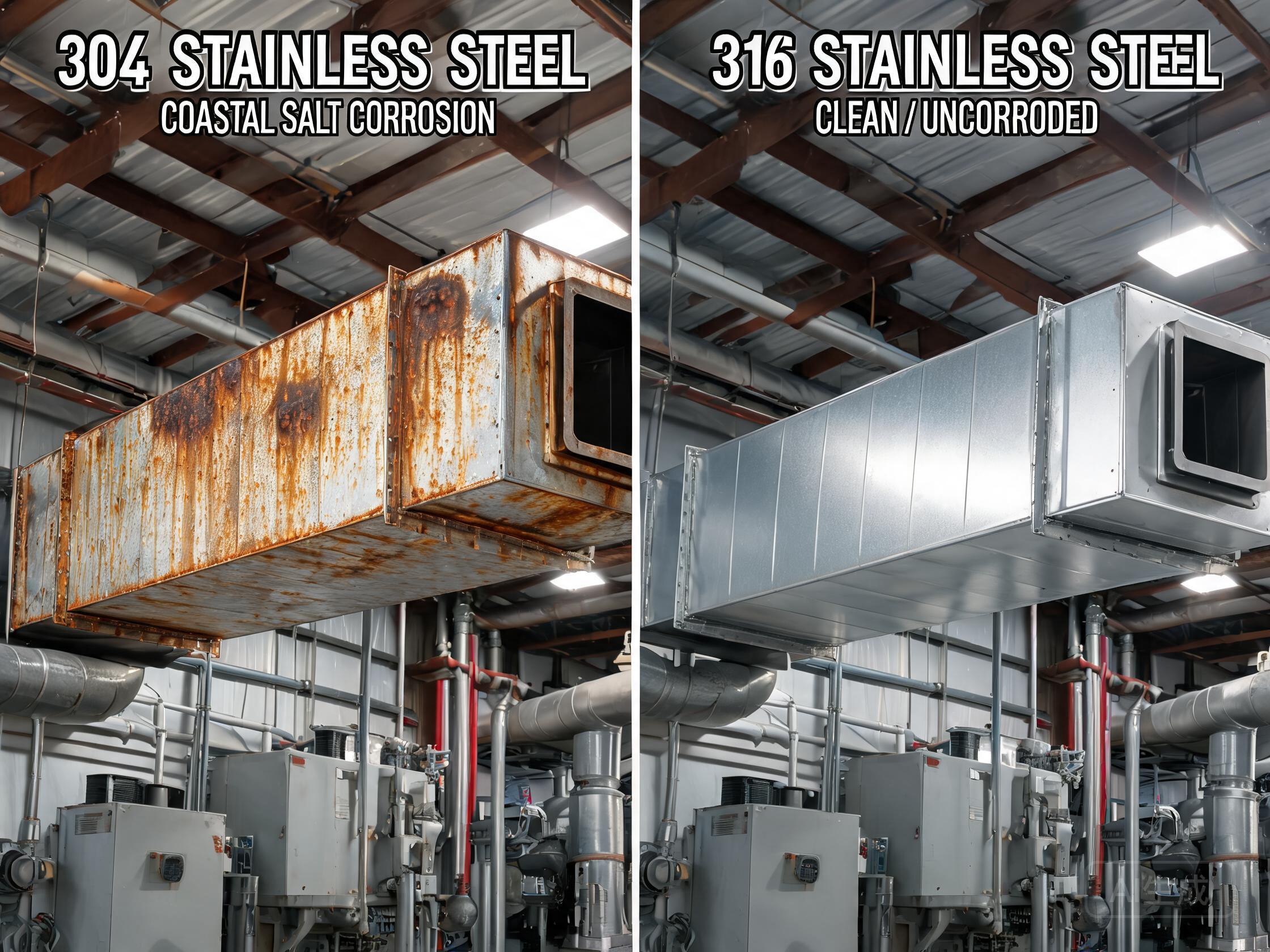
Short answer: HVAC ducts corrode from two directions. Outside, coastal salt spray eats through the paint or powder coating. Inside, condensation from cold supply duct walls drips salt-free water that still causes pitting on 304. The fix is simple: 304 for inland, 316 for coastal, always insulate with a vapor barrier, slope ducts at 1° per meter, and drain condensate every week. Skip any of these and your duct looks terrible in five years, even if you paid top dollar for “marine grade” sheet.
Mechanical contractors install 50,000 m² of cold rolled stainless steel HVAC ducts every year. Most specify 304 because “stainless is stainless.” Five years later, the project owner calls back complaining about brown streaks running down the duct from condensate leaks, or white salt stains under the insulation at the coastal installation. The contractor argues stainless steel “should not corrode.” It should — if the specification is wrong.
Quick Comparison
| Distance from ocean | Salt spray level | 304 cold rolled | 316 cold rolled | Insulation required |
|---|---|---|---|---|
| >20 km | <5 ppm | 10+ years | 15+ years | No (interior ducts) |
| 5–20 km | 5–20 ppm | 7–10 years | 12+ years | Yes |
| 1–5 km | 20–50 ppm | 3–5 years | 8–12 years | Yes |
| <1 km | >50 ppm | <3 years | 5–8 years | Yes + vapor barrier |
304 has PRE 19. 316 has PRE 25. At salt spray levels above 50 ppm, 304 pittings at 0.3 mm/year. 316 pits at 0.05 mm/year — 6x slower. The 30% premium for 316 at coastal sites is trivial compared to the 500% cost of re-installing ducts every five years.
What Buyers Should Evaluate
- Distance from ocean: the single biggest variable. Measure it before specifying. Use Google Maps. 5 km is the dividing line between 304 and 316.
- Condensation control second. Supply ducts run 10–15°C. Room air at 26°C, 60% RH condenses at 18°C — that is below the duct wall temperature. Insulate with 19 mm mineral wool + polyethylene vapor barrier. Seal all joints. No gap, no condense, no corrosion.
- Thickness: 1.2 mm (22-gauge) minimum. 0.8 mm sheet dents during installation and corrodes through faster. Specify flatness to EN 10088-2 Class B minimum — wavy ducts have stress corrosion cracking at the peaks.
- Surface finish: 2B mill finish is fine. No need for mirror polish. But specify “free of surface defects” — pits and scratches are corrosion starting points.
- Slope and drains: horizontal ducts slope at 1° per meter. Every 30 m add a condensate drain with P-trap. Neglect drains and your duct fills with water during shutdown.
Common Purchasing Mistakes
- Buying 304 for a duct 800 m from the ocean. Salt spray corrosion rate is 0.3 mm/year. At 1.2 mm thickness, you punch through in 4 years. Specify 316L within 1 km. The PRE difference of 6 saves you $200 per m² in replacement cost.
- Skipping insulation because “stainless does not condense.” It does. Cold supply duct at 12°C inside a 28°C warehouse. Uninsulated, the duct wall hits dew point in 3 minutes. Insulate or replace ducts in 6 years.
- Specifying “powder-coated stainless steel” for coastal ducts. The coating scratches during installation. Salt water gets under it. The galvanic reaction between the exposed steel and the coating pulls the coating off. Use bare 316.
- Skipping EN 10204-3.1 and PMI. A mill can label 304 on a 201 coil — both pass the magnetic test (cold worked 304 is magnetic). 201 has 4% Ni vs 8% for 304 and pitts 3x faster. Get the chemical analysis.
- Ordering 0.8 mm thickness to meet budget. The duct corrodes through in 3 years of coastal service. The warranty claim costs you 4x the difference between 0.8 mm and 1.2 mm. Corrosion allowance is not optional.
Recommended RFQ Wording
Cold rolled stainless steel sheet for HVAC ducts, grade 316 (or 304 if >5 km from ocean), thickness 1.2 mm ±0.03 mm, width 1250 mm, surface 2B mill finish, free of pits and scratches, EN 10088-2, EN 10204-3.1 test report with PMI analysis, flatness Class B, 10-year corrosion target specified, quantity 15 tonnes, destination [your site], delivery within 30 days.
State the exact distance from the ocean, the duct application (supply air / return air / exhaust), the operating temperature and the humidity condition so the supplier can confirm the grade and thickness before slitting. Put the distance measurement on the order — this is non-negotiable for grade selection.
Frequently Asked Questions
Should I use 304 or 316 cold rolled stainless steel for HVAC ducts near the coast?
304 works within 5 km of the coast only if you insulate and control condensation. 316 is required within 1 km of the coast or in areas with salt spray >50 ppm. The molybdenum in 316 stops pitting from salt droplets. Any closer than 500 m to the ocean and use 316L.
Why does my stainless steel HVAC duct corrode on the inside but look fine outside?
Condensation on cold supply ducts is inside corrosion. The duct runs at 10–15°C. Room air at 26°C, 60% RH condenses on the cold inner wall. If the duct is 304, the condensed water leaches iron and forms pitting. Insulate the duct so the outer wall stays above dew point.
What thickness and surface finish should I specify for a 10-year corrosion-free HVAC duct?
Grade 304 or 316 cold rolled, thickness 1.2 mm minimum (22-gauge), surface 2B mill finish, insulated with 19 mm mineral wool with vapor barrier. Slope horizontal ducts at 1° per meter for condensate drainage. Add a corrosion allowance of 0.1 mm for 304, none for 316.
How Still Steel Supports the Project
Still Steel supplies cold rolled stainless steel sheet and strip in the right grade and thickness for your HVAC ductwork with EN 10204-3.1 test reports. We provide slitting, cut-to-length, surface finishing and protective film application so you receive process-ready material. Send your specification and quantity to vip@still-steel.com, or discuss on WhatsApp.
Technical References
- ASTM A240 / A240M flat-rolled stainless steel for general applications
- EN 10088-2 cold rolled stainless steel sheet and strip
- ASHRAE HVAC Systems and Equipment Handbook
- NFPA 90A Standard for Installation of Air-Conditioning and Ventilating Systems
- ASTM B117 salt spray testing
- ISO 12944 atmospheric corrosion protection
Reference documents support general selection and fabrication principles. The final material decision must follow the applicable contract, standard, regulation and engineering review for the specific product.