
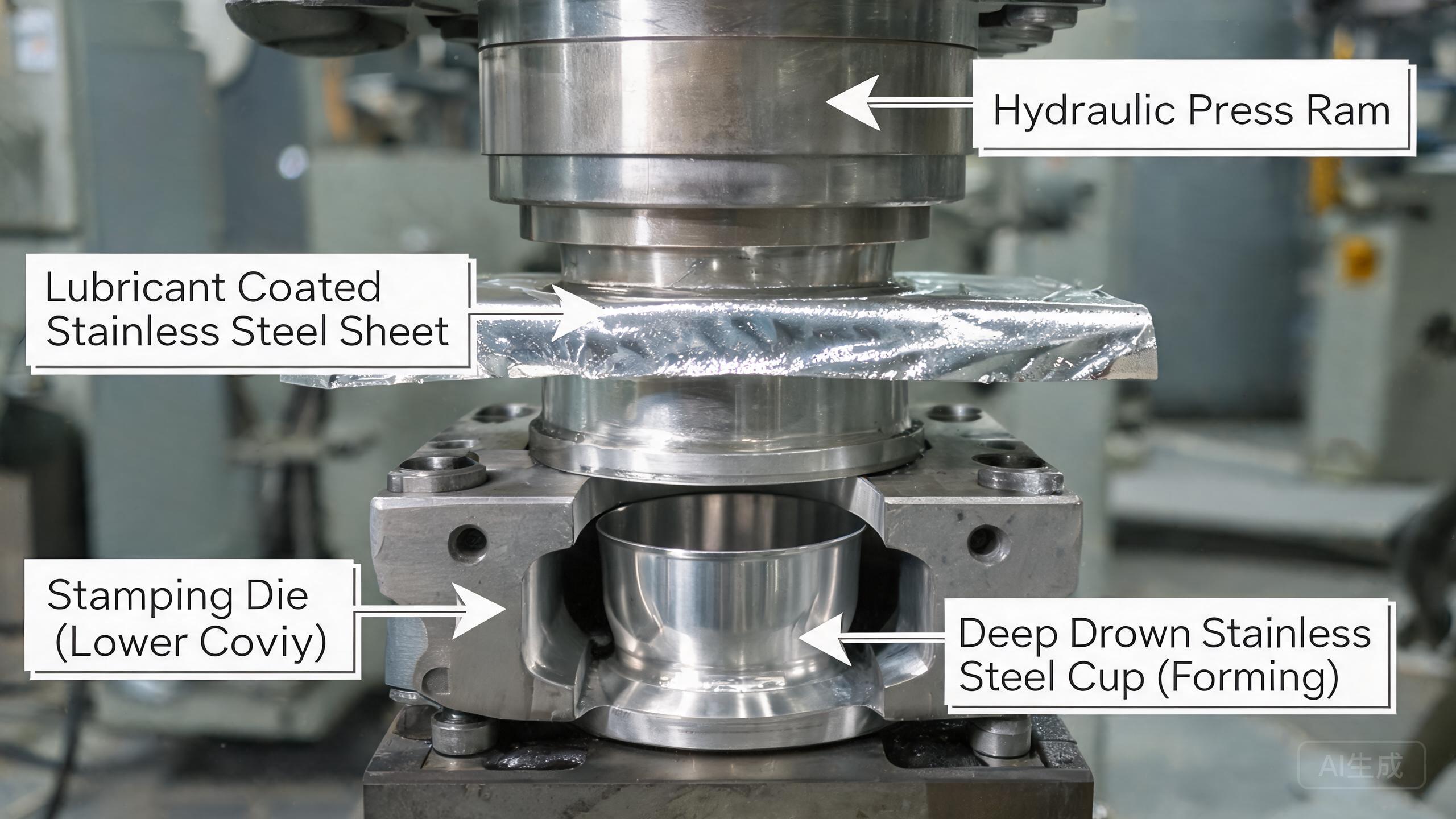
Short answer:
Deep drawing stainless steel without proper lubrication is like driving a car without oil — it will seize up. Stainless steel’s extreme work-hardening tendency means lubrication is more critical than grade selection for successful deep draws. Oil-based lubricants handle moderate draws (ratio ≤2.5). Phosphate conversion coatings with soap lubricant handle high draws (ratio 2.5-4.0) and are specified in EN 10130 for cold-rolled stainless sheet. Solid lubricants (MoS₂, PTFE) tackle extreme draws above ratio 4.0. Blank-holder pressure must also be precisely controlled — too low causes wrinkling, too high causes fracture. Chinese mills in Ningbo and Guangdong offer pre-phosphated stainless sheet that eliminates the need for in-house coating, saving both time and waste disposal cost.
Quick Comparison
| Lubrication Method | Draw Ratio | Friction Coefficient | Cleanup Required | Cost | Best For |
|---|---|---|---|---|---|
| Chlorinated Oil | 1.5-2.5 | 0.05-0.10 | Yes (degrease) | Low | Moderate draws, 304/316 |
| Phosphate + Soap | 2.5-4.0 | 0.03-0.07 | Minimal | Medium | High draws, 304 deep cups, cookware |
| Solid Lubricant (MoS₂/PTFE) | 3.5-5.0 | 0.02-0.05 | Yes | High | Extreme draws, complex shapes |
| None (dry) | <1.5 only | >0.30 | N/A | None | Not recommended for production |
What Buyers Should Evaluate
- Draw ratio calculation. Draw ratio = blank diameter / punch diameter. Calculate this first; it determines which lubrication method you need. If ratio >2.0, require phosphate coating per EN 10130.
- Sheet roughness. EN 10130 specifies that cold-rolled stainless for deep drawing must have surface roughness Ra 0.2-0.4μm (2B finish or better). Rough surfaces increase friction and lubricant consumption.
- Tool material and roughness. Use D2 or S7 tool steel (HRC 58-60) for punches and dies, polished to Ra ≤0.2μm. Poor tool surface is the #2 cause of deep draw failure after lubrication.
- China-specific note. Ningbo-based mills offer pre-phosphated 304 sheet per GB/T 4238-2019. Confirm compliance with EN 10130 if exporting to EU markets.
- Blank-holder pressure guideline. For 1.0mm 304 deep drawing, blank-holder pressure should be 10-15 MPa. Adjust ±3 MPa for thicker/thinner material. This is more critical for stainless than carbon steel due to higher springback.
Common Purchasing Mistakes
Mistake: Deep drawing 304 stainless with carbon steel lubrication practice. A Shenzhen cookware manufacturer tried to deep draw 304 stainless pots using the same light oil and minimal blank-holder pressure they used for aluminum. The result: 40% rejection rate due to galling and wall fracture. Fix: stainless needs 3x the lubrication and 2x the blank-holder pressure of aluminum. Specify phosphate conversion coating + soap lubricant per EN 10130.
Mistake: Chinese factory trick — substandard phosphate coatings. Some mills in Guangdong label their sheet as “deep-draw lubricated” but apply only a thin, loosely bonded phosphate layer (2-5μm instead of the 10-15μm required by EN 10130). This coating rubs off during the first draw operation, exposing bare stainless to tooling and causing galling immediately. Solution: PMI (Positive Material Identification) spectroscopy confirms it’s correct 304/316L chemistry. Then measure phosphate coating thickness with a Fischer thickness gauge — must be ≥10μm. Insist on EN 10204 3.1 mill test certificates that include phosphate coating verification per EN 10130.
Mistake: Skipping blank-holder pressure control. Many deep draw operators set blank-holder pressure by “feel” instead of measurement. For stainless steel, too little pressure allows the flange to wrinkle, and too much pressure causes premature necking. Specify pressure gauges on all new presses and require pressure calibration records per ISO 14801.
Mistake: Using wrong tool steel. Carbon steel or low-alloy tool steel (HRC <55) picks up stainless steel during drawing (galling), accelerating tool wear and leaving transfer deposits on parts. Only use D2, S7, or carbide tool steel with HRC ≥58 for stainless deep drawing.
Recommended RFQ Wording
Grade: ASTM A240 / UNS S30400 (304) for general deep drawing
  OR: ASTM A240 / UNS S31603 (316L) for corrosive applications
Specification: EN 10130 cold-rolled deep-draw quality stainless steel
Lubrication: Phosphate conversion coating per EN 10130 (10-15μm) + soap layer
Form: Cold-rolled sheet / coil
Thickness: [exact mm]
Width: [exact mm]
Surface roughness: Ra 0.2-0.4μm per ISO 4288
Application: [deep-drawn cup / cookware body / battery cell can]
Maximum draw ratio: [exact value]
Quantity: [metric tons]
Certification required:
  - EN 10204 3.1 mill test certificate (deep-draw quality marked)
  - PMI spectroscopy on every heat
  - Phosphate coating thickness test (≥10μm)
  - Deep draw test report (3 sample blanks, no fracture, wall thickness uniform within ±10%)
Additional: Sheet must be free of surface defects (pits, scratches) per EN 10130 Section 7.
FAQ
Why is lubrication more critical for stainless steel deep drawing than carbon steel?
Stainless steel work-hardens 3-5x faster than carbon steel (instantaneous work-hardening vs gradual). During deep drawing, the flange area undergoes severe compression while the wall undergoes tension — without proper lubrication, the high friction between blank and tooling causes galling (adhesion of stainless to tool surface), excessive thinning, or fracture at the draw radius. Carbon steel can survive minimal lubrication; stainless steel cannot.
What is the best lubrication for deep drawing 304 stainless steel?
For moderate draw ratios (1.5-2.5): chlorinated oil-based lubricant with 10-20% sulfur additive — provides low friction but requires cleanup. For high draw ratios (2.5-4.0): phosphate conversion coating (per EN 10130) combined with soap-based lubricant — forms a permanent crystalline layer that prevents metal-to-metal contact. For extreme draws (4.0+): solid lubricants like MoS₂ or PTFE sprayed directly onto the blank.
Can I deep draw stainless steel without lubrication?
Only with very small draw ratios (<1.5) and extremely low tool roughness (Ra <0.1μm polished tooling). Any production deep drawing of stainless steel (draw ratio ≥1.5) requires lubrication. Attempting to save cost by skipping lubrication results in galling, tool wear 5-10x faster than carbon steel, and rejection rates of 20-50% — the cost of lubrication is trivial compared to scrap and downtime.
CTA + Technical References
Send your grade, dimensions, annual volume and application to vip@still-steel.com, or contact us. We supply EN 10130 deep-draw quality stainless sheet with pre-applied phosphate coatings for cookware and battery applications.
References:
- EN 10130: Cold rolled low carbon steel flat products for cold forming — Technical delivery conditions
- ASTM A240 / A240M: Standard specification for chromium and chromium-nickel stainless steel plate, sheet, and strip
- ASM Handbook Volume 14: Forming and Forging
- ISO 14801: Mechanical testing of metals — Fatigue testing — Force-controlled uniaxial fatigue testing
- See also: Best stainless steel for deep drawing
Technical References
- ASTM A240M - Standard Specification for Chromium and Chromium-Nickel Stainless Steel Plate, Sheet and Strip
- EN 10088-2 - Stainless steels. Technical delivery conditions for sheet/plate and strip
- ASM International - Handbook Series, Volume 1: Properties and Selection: Irons, Steels, and High-Performance Alloys