
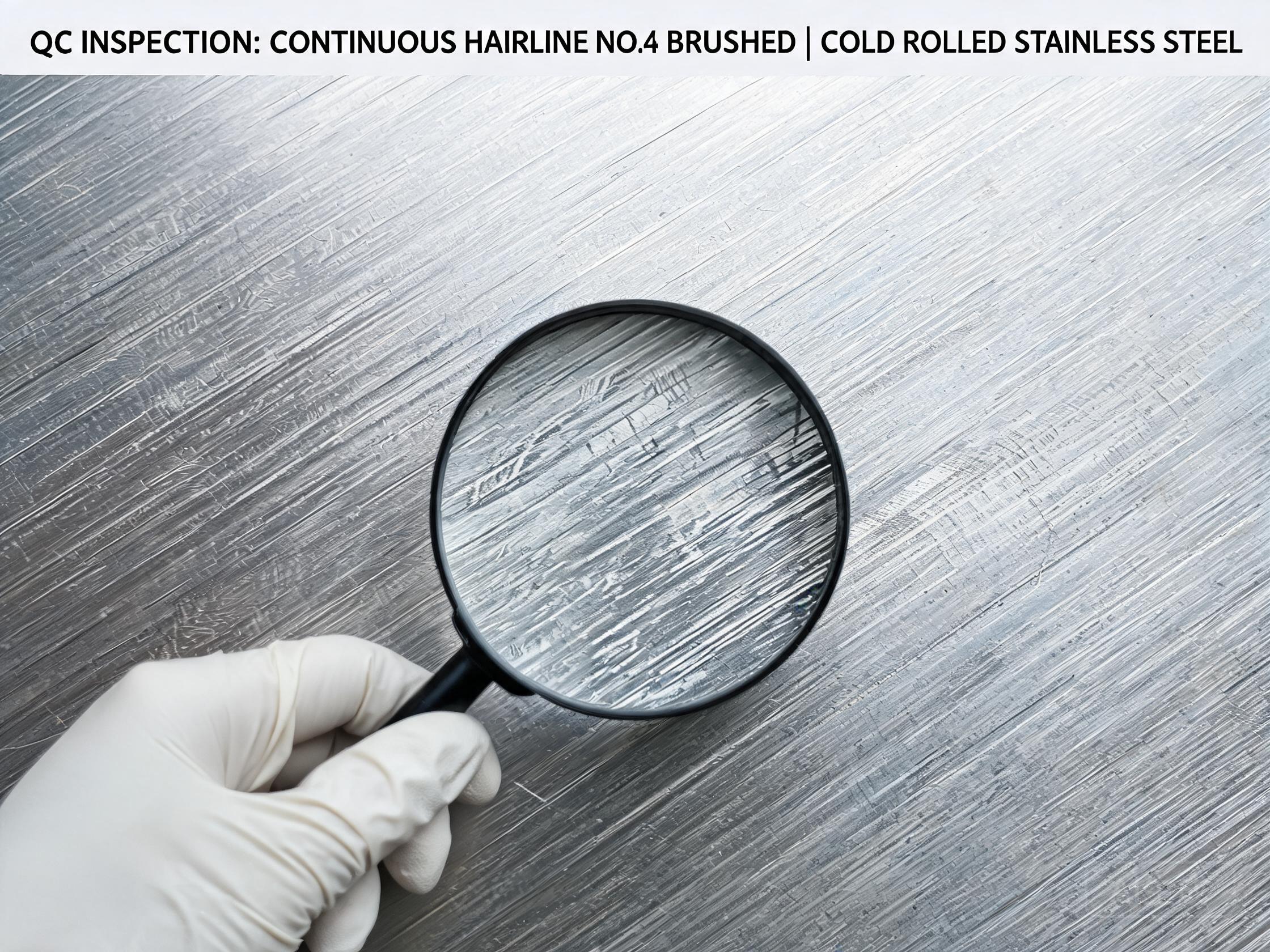
Short answer: A bad No.4 scratch brush finish has three enemies: worn brushes, inconsistent grit size, and lazy quality control. If your elevator panels have visible patchy lines or your appliance doors look scratched instead of intentionally brushed, the fabricator used brushes past their replacement cycle. Specify the grit size, brush replacement interval and scratch depth Rz on the PO.
Architectural firms love No.4 hairline stainless. It hides fingerprints, looks premium, and is cheaper than 8K. But every contractor who has ordered 500 m² of “No.4 hairline” panels from a Chinese fabricator has had at least one batch with inconsistent brush lines visible in direct sunlight. The fabricator blames the “raw 2B surface.” The real problem: their brush had done 1500 m² and was long past due.
Quick Comparison
| Grit size (ANSI) | Equivalent FEPA | Hairline appearance | Typical Rz (µm) | Application |
|---|---|---|---|---|
| 80# | P100 | Coarse, dramatic, visible lines | 4.0–6.0 µm | Heavy industrial, anti-slip |
| 120# | P150 | Standard No.4, balanced | 2.0–4.0 µm | Elevator, appliance doors, architectural |
| 180# | P220 | Fine hairline, subtle | 1.0–2.0 µm | Food equipment, medical, premium appliance |
| 220# | P240 | Very fine, almost 8K | 0.8–1.5 µm | Furniture, decorative |
The Rz value is your objective measure. Two batches both called “120# No.4” can vary by a factor of 3 in Rz if the fabricator changes pressure or runs old brushes.
What Buyers Should Evaluate
- Always specify grit number (ANSI or FEPA), not just “hairline” or “No.4.” In parts of China, “No.4” can mean anything from 60# to 200#.
- Specify Rz (ten-point height) in the brushing direction, measured at five points across the sheet width.
- Confirm brush replacement interval. A wire brush should be replaced every 800–1000 m²; an abrasive belt every 500–700 m².
- For critical jobs, specify the brush type. 316 stainless wire brush bristles last longer than steel bristles and do not deposit iron contamination.
Common Purchasing Mistakes
- Ordering “No.4 hairline stainless” from a fabricator without specifying grit size. The fabricator uses whatever grit was last loaded into the brush head — sometimes 220#, sometimes 80#. You get an inconsistent appearance across a 3-month project, and matching batches becomes impossible. This is the single most common No.4 purchasing error.
- Buying from a fabricator who does not have a brush replacement log. We have seen Chinese shops run a single brush for 5000 m² to save on replacement cost. The result is a surface that starts as proper No.4, drifts to a mixed finish, and ends as a dull smudge polish that no amount of touch-up can fix.
- Skipping Rz measurement on incoming inspection. A 3000 RMB (420 USD) portable roughness gauge catches brush defects before you install 300 m² of panels. A visual check in fluorescent light is not enough — Rz under 1.5 µm in a “120#” finish means the brush is shot.
Recommended RFQ Wording
Grade: AISI 304 / EN 1.4301, cold rolled 2B surface Secondary finish: No.4 hairline, brushed with 120# (ANSI) aluminium oxide belt Brush replacement: Every 600 m² of production, fabricator shall maintain a replacement log Scratch depth (Rz, brushing direction): 2.0–4.0 µm, measured at 5 points across sheet width Brush type: 316 stainless steel wire bristles (if wire brush used), no steel bristles Certificate: EN 10204 3.1 + brush replacement log + Rz measurement report per lot
How Still Steel Supports the Project
Still Steel supplies cold rolled stainless steel sheet and strip in 304/304L/316/316L/430 with 2B, BA, No.4 and 8K surfaces. We handle pickling passivation, electropolishing and PVD coating under one roof so your surface tolerance stays consistent. Send the grade, gauge, width and your specific surface problem to vip@still-steel.com, or discuss the requirement on WhatsApp.
Frequently Asked Questions
What grit size gives the standard No.4 hairline finish on stainless steel?
Standard No.4 hairline finish uses a 120# aluminium oxide abrasive belt or wire brush. For a finer, less visible hairline, use 180# or 220#. For a coarser, more dramatic brushed look, 80#. The European equivalent is usually P150 (FEPA grit). Always specify grit number, not just “hairline finish,” because “No.4” means different things to different fabricators.
Why does the scratch brush finish look uneven across a single sheet?
The most common cause is worn brushes. A wire brush or abrasive belt loses its cutting edge after 500–1000 m² and starts producing irregular scratch depth — deeper in the middle, shallower at the edges. Other causes: the sheet was not flat against the brush bed, or the brush pressure was adjusted incorrectly during the run. Insist on brush replacement logs from the fabricator.
How can I measure and specify scratch depth for a No.4 hairline finish?
Use a portable surface roughness gauge set to measure Rz (ten-point height) in the brushing direction. For standard No.4 with 120# grit, Rz = 2.0–4.0 µm. For fine hairline (180#), Rz = 1.0–2.0 µm. Specify the Rz range and the grit size on the RFQ, and ask for measurement points at 100 mm intervals across the sheet width.
Technical References
- ASTM A240/A240M flat-rolled stainless steel sheet
- ISO 4287 geometrical product specifications — surface texture: terms, definitions and surface texture parameters
- FEPA grit designation for abrasive products
Reference documents support general selection and fabrication principles. The final material decision must follow the applicable contract, standard, regulation and engineering review for the specific product.