
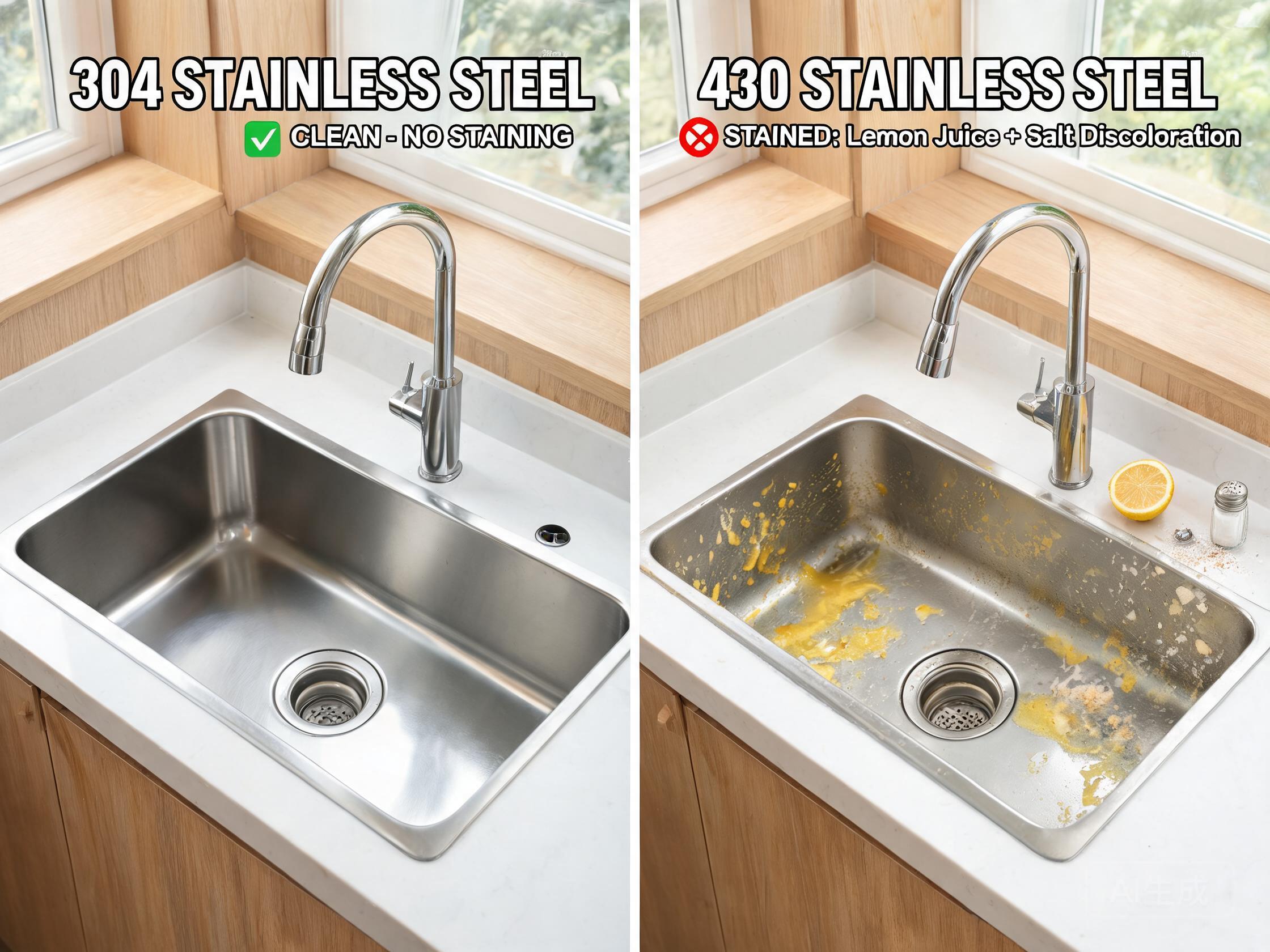
Short answer: Kitchen sinks stain for three predictable reasons. You bought 430 instead of 304. You chose 8K mirror finish which shows every water spot. Or the sheet is too thin so the passive layer wears through quickly. Run the lemon juice test before you commit — 304 stays clean after 24 hours of lemon juice. 430 develops brown rust spots in eight hours. If your supplier cannot show you the test, walk away.
Kitchen sinks see three corrosives every day: lemon juice (pH 2.3), salt water (from pasta, meat thawing), and coffee grounds (pH 4.5). Cheap sinks use 430 ferritic stainless steel — 17% Cr, no nickel. It looks like stainless in the showroom. Six months after installation, brown spots appear around the drain and the faucet base. No amount of Bar Keeper’s Friend removes them. The customer calls you complaining about a “rusty stainless steel sink.”
Quick Comparison
| Grade | Cr content | Ni content | Lemon juice (24h) | Salt water (24h) | Cost |
|---|---|---|---|---|---|
| 430 cold rolled | 17% | 0% | Rust spots (8h) | Rust spots (4h) | Low |
| 304 cold rolled | 18% | 8% | No change | No change | Mid |
| 316 cold rolled | 16% | 10% + 2% Mo | No change | No change | High |
| 201 (cheap substitute) | 17% | 4% | Rust spots (2h) | Rust spots (1h) | Very low |
The lemon juice test is the fastest way to spot a grade substitution. Apply fresh lemon juice to a polished surface, leave for 24 hours, rinse. 430 and 201 show visible rust. 304 and 316 stay clean. If your supplier labels a coil “304” and it fails the lemon juice test, it is 201.
What Buyers Should Evaluate
- Grade first. 304 is the minimum for a 5+ year warranty sink. 430 only for budget sinks with 2-year warranty and inland installation. 201 is a scam — never accept it.
- Surface finish: No.4 brushed wins. Mirror 8K looks great in the showroom but shows every water spot, fingerprint and scratch. No.4 brushed hides 90% of cosmetic defects.
- Thickness: 1.5 mm (18-gauge) minimum for a single-bowl sink. 1.2 mm dents when you drop a cast-iron pan. 2.0 mm is overkill for residential.
- Welding: laser welded or TIG welded with polished bead. Rough welds trap food particles and stain. Polish the inside weld flush to the bowl wall.
- Lemon juice test: require your supplier to do it on the first sample coil before you place volume. Save the photo. Keep it with your EN 10204-3.1 file.
Common Purchasing Mistakes
- Buying from a supplier who quotes “stainless steel kitchen sink sheet” without specifying 304. 70% of “budget kitchen sink” complaints come from 201 or 430 sheet sold as 304. The lemon juice test catches this every time.
- Accepting “304” with EN 10204-2.2 instead of 3.1. 2.2 is the mill’s self-certification. 3.1 includes independent PMI. Chinese mills print 304 on 201 coils with 2.2 certificates all the time.
- Specifying 1.0 mm thickness to undercut your competitor. The sink dents on the first day of use. You replace it under warranty three months later. The 5% thickness premium saves you 10% in warranty costs.
- Ordering 8K mirror because “it is more premium.” Mirror sinks have 3x higher return rate from customers who cannot stand water spots. No.4 brushed customers return 90% fewer sinks.
- Forgetting to specify the anti-fingerprint coating. No.4 brushed without a PVD or SiO2 coating will show fingerprints after six months of use. Specify a permanent anti-fingerprint treatment.
Recommended RFQ Wording
Cold rolled stainless steel sheet for kitchen sinks, grade 304, thickness 1.5 mm ±0.03 mm, width 1000 mm, surface No.4 brushed 150# grit, permanent anti-fingerprint coating applied, EN 10088-2, EN 10204-3.1 test report with PMI analysis, lemon juice test report (24h, no rust), salt spray test report per ASTM B117 200 hours, quantity 10 tonnes, destination [your factory], delivery within 20 days.
State the sink application (residential single bowl, commercial double bowl, coastal installation) so the supplier can confirm the grade and thickness. Put the lemon juice test and the PMI requirement on the order — these two checks catch every grade substitution trick.
Frequently Asked Questions
Why does my 430 stainless steel sink get brown spots and stains that will not come off?
430 ferritic stainless steel has 17% Cr and no nickel. Lemon juice (pH 2.3) and salt water (3.5% NaCl) break down the chrome oxide layer. The iron underneath oxidizes — that is the brown spot. 304 has 18% Cr + 8% Ni which resists both acids and salt.
Which surface finish is better for a kitchen sink — 8K mirror polished or No.4 brushed?
No.4 brushed. Mirror 8K shows every water spot and fingerprint. No.4 brushed hides minor scratches and water marks. But No.4 has higher surface roughness — wipe it dry after salt water exposure to prevent pitting.
What thickness and grade should I specify for a ten-year warranty kitchen sink?
Grade 304 cold rolled, thickness 1.5 mm minimum (18-gauge). Thinner than 1.2 mm and the bowl dents when you drop a cast-iron pan. 430 is only acceptable for budget sinks with a 2-year warranty and inland (non-coastal) installation.
How Still Steel Supports the Project
Still Steel supplies cold rolled stainless steel sheet and strip in the right grade and thickness for your kitchen sinks with EN 10204-3.1 test reports. We provide slitting, cut-to-length, surface finishing and protective film application so you receive process-ready material. Send your specification and quantity to vip@still-steel.com, or discuss on WhatsApp.
Technical References
- ASTM A240 / A240M flat-rolled stainless steel for general applications
- EN 10088-2 cold rolled stainless steel sheet and strip
- ASTM B117 salt spray (fog) testing
- ASTM G65 abrasive wear testing
- ANSI Z124.1 stainless steel sinks standard
- FDA 21 CFR Part 175.300 food contact surfaces
Reference documents support general selection and fabrication principles. The final material decision must follow the applicable contract, standard, regulation and engineering review for the specific product.