
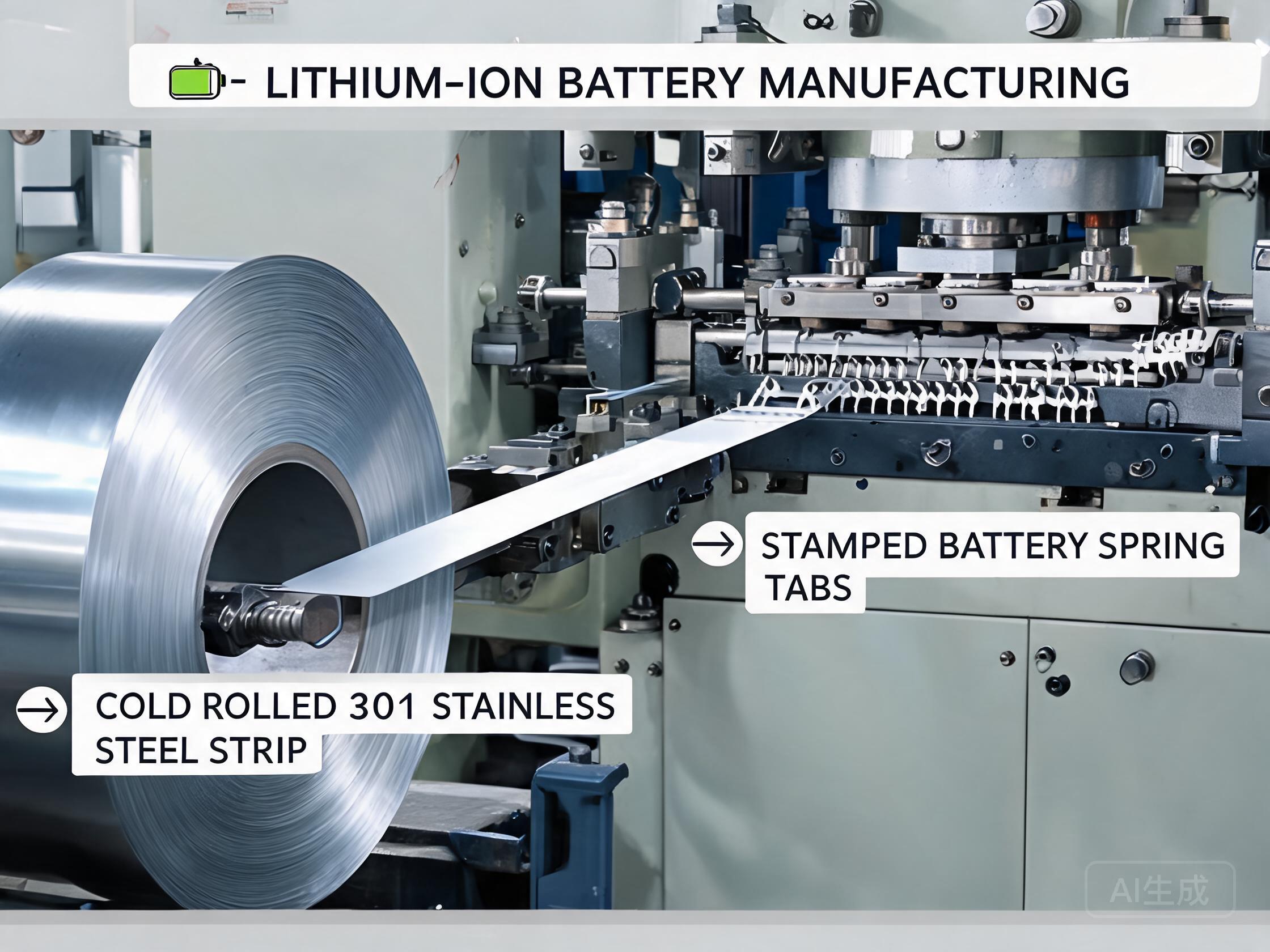
Short answer: Battery tabs fail in two ways. The spring tab does not push hard enough on the busbar, so contact resistance builds up and your battery loses 3% capacity per cycle. Or the edge burr pierces the separator during assembly, causing an internal short. Use 301 temper H for spring tabs, 304 for cell housings, specify 0.1–0.3 mm cold rolled strip with burr under 10 μm and springback under 1%. Get the temper and edge right on the first stamp, not after 100,000 units of scrap.
EV battery packs have 4000 to 8000 cells. Each cell has one or two cold rolled stainless steel tabs. The spring tabs carry 300 A continuously. The cell housing must not deform when the cell swells during charging. You buy the wrong temper and the spring force is 30% low. You buy the wrong slit edge and the burr is 20 μm. Both are silent scrap until your end-of-line tester catches 2% failure rate after you have stamped half a million parts.
Quick Comparison
| Application | Grade & temper | Thickness | Tensile strength | Yield strength | Elongation |
|---|---|---|---|---|---|
| Spring tab | 301 H | 0.15–0.20 mm | 1800–2000 MPa | ≥1500 MPa | ≥8% |
| Spring tab (flexible) | 301 1/2 H | 0.15–0.25 mm | 1400–1700 MPa | ≥1100 MPa | ≥10% |
| Cell housing | 304 2B | 0.25–0.30 mm | 500–700 MPa | ≥205 MPa | ≥40% |
| Cell housing (deep draw) | 304 BA | 0.30–0.40 mm | 500–700 MPa | ≥205 MPa | ≥50% |
| Current collector | 304 BA | 0.10–0.15 mm | 500–700 MPa | ≥205 MPa | ≥40% |
Temper matters more than grade for spring tabs. 301 H provides the 1500 MPa yield strength needed to maintain contact pressure over 5000 thermal cycles. 304 BA provides the deep draw elongation for cell housings — you cannot stamp a 40 mm deep can from 301 H, it will crack.
What Buyers Should Evaluate
- Temper first for spring tabs. 301 H is non-negotiable if your design requires spring return. 301 1/2 H only if you accept lower contact force.
- Thickness tolerance: ±0.005 mm maximum. Battery capacity varies linearly with thickness. A 20 μm thick 0.20 mm tab carries 10% less current than a nominal 0.20 mm tab.
- Slit edge quality: burr ≤10 μm, ideally ≤5 μm. Burr pierces separators and increases stamping die wear by 40%. Specify slit edge with inspection report.
- Camber and coil set: ≤0.5 mm per meter and ≤1 mm per meter respectively. Stamping dies require the sheet to lie perfectly flat. Any camber causes partial blanking.
- Protective film: use a blue PE film with adhesive ≤10 N/cm. Too much adhesive leaves residue that resists laser welding. Too little and the film falls off during slitting.
Common Purchasing Mistakes
- Ordering 301 FH instead of 301 H because the mill said “same thing.” FH is full hard with lower carbon. Yield strength is 1200 MPa vs 1500 MPa for H. Springback is 20% higher. Your tabs will not seat.
- Accepting a “slit strip” without a burr measurement. One Chinese mill’s slit edge is burr-free. Another’s is 18 μm. The difference is the slitting tool wear rate. Specify burr ≤10 μm and get a sample coil to inspect before volume.
- Specifying 0.15 mm without thickness tolerance. The mill delivers ±0.02 mm. Some strips are 0.13 mm, some 0.17 mm. Your stamping force varies 30% across the coil and the die breaks every 50,000 strokes.
- Skipping EN 10204-3.1 and PMI. A mill can label 301 H on a 201 coil — magnetic test alone cannot distinguish 301 from 201 because both are work-hardening austenitic. Get the chemical analysis.
- Buying the cheapest slit edge. Burr-free slitting costs 80 USD per tonne more. A piercing failure costs you 5 EUR per cell. Do the math.
Recommended RFQ Wording
Cold rolled stainless steel slit strip for EV battery tab stamping, grade 301 temper H, thickness 0.20 mm ±0.005 mm, width 30 mm ±0.02 mm, slit edge burr ≤10 μm, camber ≤0.5 mm per meter, coil set ≤1 mm per meter, blue PE protective film adhesive ≤10 N/cm, EN 10088-2, EN 10204-3.1 test report with full chemical analysis and mechanical properties, slit edge inspection report, quantity 5 tonnes, destination [your factory], delivery within 25 days.
State the stamping die drawing, the required spring force and the current rating so the supplier can confirm the thickness, width tolerance and temper before slitting. Put the burr limit and the thickness tolerance on the order — these are what make or break the stamping.
Frequently Asked Questions
Which cold rolled stainless steel grade and temper should I use for battery spring tabs?
301 temper H (1800–2000 MPa tensile). Full hard temper gives the spring force to maintain busbar contact through 5000 cycles without permanent set. 301 temper 1/2 H works if you need less springback in stamping. Avoid 304 — too soft for spring tabs.
What thickness and edge quality do I need for stamping 0.1–0.3 mm battery tabs?
Thickness tolerance ±0.005 mm (±5 μm). Slit edge burr maximum 10 μm, ideally below 5 μm. Camber maximum 0.5 mm per meter. Coil set maximum 1 mm per meter. Any burr over 10 μm will pierce the separator during cell assembly.
Why does my battery tab stamped from cold rolled stainless steel fail the springback test?
Three reasons. 1) You used 301 temper FH instead of temper H — less carbon, lower yield strength, more springback. 2) The sheet is wavy from the cold rolling mill — springback varies across the coil width. 3) You did not specify a slit edge, so the edge is rounded and stamps unevenly. Correct the temper first.
How Still Steel Supports the Project
Still Steel supplies cold rolled stainless steel sheet and strip in the right grade and thickness for your battery tabs and cell housings with EN 10204-3.1 test reports. We provide slitting, cut-to-length, surface finishing and protective film application so you receive process-ready material. Send your specification and quantity to vip@still-steel.com, or discuss on WhatsApp.
Technical References
- ASTM A666 / A666M austenitic stainless steel sheet and strip for springs
- EN 10088-2 cold rolled stainless steel sheet and strip
- JIS G4305 cold rolled stainless steel sheet and strip
- ISO 1328 rolling bearings — battery tab design reference
- USABC battery material specifications
Reference documents support general selection and fabrication principles. The final material decision must follow the applicable contract, standard, regulation and engineering review for the specific product.